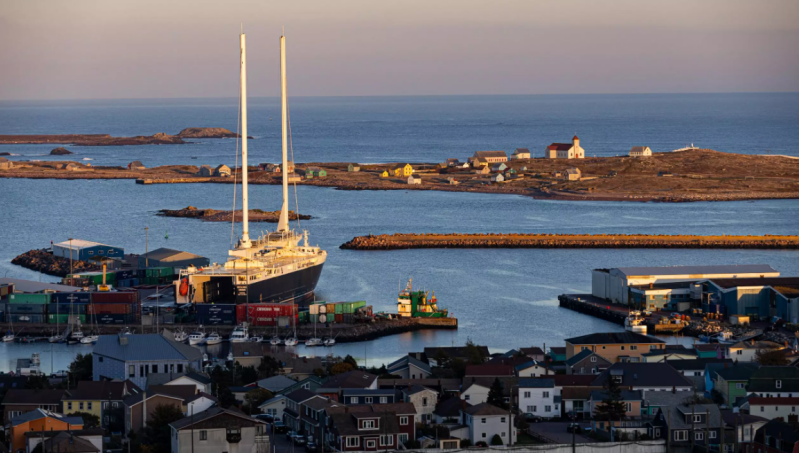
When the Neoliner Origin completed its first transatlantic crossing in late October, climate scientist Katherine Hayhoe saw more than a successful trial of a new cargo sailboat. She viewed it as a concrete sign of hope — evidence, she said, that real, scalable solutions to the climate crisis are beginning to take shape.
Hayhoe, who serves as Climate Ambassador for the World Evangelical Alliance, told Christian Daily International that the vessel’s wind-powered voyage marked a “huge step” toward cutting emissions in one of the world’s hardest-to-decarbonize sectors. With global shipping responsible for about 3% of total greenhouse gases — a share that could climb to 10% by mid-century — she said the Neoliner Origin demonstrates how innovation in commercial cargo transport can meaningfully contribute to the urgent emissions reductions the International Maritime Organization is calling for by 2030 and beyond.
The 136-meter ro-ro vessel, owned by the French company Neoline, departed Saint-Nazaire/Montoir-de-Bretagne on Oct. 16 and reached Saint Pierre and Miquelon near Canada on Oct. 30 after a 14-day voyage. Running at a commercial speed of 11 knots, the ship relies primarily on wind propulsion from two carbon-fiber masts and uses a hybrid diesel-electric auxiliary system.
Neoline estimates the design can cut emissions by 80% to 90% compared with conventional cargo vessels. Despite sustaining minor damage to an aft sail during the crossing, company officials described the maiden voyage as a successful proof of concept for low-carbon industrial shipping.
Shipping contributes 3% of global emissions, Hayhoe explains, but this figure could rise to 10% by 2050. Solutions need to be found urgently and the International Maritime Organization six months ago announced plans for the entire shipping industry to hit a net zero target by the mid 21st century. This equates to a decrease in emissions of 20% by 2030.
“That’s a big decrease that needs to be made very soon,” continues Hayhoe. “And analysis has shown that the majority of the emissions, about 25% of emissions come from container ships, 25% come from bulk carriers, about 15% come from oil tankers. So basically in shipping, cargo shipping is responsible for the majority of the emissions.”
Hayhoe acknowledges that factors such as the invention of electric cruise ships and small electric hydrofoil boats being made by Swedish company Candela for the purpose of tackling ship emissions are encouraging but even so, she says, “we have to tackle cargo ships. So that's why this is so meaningful and so important.”
“It’s clear that we need real solutions that work in the real world that can be commercialized,” adds Hayhoe. “There's no question that we need that because how are you going to reach net zero otherwise?”
Hayhoe points out that the drive to cut shipping emissions has a knock-on effect of benefit to wider global society.
“In terms of the climate issue, I can tell you without a shadow of a doubt that every ton of carbon we produce has an impact. Every bit of warming we avoid has additional impacts and suffering. And the science literally says every action matters and every year matters. So the sooner we do this, the better off we will be.”
Hayhoe noted an irony in how the world measures climate change: although global average temperature is the most common benchmark for warming, it captures only a fraction of where excess heat actually goes.
“Global average temperature is based on the temperature in the atmosphere,” Hayhoe comments. “And all of these heat trapping gases that are building up in the atmosphere, wrapping an extra blanket around the planet, trapping all this additional heat, almost 90% of this additional heat is going into the ocean. Only 1% is going into the atmosphere.”
Hayhoe sees therefore a symbolic importance in the oceans being the locations for the largest emission cutting strategies, such as with the Neoliner Origin. She calls it an “encouraging step towards a better future for humanity.”
For Hayhoe, the issue isn’t so much about “protecting the environment” because “the planet will be orbiting the Sun long after we’re gone.” The immediate urgency is what is happening to human societies as a result of emissions.
“After the polar bear, we're one of the most vulnerable species on the planet to these changes that are happening. We've built two thirds of the largest cities in the world within a meter of sea level. We have literally allocated our water, grown our crops, drawn our geographic boundaries based on the conditions of a planet that no longer exists.”
From a more historical perspective, Hayhoe points out generally that climate scientists have been “sounding the alarm” for decades about climate change.
“It was almost 60 years ago that scientists formally warned a U.S. president, for example, of the dangers of climate change [President Lyndon B. Johnson received a warning in 1965 by the President's Science Advisory Committee] and the need to change the way that we're getting our energy, change the way that we are transporting ourselves and our goods, change the way that we're heating and cooling our homes and growing our food.”
Hayhoe points out that climate scientists cannot enact such needed changes all by themselves. That is why shipping experts have a vital role as part of the wider societal contribution to the cause. She does not foresee a “silver bullet” to offset shipping emissions but —continuing the analogy—there’s a lot of “silver buckshot.”
“One technology is not going to be the solution for everything. We need all different types of technology for all different types of shipping, so this is incredibly encouraging.
“I'm a sailor myself, so I love to see sails being used for more than small pleasure boats or racing. But I also know there's a place for electric and alternative methods of transportation. There's a place for increasing the efficiency of shipping and production and supply chains.
“There's a place for all of these solutions and we need all of them. And so this is definitely a very encouraging step.”
Asked about a theological perspective on this issue, Hayhoe said technological advances such as the Neoliner Origin can be viewed through the lens of love and action. She pointed to the apostle Paul’s guidance to Timothy that “God has not given us a spirit of fear,” noting that fear about the future often drives people toward denial or inaction. Instead, she said, Scripture speaks of a spirit “of power, love and a sound mind.”
“Power means we have the ability to act when we see a problem. Love means considering the well-being of others, not just ourselves,” she said, adding that the Genesis account assigns humans responsibility to care for all living things — animals, plants and fellow human beings.
As a scientist, she said the call to a “sound mind” resonates deeply because it speaks to making wise, evidence-based decisions. “That’s what we’re seeing here,” Hayhoe said. “People are acting, and many are motivated by love for a better future for the people and places they care about. They understand that to secure that future, we have to address the climate crisis — and they are using a sound mind to develop reasonable, scalable solutions.”