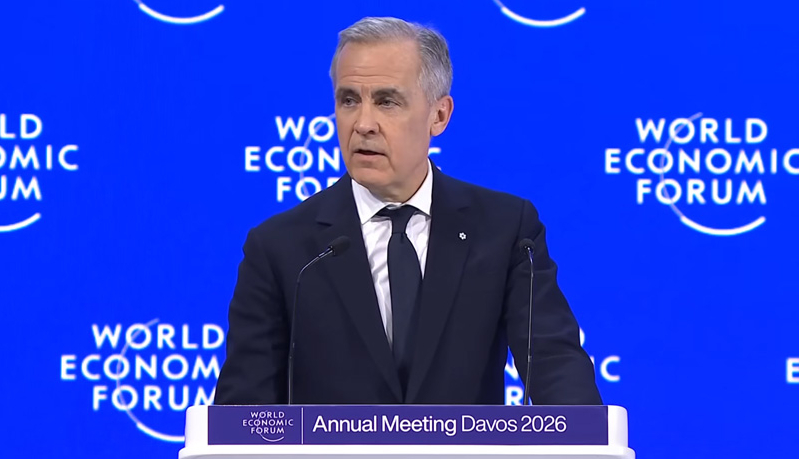
Canadian Prime Minister Mark Carney was the talk of Davos on Tuesday, January 20, 2026, following his speech at the World Economic Forum (WEF). Titled “Principled and Pragmatic: Canada’s Path,” the address has sparked considerable discussion—among political commentators and among Christians like me who engage in advocacy within the United Nations system.
The rules-based order is fading. The strong do what they can, and the weak suffer what they must.
Carney’s opening remarks dispelled any lingering stereotypes about Canadians being mild or deferential. He declared that the world is facing “a rupture in the world order—the end of a nice story—and the beginning of a brutal reality where geopolitics among the great powers is not subject to any constraints.” He continued: “The rules-based order is fading. The strong do what they can, and the weak suffer what they must.”
One can reasonably debate whether a genuine rules-based international order ever truly existed. I grew up during the Cold War, when the threat of nuclear annihilation loomed constantly. While the United Nations existed during that period, it did not establish binding rules that were consistently applied to protect peace and human rights across the globe.
From the fall of the Berlin Wall in 1989 until very recently, the world experienced a relatively rare period in which global war did not appear imminent.
Still, from the fall of the Berlin Wall in 1989 until very recently, the world experienced a relatively rare period in which global war did not appear imminent.
Since 2021, however, armed conflicts have risen sharply, and the United Nations—the body created to safeguard international peace—has often appeared powerless to respond effectively. As Carney bluntly observed, “Let me be direct: we are in the midst of a rupture, not a transition.”
Russia’s invasion of Ukraine in February 2022 illustrates this rupture clearly. Although the UN Security Council is charged with responding to such aggression, Russia’s veto power rendered it ineffective. Even a special session of the UN General Assembly condemning the invasion had little practical impact on President Vladimir Putin’s actions.
The erosion of multilateral norms has been compounded by the conduct of powerful states. When Donald Trump became President of the United States, his administration withdrew from several UN bodies, severely weakening the organization’s capacity.
U.S. withdrawal reduced the UN budget by roughly 30 percent.
UN Secretary-General António Guterres had been pursuing reforms to improve effectiveness, but the U.S. withdrawal reduced the UN budget by roughly 30 percent. In addition, the use of tariffs, threats, and military force outside multilateral frameworks further undermined the very “rules-based order” that Western leaders had long invoked.
Against this backdrop, Carney cautioned, “Stop invoking the rules-based international order as though it still functions as advertised.” That remark lands close to home for me. My work involves advocacy within the UN human-rights processes in Geneva, and I have long recognized that these mechanisms often fail to secure real compliance with global human-rights standards.
If you’re not at the table, you’re on the menu.
What, then, does Carney propose instead? He points to new trade partnerships and defense arrangements, describing them as “variable geometry—different coalitions for different issues, based on shared values and interests.” His most memorable line was stark: “Middle powers must act together, because if you’re not at the table, you’re on the menu.”
Notably absent from Carney’s speech, however, was any mention of human rights. Given his background as former governor of the Bank of Canada and the Bank of England, it is unsurprising that economic and defense issues dominated his remarks. To be fair, economic stability and the avoidance of war profoundly affect human dignity. Yet the absence of explicit human rights commitments is telling.
Did not address the development challenges facing the poorest nations.
Carney also emphasized cooperation among “middle powers,” but he did not address the development challenges facing the poorest nations—those that cannot afford the price of admission to Davos where an elite badge with access to the main conference center is over US$30,000.
This omission mirrors a broader shift in Canadian development policy, away from poverty reduction and toward trade-focused engagement. As Carney put it, “We aim to be principled and pragmatic,” and “We take on the world as it is, not wait for the world we wish to be.”
There is wisdom in realism. Yet realism without moral grounding risks becoming resignation. When one calls for new coalitions, it is also prudent to ensure that allies are prepared to act. Carney quoted Václav Havel’s observation about how communism endured: everyone behaved as though the system worked the way it claimed to. Carney urged realism—acknowledging that the system does not work as advertised and acting accordingly.
A waiting game to see if Carney will be punished.
Although he never named him directly, Carney was clearly speaking into the context shaped by Donald Trump. Without clear commitments from allies, such statements invite a waiting game to see if Carney will be punished. Trump’s response came swiftly the following day: “Canada lives because of the United States. Remember that, Mark, the next time you make your statements.”
The setting matters. The World Economic Forum is a private organization whose stated aim is “connecting leaders to make sense of global challenges and move the world forward together.” It is accountable only to itself. Yet global political leaders and business elites gather there to make public pronouncements and private deals.
This raises an unavoidable question: what becomes of the one forum where all nations—rich and poor alike—are meant to gather to address the world’s problems? I am speaking, of course, of the United Nations.
We recently marked the 80th anniversary of the UN Charter, which commits the international community to peace and security, equal rights among nations, respect for human rights, and cooperative action. This is the multinational order Carney described as a “nice story” that no longer “functions as advertised.”
That moral vision draws deeply from Christian principles of human dignity and the inherent worth of every person.
When we read the UN Charter and the Universal Declaration of Human Rights, their aspirations are undeniably lofty—and inspiring. They describe the world as it ought to be. Much of that moral vision draws deeply from Christian principles of human dignity and the inherent worth of every person.
So, must we abandon those aspirations? I believe we must not. The prophet Micah reminds us of God’s enduring requirement: “To act justly and to love mercy and to walk humbly with your God” (Micah 6:8).
We need a place where all nations can negotiate, cooperate, and seek peace together.
As former U.S. Secretary of State Madeleine Albright famously said, “If the United Nations didn’t exist, we would have to invent it.” We need a place where all nations can negotiate, cooperate, and seek peace together. We cannot rely solely on elite forums that systematically exclude the world’s poorest countries.
In this time of disruption, Christians engaged in public policy must be clear-eyed and realistic—without surrendering moral conviction. This is a moment for major Christian organizations to demonstrate leadership and unity, to advocate persistently for peace and the protection of human rights, and to defend the necessity of a global gathering place that seats every nation at the table, not just the powerful.
Charity demands realism. Faith demands hope. And justice requires that we hold fast to both.
Dr. Janet Epp Buckingham is Director of the World Evangelical Alliance (WEA) Office in Geneva, representing the WEA at the United Nations and former Director of Global Advocacy for WEA. She is also the Executive Editor of the International Journal for Religious Freedom, the flagship publication of the International Institute for Religious Freedom. Janet is a Professor Emerita at Trinity Western University with research expertise in religious freedom law in Canada and internationally. She has a doctorate in Public Law from the University of Stellenbosch, South Africa.