
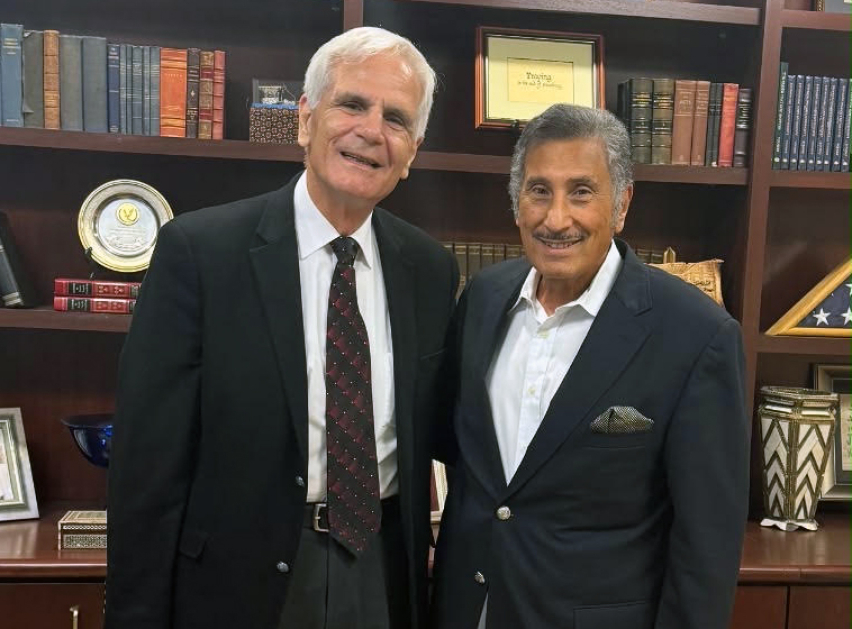
Prominent Christian leader Rev. Dr. Michael Youssef will visit Jordan to take part in a public ministry event Sept. 4 at the Jordan Evangelical Theological Seminary (JETS) in Amman. The event is sponsored by retired Maj. Gen. Imad Maayah, a former member of the Jordanian parliament and president of the Jordan Evangelical Council.
Speaking in a wide-ranging interview ahead of his travel, Youssef said his focus is renewed hope in Jesus Christ, reconciliation among divided Christians, and a faithful commitment to truth and justice amid regional tensions. "At this stage in my life… I'm only two years away from 80," Youssef said, noting that after nearly four decades of preaching every Sunday, he has stepped down from the pulpit. "My son Jonathan… said, 'We need you to come now, dedicate those years to the Arab world,' and I said, 'I want to start in Jordan.'"
Youssef, an Egyptian-American pastor who founded the Al Malakoot satellite television station, has preached for more than 52 years and written 57 books. He described a long history of ministry across the Middle East and around the world, including decades of radio and television outreach. "Whenever you lift up Jesus, there is hope," he said. "We live in a world that is losing hope—whether in the West or the East. I will continue to travel… because I'm seeing there's a loss of hope everywhere I go. And so… I want to spend [my time] bringing hope, and the only one who brings hope is Jesus."
He also spoke about serving communities in the region through sharing the gospel, encouragement and faith-based unity — especially as Jordan prepares for the 2030 commemoration of the 2,000th anniversary of Jesus' baptism at Bethany Beyond the Jordan. The UNESCO-recognized site on the east bank of the Jordan River is where John baptized Jesus and where Christ's public ministry began. Asked whether he would encourage Christians to take part, Youssef said: "If I'm invited to help, I will be there."
On Christian Zionism and Israel
Asked about views often linked to Christian Zionism and dispensationalism, Youssef described himself as Reformed in theology with a preference toward preaching "peace and reconciliation."
"Israel has the right to exist and has the right to defend itself," he said. But he added that he does not endorse unchecked violence on either side.
Asked whether Palestinians are "Amalek" in biblical terms, Youssef said: "No… not any more than Israel is the old Israel." Amalek was a people the Israelites were commanded to destroy in the Hebrew Bible, and the reference has been invoked by some in rhetoric following the Oct. 7, 2023, attacks.
Youssef, who has hosted Rev. Dr. Imad Shehadeh, the president of JETS, in Atlanta, said he is happy to support efforts related to reconciliation and peace. He called reconciliation "the joy of my life" and said he would be ready to engage if asked.
On the Church's identity
Youssef addressed political and religious pressures affecting the Christian community in Jordan, including concerns about full recognition, ecclesiastical authority and the protection of Christians in the region.
In his message to Christians and communities in Jordan, Youssef said that the Church, and not any other body or group, maintains continuity with Israel's biblical identity, citing the biblical language used by Paul and Peter. "The Church… is the center," he said, referencing passages about the "holy nation" and "royal priesthood."
He said Christians should respond more courageously to violence and persecution, and he condemned attacks against Christian clergy anywhere in the world. He said he would speak against attacks on Christians "in a heartbeat," saying that "anybody who loves the Lord… loves justice, mercy, and truth" must respond. He encouraged leaders to address grievances at the highest levels.
On the Israeli-Palestinian conflict, Youssef said he hopes for a move toward negotiation rather than military solutions, citing Jesus' words in the Beatitudes of the Sermon on the Mount. "Blessed are the peacemakers," he said.
Youssef urged that faith must be protected from distortion. "Our faith is being abused or misunderstood," he said in response to concerns that some Christian voices are perceived as justifying conflict.
Youssef also gave his position on ministry roles, saying, "Scripture is very clear. A woman can minister in any area except being the senior pastor." He linked that view to biblical leadership structures and to church life as an extension of family order: "The church is nothing but the extension of the family… the head of the household… has to be a male."
Youssef said he does not believe the question should divide Christians, and pointed instead to faithfulness and mutual understanding.
His visit is expected to include ministry engagements with local church leaders. Youssef said he wants to bring hope, and that Jordan is where he chose to start.








