

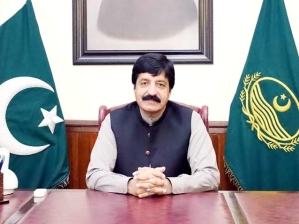
In a landmark move welcomed by Christian rights advocates, the governor of Pakistan’s Punjab Province on Wednesday (Feb. 11) signed into law an ordinance raising the minimum legal age of marriage to 18 and making child marriage a non-bailable offense punishable by up to seven years in prison.
Gov. Saleem Haider Khan signed the Punjab Child Marriage Restraint Ordinance 2026 into effect under Article 128(1) of the Constitution, as the provincial assembly is not currently in session. The ordinance takes immediate effect across the country’s most populous province, home to more than 120 million people, including a significant Christian minority.
The ordinance replaces provisions of the nearly century-old Punjab Child Marriage Restraint Act, 1929, under which the legal marriage age was 18 for men and 16 for women. The new measure eliminates that gender-based distinction by setting 18 as the minimum age for both sexes.
Under the revised legal framework, anyone who contracts, facilitates or promotes a child marriage faces stringent penalties. Offenders can receive up to seven years’ imprisonment and fines of up to 1 million Pakistani rupees ($3,500). All offenses under the ordinance are classified as cognizable, non-bailable and non-compoundable, meaning police can register cases without prior court approval, bail is not automatically granted and cases cannot be privately settled between parties.
The law also imposes penalties on marriage registrars, known as Nikah Khawans, who are barred from registering marriages involving anyone under 18. Violations carry penalties of up to one year in prison and a fine of 100,000 rupees ($357).
Adults who marry a child face rigorous imprisonment of no less than two years and up to three years, along with fines of up to 500,000 Pakistani rupees ($1,787).
In a significant expansion of criminal liability, the ordinance classifies cohabitation resulting from a child marriage as “child abuse,” punishable by five to seven years in prison and a minimum fine of 1 million rupees (USD 3,500), regardless of whether the minor purportedly consented.
The ordinance further criminalizes child trafficking linked to marriage and places legal responsibility on parents and guardians. Any guardian or person who promotes, permits or fails to prevent a child marriage, whether intentionally or through negligence, can face two to three years’ rigorous imprisonment and fines of up to 500,000 Pakistani rupees ($1,787).
All cases under the ordinance will be tried exclusively in Courts of Session and must be concluded within 90 days, a provision aimed at preventing prolonged litigation. The ordinance seeks to modernize child protection laws in Punjab, remove gender discrimination in the minimum marriage age and strengthen safeguards against exploitation and abuse.
Christian leaders welcomed the ordinance, describing it as a long-overdue reform and urging lawmakers to convert it into permanent legislation when the assembly reconvenes.
“The establishment of 18 as the uniform minimum age sends a clear message that child marriage will not be tolerated,” said Ejaz Alam Augustine, a Christian member of the Punjab Assembly and former provincial minister for human rights and minority affairs.
He said the reform brings provincial law more closely in line with constitutional guarantees and Pakistan’s obligations under the U.N. Convention on the Rights of the Child.
Augustine added that raising the age limit was necessary to safeguard underage girls, including those from minority communities, from forced faith conversions in guise of Islamic marriages. While welcoming the strengthened penal framework, he stressed that the ordinance must be enacted as a permanent law to ensure long-term protection. Ordinances promulgated by a governor lapse unless approved by the legislature within a constitutionally defined period.
For years, national and international advocacy coalitions have lobbied to raise the legal age of marriage for girls from 16 to 18, arguing that the previous law discriminated on the basis of gender and left adolescent girls vulnerable to forced marriages and abuse. Although the 1929 law prescribed penalties for contracting or solemnizing child marriages, enforcement was widely regarded as weak.
Tehmina Arora, director of advocacy for Asia at ADF International, called the ordinance a significant development, particularly for girls from religious minority communities.
“Over the years, many underage girls in Pakistan, particularly in Punjab and Sindh provinces, have reportedly been illegally married following abduction and forced conversion,” Arora said. “We hope that this ordinance will help deter such incidents and that the provincial legislature will pass it as an Act and implement it without religious bias.”
Efforts to amend the 1929 law have faced resistance from some religious leaders and political parties. The Council of Islamic Ideology, a constitutional advisory body, has previously objected to raising the marriage age for girls, arguing that Islamic jurisprudence does not prescribe a specific minimum age tied to modern statutory definitions.
A key legal development came in April 2024, when Lahore High Court Justice Shahid Karim struck down the gender-based age distinction in Section 2(a) of the 1929 Act as unconstitutional. The court ruled that the provision setting 16 as the minimum age for females was “without lawful authority and of no legal effect” and directed the provincial government to amend the law within 15 days.
Although lawmakers and advocates proposed additional reforms in 2024, including stricter age-verification mechanisms such as mandatory checks of national identity card records, those proposals were debated through 2025 but had not been enacted before the promulgation of the ordinance.
The ordinance is expected to come before the Punjab Assembly for formal consideration once it reconvenes. Advocacy groups say that legislative review will provide an opportunity to strengthen implementation safeguards, including clearer liability for those who solemnize child marriages and enhanced child-centered protection measures.
“Legislative reform is an important milestone,” Arora said. “But its success will ultimately depend on effective enforcement, institutional coordination and sustained public awareness.”
Pakistan, where more than 96 percent of the population is Muslim, ranked eighth on Open Doors’ 2026 World Watch List of countries where Christians face the most severe persecution.


