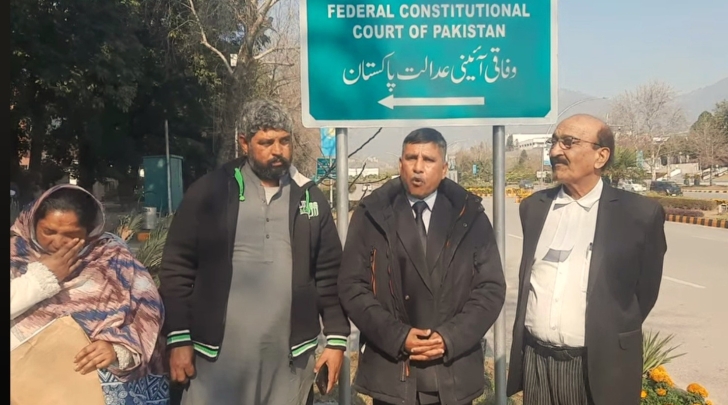
A federal court in Pakistan on Tuesday (Feb. 3) gave custody of a 13-year-old Christian girl to a Muslim who kidnapped and forcibly converted and married her, sources said.
The parents of Maria Shahbaz were devastated at the ruling after the two-judge bench of the newly constituted Federal Constitutional Court (FCC) rejected her official birth record and disregarded earlier judicial findings that the marriage was illegal, said Safdar Chaudhry, chairperson of rights group Raah-e-Nijaat Ministry.
Justice Karim Khan Agha and Justice Syed Hassan Azhar Rizvi accepted Maria’s statement, which her parents and their attorney say was given under coercion, that she had converted to Islam and married 30-year-old Shehryar Ahmad of her own free will, Chaudhry said.
“We were hopeful that the court would consider the girl’s official birth document (B-Form) and the sessions court order confirming that the accused had contracted an illegal marriage with a minor,” Chaudhry told Christian Daily International–Morning Star News. “Even the investigating officer informed the court that no marriage record existed at the relevant union council, yet this was ignored.”
Chaudhry said the court also failed to consider that the girl had remained in the custody of the suspect for more than six months, raising serious concerns about coercion.
“The judges should have taken into account that she was likely to give a statement in the accused’s favor under duress,” he said. “It is deeply disappointing that the court did not provide a safe and conducive environment for recording her testimony.”
Maria was abducted on July 29, he said. Since then, her family has repeatedly sought judicial intervention to recover her, without success.
Chaudhry, whose ministry is providing legal assistance to the girl’s father, Shahbaz Masih, also criticized police for what he described as inaction and leniency toward the suspect.
“After police discharged the abduction FIR [First Information Report] based on the girl’s statement before a magistrate, we approached the sessions court seeking her custody,” Chaudhry said. “Although the court did not grant custody, it ordered police to investigate the marriage documents.”
The investigation concluded that the marriage certificate was fabricated, a finding confirmed by the secretary of the relevant union council in court, he said. The family then requested a reinvestigation from the senior superintendent of Lahore police.
“After a month-long inquiry, a deputy superintendent restored the FIR and added additional charges,” he said. “Yet the police made no attempt to arrest the accused, who did not even seek pre-arrest bail and continued appearing in court without fear. This brazen conduct points to police collusion with the abductor.”
Chaudhry also expressed concern over remarks made by one FCC judge who rejected Maria’s B-Form and questioned her age.
“The judge asked why the family registered her with NADRA [National Database and Registration Authority] in 2022 instead of at birth, and then stated that the girl did not appear to be 13 years old and looked much older,” he said.
He warned that the ruling set a dangerous precedent.
“If superior courts refuse to recognize official birth documents, there is little hope for protecting minor girls,” Chaudhry said.
He added that the family and their legal team are considering filing a review petition and pursuing other legal and advocacy avenues.
“We will approach all available forums to highlight systemic flaws that allow perpetrators to sexually exploit minor girls with impunity under the guise of religious conversion and marriage,” he said.
Masih, a driver and father of five, said his neighbor, Ahmad, abducted his daughter when she stepped outside their home to go to a nearby shop. Masih filed an FIR at Nawab Town Police Station in Lahore, but police later informed him that Maria had recorded a statement on July 31 before Model Town Judicial Magistrate Hassan Sarfaraz Cheema, claiming she had converted to Islam and married Ahmad voluntarily.
Human rights advocates say such cases follow a recurring pattern in Pakistan, where girls, some as young as 10, are abducted, forcibly converted and sexually abused under the cover of Islamic “marriages.” Victims are often pressured to record statements favoring their abductors, while courts frequently disregard documentary evidence of age and return the children to their alleged kidnappers as “legal wives.”
In May 2025, President Asif Ali Zardari signed a landmark bill raising the minimum marriage age to 18 for both genders in the Islamabad Capital Territory (ICT). The law was enacted despite strong opposition from Islamist groups, including the Council of Islamic Ideology (CII), Pakistan’s top Islamic advisory body.
The CII argued that defining marriage under the age of 18 as rape was inconsistent with sharia (Islamic law).
A similar bill has remained pending in the Punjab Provincial Assembly since April 25, 2024. In Punjab, the legal minimum age of marriage for girls remains 16. At the national level, the Christian Marriage (Amendment) Act 2024 raised the marriageable age to 18 for Christians; however, if Christian girls convert to Islam, they are treated as Muslims under sharia, which allows marriage at a younger age.
Pakistan, where more than 96 percent of the population is Muslim, ranked eighth on Open Doors’ 2026 World Watch List of countries where Christians face the most severe persecution.