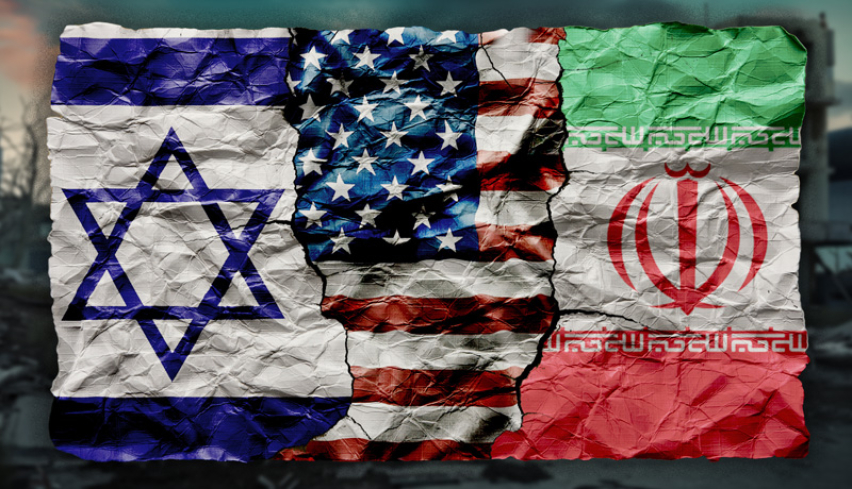
When it began, I had no idea why the United States decided to attack Iran. It seems the official line is that it was a pre-emptive strike aimed at preventing Iran’s imminent development of nuclear weapons; although we were told months before that US and Israeli strikes had already achieved that aim.
It’s also been suggested that it was to prevent Iran from developing missiles that could hit Europe. And Marco Rubio said:
“We knew that there was going to be an Israeli action. We knew that that would precipitate an attack against American forces, and we knew that if we didn’t pre-emptively go after them before they launched those attacks, we would suffer higher casualties.”
The US attacked Iran because Israel was going to do so first.
In other words, the US attacked Iran because Israel was going to do so first. I even saw a video in which the US Secretary of War claimed that the US wasn't complicit in starting the war.
From my point of view, the most fascinating and worrying suggestion is that Donald Trump has been anointed by God to attack Iran and usher in the end times. I urge you to read the entirety of Jonathan Larsen's article linked above, but in case you don’t. the following quote gives an indication of what is going on.
"I am a (NCO rank withheld) in our unit. This morning our commander opened up the combat readiness status briefing by urging us to not be 'afraid' as to what is happening with our combat operations in Iran right now. He urged us to tell our troops that this was 'all part of God’s divine plan' and he specifically referenced numerous citations out of the Book of Revelation referring to Armageddon and the imminent return of Jesus Christ. He said that 'President Trump has been anointed by Jesus to light the signal fire in Iran to cause Armageddon and mark his return to Earth'. He had a big grin on his face when he said all of this which made his message seem even more crazy."
Apparently, a number of units have received motivational talks like this as the war has got underway. I’ll ignore what I would consider a number of problems with this perspective, such as why members of the US military (who are drawn from all faiths and none) should get excited about the explicitly Christian expectation of the return of Jesus—hence the many complaints.
How would a committed Christian view Muslims if they believed that the return of Christ was imminent?
What I will focus on here, is to revert to my former life as a missionary and consider what I believe is going on. A very simple question needs to be asked; how would a committed Christian view Muslims if they believed that the return of Christ was imminent?
Surely the response would be to desire that Muslims (and anyone else who was not a Christian) should come to saving faith in Jesus. That is a significant part of what loving our neighbor as ourselves means—and when Jesus told a story about this, the neighbor was most definitely someone considered foreign to the Jews.
Killing people and condemning them to an eternity of judgement is a very strange way of preparing for the return of the king. Given that many Muslims still identify Christians with violent Crusaders, the current war is playing into a stereotype that is far more likely to alienate Muslims (across the various schools of Islam and across the world) than draw them into faith. It is also worth noting that it does nothing to counter the persisting secular narrative that religious fervor causes wars.
Iran is one of the few countries in the region that is seeing a growth in the church.
Ironically, Iran is one of the few countries in the region that is seeing a growth in the church. It is more than likely that a number of those killed by the US and Israeli action will be faithful Christian believers who have been persecuted by the Iranian regime. Again, the parallels with our Crusading forebears are hard to avoid.
In The Last Battle, C.S. Lewis wrote about the danger of doing evil in the name of Jesus. Aslan the lion speaks:
“And if any man do a cruelty in my name, then, though he says the name Aslan, it is Tash who he serves and by Tash his deed is accepted.”
While I think there are theological issues with this encounter in The Last Battle, I stand by the veracity of that particular statement.
It isn’t just a select group of Christians who bring an apocalyptic vision to this latest war.
We all need to realize that it isn’t just a select group of Christians who bring an apocalyptic vision to this latest war. The end of the world is actually a far stronger driver for the Iranian regime than it is for the “Left Behind” strain of Christianity.
This article by Australian theologian Mike Bird is absolutely essential reading if you want to understand the ideologies behind this conflict. Very briefly, Shiite Muslims have been waiting 1,000 years for the return of a spiritual leader, known as "the Lost Mahdi", and the architects of the 1979 Iranian revolution believed that they were creating a society that paved the way for his return and the final triumph of Islam over the forces of Satan. Bird concludes by saying:
“So, what does this all mean? It means that when we look at Iran’s actions on the world stage, their nuclear program, their proxy wars, their internal crackdowns, we aren’t just looking at a country playing the game of thrones or engaging in aggressive foreign policy. We are looking at a regime that believes it is writing the final chapter of human history.
A final battle against the forces of evil, isn’t something they fear… it’s something they are actively trying to build.
For the Ayatollahs, the survival of the Iranian state is sacred because they believe it is the only gateway to the end of the world. Whether you see it as a religious conviction or a political tool for control, one thing is certain: in Tehran, the apocalypse, the end of the world, a final battle against the forces of evil, isn’t something they fear… it’s something they are actively trying to build.”
On The Rest is Politics Podcast, Rory Stewart said that Donald Trump expected that if he bombed Iran then the leadership would be frightened into surrender, what the President didn’t realize is that, for deeply embedded theological reasons, the Ayatollahs fear surrender more than they do bombs.
I find it fascinating and chilling that two groups of people coming from polar opposite standpoints are willing to sacrifice so many lives because of their particular apocalyptic vision.
How should the average Christian respond?
Meanwhile, how should the average Christian respond? What ought to be our biblically faithful posture? It's not difficult to discern. It's the same as always: we should love the Lord with all our heart and soul, and our neighbor as ourselves (Mark 12:30-31). Some things don’t change whatever the political situation.
Originally published on Dr Eddie Arthur's Living in the Venn Diagram Substack. Republished with permission.
Dr Eddie Arthur has been a member of Wycliffe Bible Translators for over thirty years. For twelve years he and his wife Sue lived in Ivory Coast where they were part of the team translating the scriptures for the Kouya people. He is now based in the UK where he researches, writes, and talks about the future of global missions and provides contextual perspectives on societal change. Eddie's more recent writing can be found on his Substack "Living in the Venn Diagram".