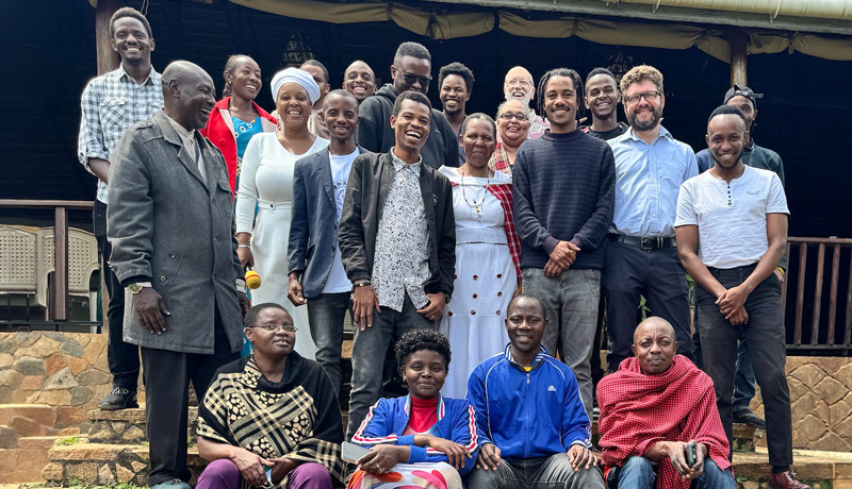
At the end of April 2026 I visited Arusha, Tanzania. There, I became more convinced than ever that much of what we call “mission” needs to change. I was there with the Network for the History of Mission, where we examined in detail the entanglements between mission and colonialism. In the case of Tanzania, it became unmistakably clear that the story of early missionaries cannot be told faithfully without confronting the extreme violence of German colonial rule in the 1890s.
We heard from Felix Kaaya, the grandson of the famous Mangi Lobulu, about how, in 1896, following the killing of two German missionaries near Mount Meru, the German officer Kurt Johannes led a large-scale punitive expedition against the Meru and Arusha peoples. The punitive expedition was not a minor reprisal but a devastating campaign—villages were destroyed, livestock seized, and hundreds killed).
Christian mission did not arrive alone... it was entangled with empire from the beginning and... shaped both its message and its methods.
This violence was not incidental to the missionary story; it was part of the same historical moment in which mission and colonial power were deeply entangled. As in much of Africa—especially in the aftermath of the Berlin Conference—Christian mission did not arrive alone. But, as I have argued in Decolonising Mission, it was entangled with empire from the beginning—and that entanglement has shaped both its message and its methods.
It would be convenient to treat the entanglement as history. But the deeper truth is more uncomfortable: colonial entanglements in mission persist around the world today. The language has shifted somewhat. We speak of partnership, global church, collaboration, but the underlying dynamics often remain.
Power still flows disproportionately. Authority is still centered elsewhere. And in many subtle ways, mission continues to carry assumptions about culture, identity, and legitimacy that echo its colonial past. We have refined the vocabulary, but we have not dismantled the system.
Local believers making disciples among their neighbors with remarkable clarity and conviction.
In Arusha, I found myself holding two realities together, realities that do not easily sit side by side. On the one hand, I witnessed local believers making disciples among their neighbors with remarkable clarity and conviction, often without external funding, without imported strategies, without Western oversight.
It was simple, grounded, and deeply faithful. On the other hand, I encountered Christians still wrestling with a quieter but equally significant struggle: the sense that to follow Christ faithfully, they must become something other than themselves.
That tension came into sharp focus in conversations with two pastors. A female Maasai pastor spoke candidly about the challenge of discipling Maasai communities without defaulting to forms of Christianity that subtly seek to westernize them.
"Empowered to be Maasai and Christian without having to choose one."
She was visibly struck when she encountered, for the first time, the idea of the “Maasai Creed”, a contextual confession of faith that names Christ within Maasai categories and imagination. She said more than a few times, “For the first time ever, I feel confident and empowered to be Maasai and Christian without having to choose one.”
In another conversation, a pastor from the Safwa people declared a quiet but profound shift in perspective: I am finally able to imagine a way to follow Christ that enables me to become a fully authentic Safwa, rather than requiring me to move away from my identity.
Mission is being decolonized in practice, while remaining colonized in imagination.
And this is where the crisis of mission becomes most acute. Because even where local mission is thriving, the deeper formation of Christian identity is still often shaped by inherited assumptions: that maturity looks Western, that faithfulness requires cultural distance, that the gospel arrives with an implicit template for what a so-called "real" Christian should look like. So we are left with a contradiction: mission is being decolonized in practice, while remaining colonized in imagination.
Are we participating in what God is doing or quietly resisting it?
This raises a question we can no longer avoid: if our models of mission continue to carry these assumptions, are we participating in what God is doing or quietly resisting it? What must end is not evangelism or witness, but mission as empire, mission as the subtle reshaping of people into someone else’s image.
Decolonizing mission is not optional; it is a theological reckoning. And the future of the church will not wait—not while believers are discovering, often for the first time, that in Christ they are not less themselves, but more.
Pastors and Christian leaders equipped to lead diverse churches with both theological clarity and cultural intelligence.
Churches today are being reshaped by migration, diaspora realities, and increasing cultural complexity. While many leaders are theologically well-formed, they are often less equipped to navigate cultural difference, recognize hidden patterns of exclusion, or cultivate a genuinely shared life across diversity. More theological reflection, practical engagement, and shared learning around the challenges and opportunities of multicultural ministry must be encouraged, with pastors and Christian leaders equipped to lead diverse churches with both theological clarity and cultural intelligence.
This opinion was originally published on Harvey's Substack, Global Witness Globally Reimagined. Republished with permission.
Dr Harvey Kwiyani is a Malawian missiologist and theologian who has lived, worked and studied in Europe and North America for the past 20 years. He has researched African Christianity and African theology for his PhD, and taught African theology at Liverpool Hope University. Harvey is also founder and executive director of Missio Africanus, a mission organization established in 2014 as a learning community focused on releasing the missional potential of African and other minority ethnic Christians living in the UK. More recently he became African Christianity Programme Lead for CMS (UK) Pioneer Mission Training and in August 2025 his book Decolonizing Mission was published.
If you are interested in further training from Harvey on how to lead diverse churches with both theological clarity and cultural intelligence via an online, cohort-based course beginning in mid-May, find out more here: https://shorturl.at/08VSg.