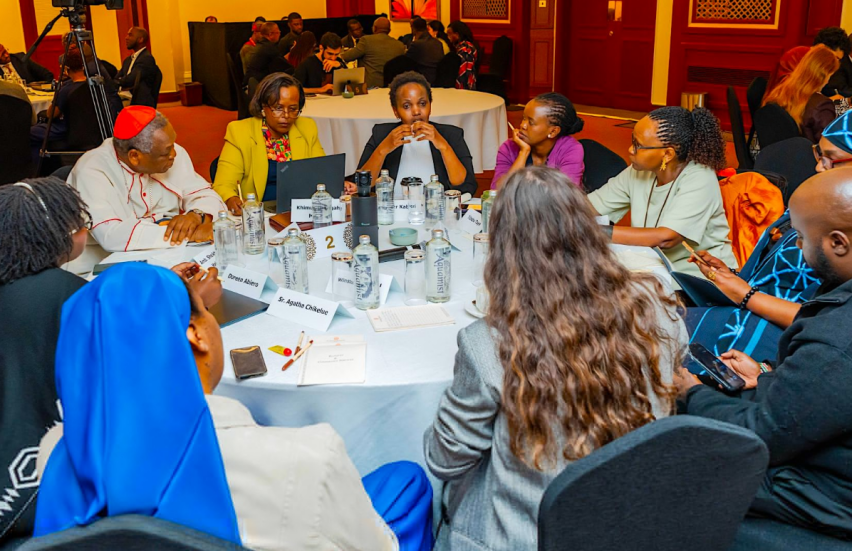
African Christian, Muslim and interfaith leaders joined technology experts and policymakers in Nairobi to discuss how artificial intelligence could affect young people's well-being, contribute to radicalization and shape the representation of African languages and values in digital systems.
The gathering on Oct. 13 was the third roundtable under the Faith-AI Covenant, an international initiative seeking to bring religious leaders and technology developers together to establish ethical principles for artificial intelligence.
Participants included representatives of the All Africa Conference of Churches and the Evangelical Alliance of Kenya, alongside Christian, Muslim and interfaith leaders, academics, civil society representatives and technology specialists.
The discussions focused on how faith communities and technology companies could work together to protect children, support young people's development and prevent artificial intelligence from being exploited to spread extremist messages.
The meeting was organized by the Interfaith Alliance for Safer Communities in partnership with Precognition, a London-based firm working in artificial intelligence and emerging technology.
One of the meeting's central themes was the influence of interactive digital environments on young people’s identities, relationships and moral development.
Organizers said discussions explored how artificial intelligence could be used to facilitate radicalization and what pastoral, technical and community-based interventions might help address the risks.
The meeting also examined AI’s effects on children’s emotional well-being, including the safeguards needed to ensure educational applications support healthy development.
Faith leaders, educators, technology developers and civil society groups were identified as having a shared responsibility in developing protections for children and young people.
Baroness Joanna Shields, chief executive of Precognition and co-chair of the Faith-AI Covenant, said artificial intelligence was advancing faster than institutions and communities could adapt.
“AI is advancing faster than our institutions and communities can adapt,” Shields said.
She argued that the technology was changing how people understand themselves, their work and their purpose.
“The purpose of this Covenant is not to slow innovation, but to ensure it is guided by conscience,” she said. “African voices are critical in helping define the values these systems carry, so dignity and resilience are designed in from the outset.”
African languages and local values
The roundtable also raised questions about whose languages, cultural experiences and ethical priorities are reflected in artificial intelligence systems.
Many AI models are developed using large collections of data, but the availability and quality of training material vary considerably across languages. Participants discussed the importance of ensuring African languages and local perspectives are represented as the technology develops.
The organizers said the discussions considered Kenya’s National AI Strategy 2025-2030 and the practical challenges of introducing ethical safeguards and human oversight in African settings.
Dana Humaid, chief executive of the Interfaith Alliance for Safer Communities and a co-chair of the initiative, said African faith leaders and technology specialists wanted technological development to advance alongside religious moderation and interfaith cooperation.
The Covenant draws partly on the United Arab Emirates' approach to combining investment in artificial intelligence with efforts to promote religious moderation and peaceful coexistence.
The Nairobi meeting brought together several prominent religious figures, including Cardinal John Olorunfemi Onaiyekan, archbishop emeritus of Abuja, and Bishop Fred Sheldon Mwesigwa of Ankole.
Other participants included Ambassador Mussie Hailu of the United Religions Initiative for Africa, Imam Muhammad Nurayn Ashafa of Nigeria’s Interfaith Mediation Centre and Dr. Mustafa Yusuf Ali of Arigatou International in Nairobi.
Technology and policy organizations represented included IBM Research Africa, Qhala, Indigenius AI, Vambo AI and the Africa AI Council.
No covenant adopted yet
Despite its name, the Faith-AI Covenant has not yet been launched as a completed set of commitments. The initiative is developing shared principles and voluntary pledges through a series of international roundtables.
The Nairobi gathering followed earlier meetings in New York and Paris. Further discussions are planned in Asia before the Covenant’s launch in Abu Dhabi in 2027, according to its organizers.
The initiative aims to develop principles that protect human dignity, strengthen social trust and promote the common good while allowing technological innovation to continue.
Its next challenge will be translating broad ethical concerns into practical commitments that religious institutions, technology companies and policymakers can implement.
The Nairobi meeting did not announce a binding agreement or a specific policy change. Its immediate contribution was to bring African faith leaders and technology specialists into discussions about the social and ethical consequences of artificial intelligence.
As AI becomes more widely used for education, communication and personal guidance, the initiative's organizers argue that African religious communities should have a voice in determining how the technology develops and how its risks are addressed.