One of the many contributions that missionaries (and monks) have made has been in the area of literacy. Wherever Christian missionaries have gone they have carried with them the Bible and have taught people how to read.
Literacy is present in many foundational aspects of missionary work:
- Bible translation is often done alongside literacy training, such that the cultures receiving new language translations of the Bible can read them.
- The creation of written languages where none existed before. This has been a cousin of Bible translation, of course, and has also served to preserve languages that might otherwise be lost.
- Many educational schools and systems owe their founding to missionaries. Educational system based on Western models were brought by missionaries to India, China, many African countries, Japan, Korea and I could go on,
- Printing was driven largely by Bible printing in its early days. Even now, the Bible remains the most printed book in all of history.
It is no exaggeration to say that the modern world was shaped by missionaries... because they taught people to read.
I think it is no exaggeration to say that the modern world was shaped by missionaries in large part because they taught people to read. Almost all fields of intellectual pursuit have been enriched and, in some cases, made possible because of high levels of literacy.
What was gained can easily be lost
There is little doubt that in the USA (and I would venture to say, other Western countries) literacy is in decline. Screens and images have replaced paper and letters as a primary way of communicating. High school proficiency scores are plummeting.
I did a little scratching around with AI research on literacy rates. It is very hard to get consistent data reporting because educators have changed the goalposts.
"Proficiency" is a low standard compared to literacy evaluations of previous generations.
After reading several reports and analyses of those reports, I learned that approximately 34% of high school graduates are considered to be “proficient readers.” Be aware, though, that reading "proficiency" is a low standard compared to literacy evaluations of previous generations.
The church can do what it did before
Both the homeschooling movement and the classical education movement are swimming upstream in the face of rising illiteracy. Both of these movements are dominated by Evangelicals.
Evangelicals are more likely to provide educational alternatives for their children.
While there is a lot of hand wringing today that Evangelicals are not producing institutions or institutional leaders, I would give some push back and note that Evangelicals are more likely to provide educational alternatives for their children than just about any other group.
Yet, today’s reading needs are different and I would suggest a two-pronged approach. First, we need to learn to wisely use digital tools. We need to tame our screens and wrest the best possible practices out of them to advance human flourishing.
Discipline surrounding digital exposure, an understanding of the way screens change our thought processes, and taking seriously the stages of mental and emotional development that children need should be part of this first prong.
Double down on old school, classic reading.
The other prong is to double down on old school, classic reading. I mean reading long form material. Books.
Long books with detailed arguments and logic that force one to develop mental models to understand the author’s proposed goals. Novels that create empathy and emotion. Biographies that force us to learn history, struggle, failure and victory.
The Bible plays a role here. There is no Western culture without an understanding of the Bible. The metaphors of Western history were created through the pens of Biblical authors.
Another missionary moment?
Over the next three to five years, our society is going to undergo a foundational and fundamental transformation because of AI. Things that we would never consider doing now are going to be commonplace.
The way that we understand human existence, particularly human existence from an imago Dei perspective, is going to be displaced. The time-frame here is not slow and incremental. This will be a war of Blitzkrieg.
How we understand literacy and reading is already changing.
How we understand literacy and reading is already changing. Why read the book when a short, one-page summary can be created in seconds?
I love reading but I find myself fighting the urge to just query a topic instead of reading something long-form about it. For sure, there are times when the screen is superior to the page, but I fear that few will get much exposure to the written word from now on.
Not for the first time
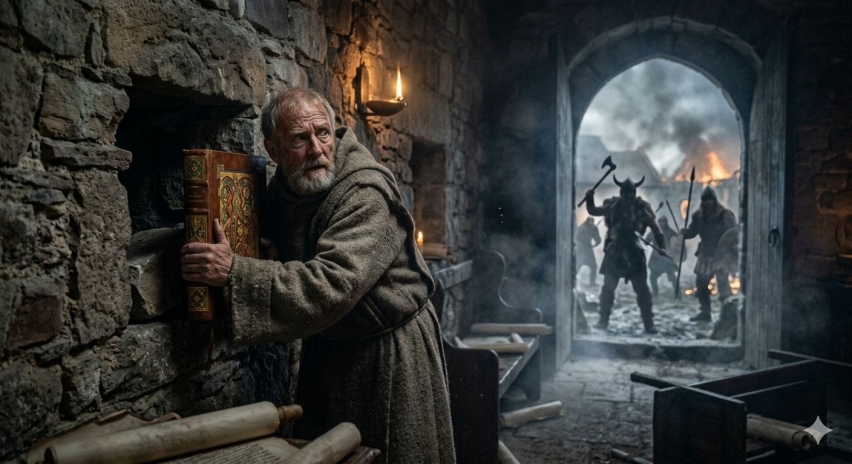
I was reminded last year while in Dublin that something very similar happened once before. Following the collapse of the Roman Empire and the subsequent instability of the commonly-called "Dark Ages," European classical knowledge faced widespread threats from invading forces and the dissolution of centralized institutions.
Ireland... emerged as a vital sanctuary for intellectual and cultural preservation.
Ireland, shielded from these disruptions, emerged as a vital sanctuary for intellectual and cultural preservation. During this period, Irish monks and scribes copied both pagan and Christian texts (including works by ancient philosophers), while establishing monasteries that became renowned hubs of literacy and artistic innovation, most notably producing works like the Book of Kells, which I saw (in real life) at Trinity College.
By safeguarding these foundational works of Western literature, philosophy, and theology, these monks played a crucial role in ensuring the survival of classical heritage at a time when continental learning was at severe risk of being destroyed altogether. The loss would have been akin to the burning of the Library of Alexandria, but these monks prevented that sort of loss.
If you want the long-read version of this, you can read about it in Thomas Cahill’s book, How the Irish Saved Civilization.
It won’t be literal pages to be burned this time around. It will be how we read (short summaries versus long form material), where we read (phones versus paper and paper-like digital devices), and who we read (curated feeds that AI decides to send us versus what we choose to feed our souls).
Where are the Irish monks of literacy today?
Originally published on Ted's Substack, TedQuarters. Republished with permission.
Ted Esler is the President of Missio Nexus, an association of agencies and churches representing hundreds of mission agencies and churches. Ted worked in the computer industry and then served in the Balkans during the 1990s. He then held various leadership roles with Pioneers. He was appointed the President of Missio Nexus in 2015. He is the author of The Innovation Crisis. Ted has a PhD in Intercultural Studies (Fuller Theological Seminary, 2012).