
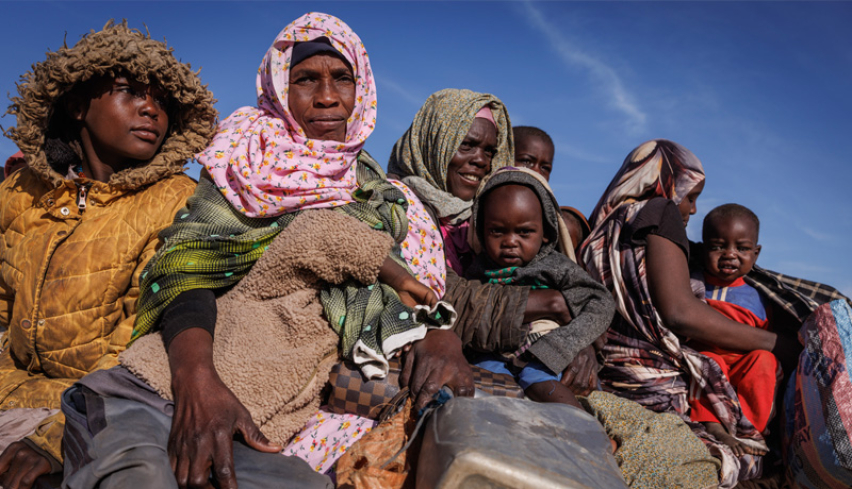
Attention briefly returned to Sudan's civil war last week, to mark three years of devastating conflict. Normally, Gaza dominates headlines, alongside Ukraine whose people continue with resolve against Putin’s war machine. Iran's nuclear ambitions and Trump’s war against them have shaken the foundations of our globalized world. Sudan, for the most part, has slipped into the margins—a crisis too complex, too distant, too African to hold the Western gaze.
Yet it is nonetheless the most deadly conflict in the world today. More than 11 million people have fled their homes—four million of them children. The United Nations warns that two-thirds of the country's 49 million people need humanitarian aid, with some four million children acutely malnourished. Deaths estimates range from tens of thousands to over 150,000, with the true figure likely far higher.
The conflict, which erupted in April 2023, is a power struggle between the Sudanese Armed Forces and the Rapid Support Forces, a paramilitary group with links to the former Wagner Group and allegedly backed by Libya and the UAE. What began as a contest for control in Khartoum in the vacuum left by democratization and the removal of longtime dictator Omar al-Bashir, has since fragmented into a wider war marked by mass atrocities, ethnic and religious violence, and the collapse of state authority.
A strong feeling of abandonment.
Two years ago, Illia Djadi, a senior analyst with Open Doors, said after visiting the region that "there is a strong feeling of abandonment”. That is, to the world’s shame, still true today. "Sudan is home to the world's largest mass displacement and is facing the world's largest hunger crisis, but it is not getting the attention and the response it should."
Christians: targeted, displaced, ignored
Sudan's two million Christians face particular peril.
Within this overlooked catastrophe, Sudan's two million Christians face particular peril. The country now ranks fourth on the 2026 World Watch List of nations where Christians face the worst persecution—and the war continues to make things worse.
More than 150 churches have been damaged or destroyed since fighting began, some by collateral damage, others deliberately targeted. Christians who flee the violence often find that displacement brings new dangers. Many report discrimination when seeking shelter and being overlooked during aid distribution.
Rafat Samir, Secretary General of the Sudan Evangelical Alliance, escaped Khartoum in the war's early days. Antiaircraft guns fired outside his bedroom window. Bodies lay in the streets, covered with sand to mask the smell. He paid US$500 to travel two kilometers. A bus ahead of his was stopped by militants; its passengers were killed and robbed.
The threat extends beyond the battlefield.
The threat extends beyond the battlefield. Church leaders fear that former Islamist officials may exploit the chaos to return to power and reimpose hard-line Sharia laws—including blasphemy statutes that once made conversion from Islam a capital offense. For young believers like Amona Kaki, 18, expelled by her own family last year for reading the Bible, the danger is immediate and intimate. Like many Christians, she has been forced to fend for herself outside the refugee camps.
Persecution in the camps
For these Christians, flight does not bring safety, only a change in the form persecution takes. In a refugee settlement outside Juba, South Sudan, a 31-year-old Sudanese man who fled the war to the majority-Christian nation (established 2011) converted to Christianity after encountering the faith in exile.
His decision did not go unnoticed. Fellow residents reported him to his family in Darfur, who, like Amona’s parents, responded by disowning him and declaring him worthy of death under prevailing interpretations of apostasy. Now in hiding within a church compound, he lives under constant threat, unable to move freely, dependent on the protection of a fragile community that itself has little power or will to defend him.
Structures that enforce conformity often survive the journey.
In reality, the social and religious structures that enforce conformity often survive the journey to refuge intact, carried across borders by the very communities that have fled violence. In the absence of functioning state authority, these pressures can become even more acute.
Refugee camps, intended as places of sanctuary, risk becoming environments where belief is monitored, deviation punished, and conversion treated not as a right but as a provocation. For Sudan’s Christian converts in particular, there is no clear line between war and refuge.
Hope for an end to conflict
Sudan exposes a deeper failure in how we understand modern conflict. When persecution is embedded within state collapse, it ceases to appear as a distinct humanitarian concern and instead dissolves into the background noise of war.
Persecution and violence follow refugees.
As in the case of the Rohingya Muslims suffering in Bangladeshi refugee camps having fled persecution in Myanmar, persecution and violence follow refugees unless enormous efforts are made to insulate them from the effects of the war they are fleeing.
Absent sustained external pressure and a unified diplomatic effort, Sudan is unlikely to see a decisive end to the conflict this year. Instead, the most probable outcomes are either a de facto partition of the country or a prolonged war of attrition in which the state continues to fragment and civilians continue to bear the cost.
Azeem Ibrahim is the Chief Strategy Officer at the New Lines Institute for Strategy and Policy and a columnist at Foreign Policy magazine. He has written extensively on the persecution of religious minorities, including essays for Foreign Policy on the targeting of Christian communities in Myanmar and China. See Azeem's website for more information: https://www.azeemibrahim.com/.








