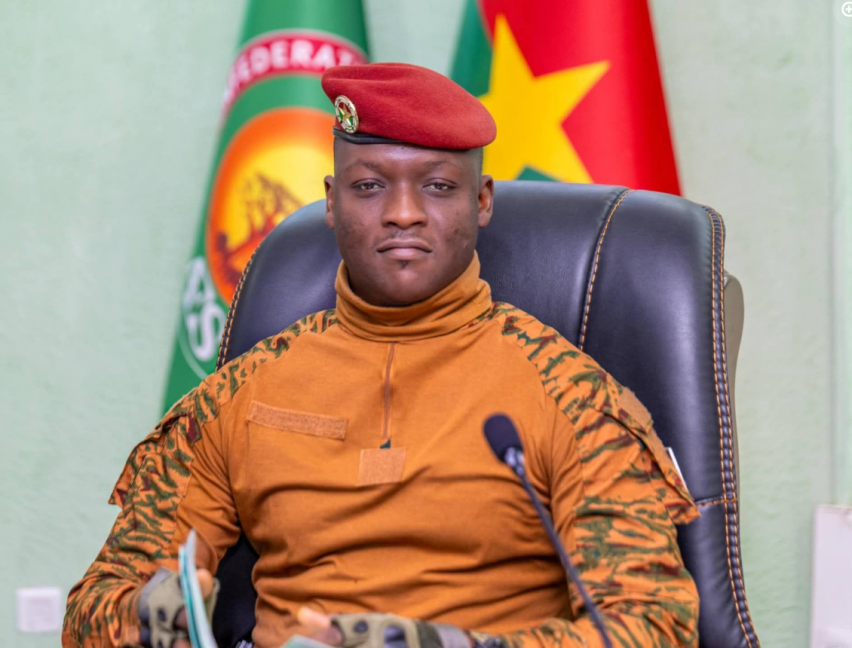
Burkina Faso’s military government appears to have strengthened its commitment to religious freedom and the country's secular identity following the adoption of a new law regulating religious practice.
In a speech seen online, Capt. Ibrahim Traoré rejected calls for the implementation of Sharia (Islamic law). The video, which has circulated widely on Facebook and was republished by Pulse Nigeria, shows Traoré addressing a gathering about religious education, foreign funding and national sovereignty.
Traoré, a Muslim who has fought against an Islamic extremist insurgency, criticized the practice of sending young people abroad to study Islamic law while neglecting vocational training.
“They are coming back to implement Sharia here,” said Traoré, in French. “Not one of them has learned a profession or trade.”
He argued that religious education should be developed within Burkina Faso instead of relying on outside sponsors.
“We ourselves will take responsibility for this funding,” Traoré said. “Whether they are Catholic youth, Protestant youth, Muslim youth, or followers of traditional religions, we will find a way to support them ourselves.”
The Burkinabe leader also appeared to criticize foreign financial support for religious training, saying some people are drawn by money rather than genuine service.
“They receive funding, do what they have been sent to do, and then return after studying Sharia to try to apply it here – I will never pay for that [religious studies],” said Traoré, 38, the world’s youngest head of state, who came to power as interim president in 2022 through a military coup overthrowing the previous junta leader, Paul-Henri Damiba.
The comments come only weeks after Burkina Faso’s Transitional Legislative Assembly unanimously adopted a sweeping law on religious freedoms that seeks to bring order to religious organizations while reaffirming the country's secular character.
According to the government, the legislation is intended to guarantee freedom of worship, strengthen public order and social cohesion, and establish a clearer legal framework for religious practice. The law also regulates the establishment and management of places of worship and certain religious activities in public spaces.
Government officials have said the measures are aimed at preventing extremism while preserving the rights of all religious communities. Earlier explanations of the bill also stated that it reaffirmed freedom of worship while introducing regulatory mechanisms for religious organizations.
Burkina Faso’s constitution identifies the country as a secular state, where citizens are free to practice their religion. Muslims make up the majority of the population, while Christians and followers of traditional African religions also form significant communities.
Countering Islamist insurgents and radicalisation
The government’s emphasis on secularism comes as Burkina Faso continues to battle Islamist insurgent groups linked to al-Qaida and the Islamic State. The militant groups have carried out attacks on civilians and security forces while attempting to impose a strict interpretation of Islamic law in areas under their control.
Churches in parts of northern and eastern Burkina Faso have been forced to close due to insecurity, and thousands of Christians have been displaced alongside Muslim communities fleeing violence.
Although Traoré's recent remarks have not yet been widely reported by news agencies, they appear consistent with the direction taken by his administration in recent months. The military-led government has spearheaded a highly nationalist, self sustaining and anti-imperialist agenda. The remarks closely align with the government's recently enacted law on religious freedoms.
The government’s new religious law does not establish a state religion or give preference to one faith over another. Instead, officials say it seeks to ensure that religious freedom exists alongside national unity and public security.
Traoré’s remarks suggest the government intends to resist any effort to introduce Sharia as the country’s legal system while encouraging locally supported religious education across all faith communities. His apparent call for equal support of Muslim, Catholic, Protestant and traditional religious youth also reflects the government's stated position that all recognized faiths should operate within the framework of a secular republic.
As Burkina Faso continues to confront both violent extremism and growing social pressures, the debate over religion’s place in public life is likely to remain a significant issue. The newly enacted religious freedoms law provides the legal framework, while the widely shared video offers what appears to be Traoré’s clearest public comments yet on how his government intends to balance freedom of religion with national sovereignty.