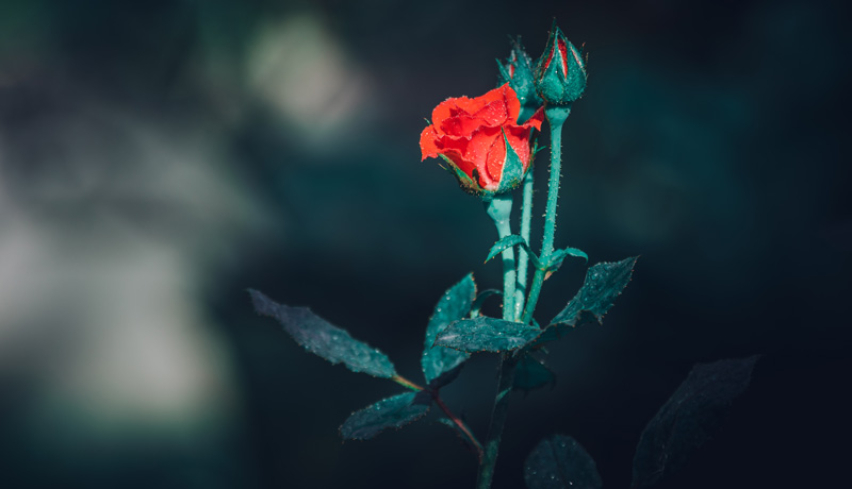
Roses are beautiful, but the most spectacular ones have thorns. It makes sense. Something as exquisite as a rose needs some protecting, for though lovely, they are delicate and vulnerable, and need some safeguarding from grasping hands which might clutch their blooms without thought or heed.
A rose, buds, thorns exercise, where you explore what is deeply pleasing... (the roses), what... opportunities are waiting... (buds) and what difficulties are being faced (thorns).
I recently led a leadership strategic planning day and instead of the tried and trusted SWOT analysis (strengths, weaknesses, opportunities, threats) I was asked to run a similar but not identical rose, buds, thorns exercise, where you explore what is deeply pleasing about what you are presently doing (the roses), what potential or opportunities are waiting to be grasped (buds) and what difficulties are being faced (thorns). The group responded really well to it, and some very constructive discussion was backed by excellent decisions. It was a valuable time.
It struck me that this is not simply a good exercise for organizations, but that it’s also helpful for individuals. I like it because the framing is essentially positive. It’s the fine balancing act between the beautiful, the possible, the vulnerable, the sharp and the difficult. It normalizes that all are present. It’s so easy to look at the thorns and not to notice all that is still beautiful and possible.
A true story.
Here's a true story. I was plus minus 7 years old and had just got my first two wheeler bike. Yes, I know kids now get them at about 2, but there was a different financial climate back then where I grew up in South Africa.
My friend Lynton was helping me learn to ride and would faithfully run behind the bike holding it up with his one hand. Getting short of breath he suddenly stopped and I was alone, riding the two wheeler with immense pride. And then I saw them: a full bed of Christ Thorn flowers. You know the ones, with pretty red flowers but seriously savage thorns. I couldn’t stop myself from fixating on them. The more I told myself to steer away the more I felt magnetically drawn to them, I have no idea why. And, yes, I crashed right into them.
Beautiful flowers, but they sure knew how to defend themselves.
I still wince when I think how many of those thorns went into my hands and knees. They were beautiful flowers, but they sure knew how to defend themselves. Ah the parables you learn when you are seven years old!
Back to today. How would you answer someone who asked what are the roses, buds and thorns in your life? Let's think about it.
Start with gratitude.
It is always good to start with the roses; or, to put it differently, to start with gratitude. It’s the Philippians 4:8 principle: whatever is good, whatever is lovely, true, noble, right, admirable, think about these things.
It’s a choice we make. The conscious decision to notice and affirm the beautiful, because that then sets the tone for everything else. It is clear that Paul expects us to find many things to think about. You shouldn’t have to wrack you brain extra hard to find something to fit the bill. Be quietly confident. Even in difficult seasons, there is much that is beautiful. Observe it. Celebrate it.
And then there are buds. The little bits of potential that surround us. You can never be certain with a bud. It may of may not flower into full bloom. It’s far more likely to if it is noticed, protected (just a little), and allowed to flourish.
What’s there waiting to develop?
It’s the “what’s there waiting to develop” conversation. It could be a new skill to learn, a challenging task to accept, a friendship to develop. Each bud is a gift, a possibility, a sign of hope.
Paul again frames it well when he instructs Timothy to fan into flame the gift that was within him through the laying on of hands (2 Timothy 1:6). The bud was there. Timothy now needed to fan it into flame. And so should we.
Our difficulties are protective.
We finish with the thorns, not because they are the last word—anything but. Reminded of how much is good and lovely, and of the gifts that God has placed in our orbit, we soberly look at the thorns, and accept their challenge to cherish the roses and buds which they protect. Because in a strange way, our difficulties are protective—they strengthen us, teach us resilience, and invite us to put our trust and faith in God.
For, to quote Paul one more time, “I can do all things through Christ who gives me strength” (Philippians 4:13). And lest you (or I) forget it, it is “through Christ”, not without Him, that this is possible. And here is an "amen and amen" to that.
Originally published by on Brian Harris' Blog. Republished with permission.
Dr Brian Harris, is based in Perth Australia. After decades of church pastoring and 17 years leading a theological college, he now directs the Avenir Leadership Institute, a future-focused consultancy which helps to shape the kinds of leaders the world needs. Brian is the author of seven books, the latest of which are: Why Christianity is Probably True (Paternoster, 2020) and Stirrers and Saints: Forming Spiritual Leaders of Skill, Depth and Character (Paternoster, 2024).