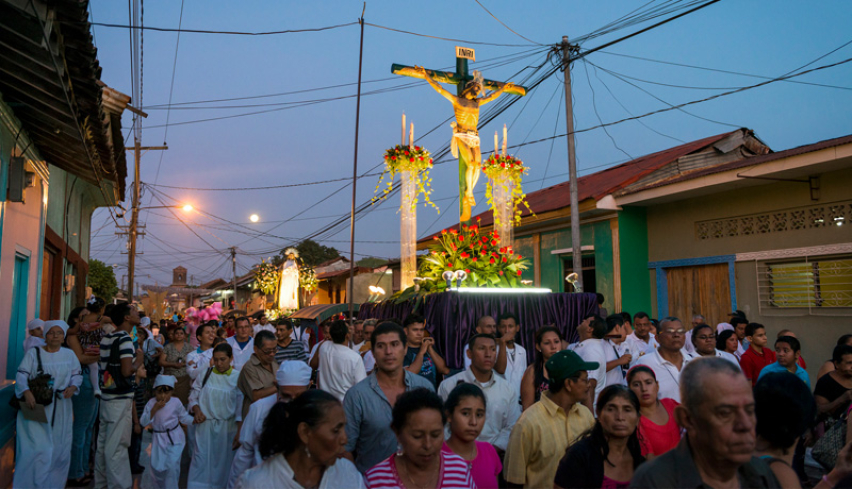
There is something revealing about a government that becomes frightened of a religious procession.
In Nicaragua, the government of Daniel Ortega and Rosario Murillo has spent years systematically restricting the ability of Christians to worship publicly. This year, authorities reportedly prohibited more than 400 Stations of the Cross processions during Lent. Holy Week celebrations were restricted for the fourth consecutive year. By September 2026, according to the U.S. Commission on International Religious Freedom, as many as 27,286 religious processions and other acts of public piety had been prohibited since 2019.
This is not merely religious intolerance. It tells us something deeper about the nature of modern authoritarianism.
Dictators... fear any institution capable of commanding loyalty that the state does not control.
Dictators do not only fear political parties, journalists or opposition movements. They fear any institution capable of commanding loyalty that the state does not control. Churches can do precisely that.
Nicaragua demonstrates the principle with disturbing clarity.
The repression accelerated after the mass protests of 2018, when demonstrations against Ortega's government developed into a nationwide political crisis. Churches sheltered protesters, clergy provided humanitarian assistance and Catholic leaders attempted to mediate. The government increasingly came to regard the Church not merely as a religious institution but as an alternative center of social authority.
What followed was not an isolated dispute with a handful of outspoken priests. It became systematic.
Religious leaders have been arrested, imprisoned, expelled...
Religious leaders have been arrested, imprisoned, expelled or prevented from returning to Nicaragua. Human Rights Watch reported that more than 200 members of the Catholic clergy had been forced into exile, deported or denied re-entry since 2022. Protestant and evangelical communities have increasingly been targeted as well.
Religious organizations have been dissolved and their assets confiscated. USCIRF reported that in January 2025 alone the government dissolved 15 nonprofits, including Protestant Christian foundations and a Catholic religious foundation. The authorities have used laws covering treason, sovereignty, cybercrime, money laundering, and other offenses against religious leaders and institutions.
The pressure now reaches into the mechanics of religious life itself. Priests have reportedly been required to obtain permission before traveling between municipalities. Pastors have been warned against including criticism of the government in sermons. In March this year, the government prohibited priestly and diaconal ordinations in four dioceses already depleted by expulsions. Reports have even emerged that travelers were prevented for a period from bringing Bibles into the country.
Authoritarianism ultimately seeks... the destruction of autonomous society.
Why would an ostensibly powerful government concern itself with sermons, priests traveling between towns or worshipers carrying crosses through the streets? Because authoritarianism ultimately seeks more than obedience. It seeks the destruction of autonomous society.
A political opposition can be outlawed. A newspaper can be closed. An NGO can lose its registration. Universities can be brought under state control. But religious institutions present a more difficult problem. They possess networks, buildings, traditions, leadership structures and sources of legitimacy that do not originate with the government.
Most importantly, their claim to authority is fundamentally beyond the state.
A dictatorship can insist that the government is supreme. Christianity insists that it is not.
Independent religious communities create spaces in society in which people assemble, communicate, and organize without requiring permission from the ruling party.
This does not mean that every Christian congregation becomes a political opposition movement. Most do not. Nor does it mean that every action taken against a religious figure necessarily originates in theological hostility. The more important point is structural: independent religious communities create spaces in society in which people assemble, communicate, and organize without requiring permission from the ruling party.
For a government intent on eliminating independent civic life, that autonomy itself becomes suspicious.
Since 2023 the categories of people targeted had expanded to include church members.
The latest findings of United Nations investigators make the wider context difficult to ignore. In September, the UN Group of Human Rights Experts on Nicaragua said that state institutions had committed crimes against humanity including enforced disappearance, torture and arbitrary detention as part of a systematic campaign against perceived opponents. Investigators reported that since 2023 the categories of people targeted had expanded to include church members, Indigenous leaders and former state officials.
Nicaragua's government has rejected international criticism of its rule and has repeatedly portrayed hostile religious figures and institutions as political actors working against the state. Its confrontation with the Catholic Church has at times become extraordinarily bitter: last year the Foreign Ministry publicly attacked the Vatican after an appearance by exiled Bishop Rolando Álvarez, one of the government's most prominent clerical critics.
Yet the widening campaign against Catholic and Protestant communities makes the broader pattern harder to dismiss as a dispute with individual political clerics.
The lesson extends well beyond Nicaragua.
Religious persecution... can be an early warning sign.
Religious persecution should not be treated as an obscure subsection of human-rights policy. It can be an early warning sign of something much larger: the determination of a state to eliminate every institution capable of existing independently of political power.
Once governments begin deciding where people may pray, what ministers may preach, whether crosses may be carried through the streets and who may train the next generation of priests, the issue is no longer simply freedom of religion. It is whether anything in society is permitted to exist beyond the reach of the state.
That is why dictators so often become afraid of Christians.
Dr Azeem Ibrahim is the Chief Strategy Officer at the New Lines Institute for Strategy and Policy and a columnist at Foreign Policy magazine. He has written extensively on the persecution of religious minorities, including essays for Foreign Policy on the targeting of Christian communities in Myanmar and China. See Azeem's website for more information: https://www.azeemibrahim.com/.