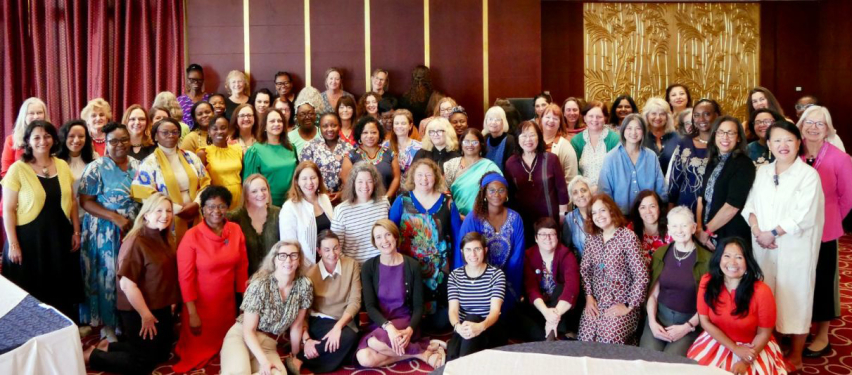
Close to 80 Christian women leaders from around the world met in Cairo, Egypt, Nov. 9-13 for Rise26. Organized by the Rise in Strength network, the gathering was built around the biblical image of the wilderness as a way to think about leading through times of upheaval and uncertainty.
Meeting under the banner "Rise in Strength: Leading in the Wilderness," participants followed a three-day journey through the theme, from arriving in the wilderness to surviving it and, on the final day, thriving in it. Rather than revolving around keynote speakers, the program was made up of Bible teaching, devotionals, personal stories, reflection in table groups and theme-based groups where participants shared resources and talked about working together.
Amanda Jackson, a co-founder of Rise in Strength, said that format is what sets the network apart. "We wanted to have a consultation which was really tapping into women's expertise," she told Christian Daily International. She said the organizers did not want to run another women's conference.
Most mornings began with Bible teaching and group discussion on topics such as being driven into the wilderness, resilience and flourishing. Training sessions followed. Women met in groups of three to talk about what they were hearing. On each full day, time was set aside for several participants to tell their own stories and personal experiences under the title "Words from the Wilderness."
On the middle day, participants went for a tour of the Giza Pyramids. Jackson said the visit was a reminder that no human achievement lasts forever, even one whose builders thought it would. The meeting closed Thursday evening with a blessing for the wilderness.
'Egypt seemed like the perfect place'
Jackson said the idea for this year's theme took shape after the network's previous gathering. She and fellow organizer Jen Williamson had been reflecting on conflict and on shifts in global power.
The organizers drew on "A Non-Anxious Presence," a book by Australian author Mark Sayers. As Jackson summarized it, Sayers argues that in times of upheaval the Church can either withdraw to try to stay safe or become a community that helps guide people through change. The team also wanted to explore whether the experience of wilderness is different for women.
Jackson said many women in the network had recently become interested in the Desert Fathers and Mothers, early Christians who withdrew into the deserts of Egypt and the Middle East. Some had gone on retreat for the first time, she said, a practice that is not common in evangelical circles, and had come away convinced that stepping back is both valuable and necessary. In Jackson's view, wilderness is not necessarily only something forced on people. It can also be chosen, as when Jesus withdrew into the desert on several occasions.
"Egypt seemed like the perfect place to do that," she said.
Exploring the wilderness theme
Three online webinars between March and July introduced the theme before the meeting.
In the first, Jeff Fountain, founder of the Schuman Centre for European Studies and a former European director of Youth With A Mission, described how geopolitical, environmental, technological and economic pressures were combining into what he called "a perfect storm of volatility." He argued that the crisis is also moral and spiritual.
Rev. Dr. Megan Powell du Toit, senior pastor of a Baptist church in Sydney, Australia, warned against longing for a lost golden age. She compared it to the Israelites who wanted to return to Egypt. Looking at several periods Christians often idealize, she asked, "Who were they golden for?"
The second webinar, in May, asked whether wilderness looks different for women. Chine McDonald, director of the British think tank Theos, spoke about Hagar, who met God in the desert and called him "the God who sees me." She said many women know what it is like to go unseen.
Beth Allison Barr, a history professor at Baylor University in the United States, described how women across the centuries have mentored and supported one another, from the 12th-century abbess Hildegard of Bingen onward. "Patriarchy may be a part of Christian history, but that does not make it Christian," Barr said, quoting her first book.
The third session, in July, turned to what can be gained in the wilderness. Janet Epp Buckingham, director of the World Evangelical Alliance's Geneva office, presented Moses' years in Midian as a time of preparation. She recommended regular silent retreats of at least 24 hours away from home.
Latvian theologian Kristina Ecis, academic dean of the Latvian Bible Center, talked about living with the threat of war on her country's border with Russia. She urged people to prepare "not out of fear, but really out of wisdom."
Inspired by the story of Deborah
Jackson said the idea for Rise in Strength came up around 2017, when she and a colleague saw that women in international leadership had few places to share ideas and learn together. The name is taken from Judges 5, which tells the story of Deborah, a judge and trusted leader who also prepared others to fight for righteousness and justice.
The network brings together women from World Evangelical Alliance and Lausanne Movement circles and women who lead nongovernmental organizations and think tanks outside both. Its first gathering, in Amsterdam in June 2019, drew about 65 women. An online meeting followed during the COVID-19 pandemic, and the network now meets in person every two years.
Jackson said the organizers keep the gathering small on purpose. While about half of the women at the first meeting were from the United States and Canada, that share has since fallen as the network has brought in more voices from other regions, she said.
Researching the role of women in the Church
According to Jackson, participants especially value the research presented at each gathering, a part of the program that has grown since the first meeting. Gina Zurlo, co-director of the Center for the Study of Global Christianity at Gordon-Conwell Theological Seminary in the United States, has attended every Rise meeting. She has said the network helped inspire her to study what women actually do in the Church, Jackson said. Jackson noted that the often-repeated claim that women make up 60% of the Church had previously rested largely on anecdotes.
At the earlier gathering two years ago, the research group was the largest of the theme-based groups. Participants wanted to learn how to carry out studies ranging from small local projects to global surveys, Jackson said. In a webinar before the Cairo meeting, she cited Zurlo's findings that the only church roles in which women were dominant were children's ministry and administration.
Zurlo gave an updated report in Cairo. Jackson said Zurlo told participants that the typical Christian worldwide, often described as a Nigerian woman, is expected to be a woman from the Democratic Republic of Congo by 2050 or earlier, which came as a surprise.
A space for learning and encouragement
This year the organizers also made networking a formal part of the program, under the name "Finding your People." Jackson said the goal was for each woman to go home with five or six contacts who could support her in friendship and ministry. She said women at large mixed conferences often don't get the chance to work out which of the few other women present they should connect with.
Looking ahead, Jackson said she hopes Rise in Strength stays closely linked to the World Evangelical Alliance and the Lausanne Movement, and that more women from Latin America and Central Asia take part. Apart from the gatherings, the network holds a prayer meeting every month.
"It's not an organization. You don't have to join," Jackson said. "But it's something that will provide learning, encouragement, prayer."