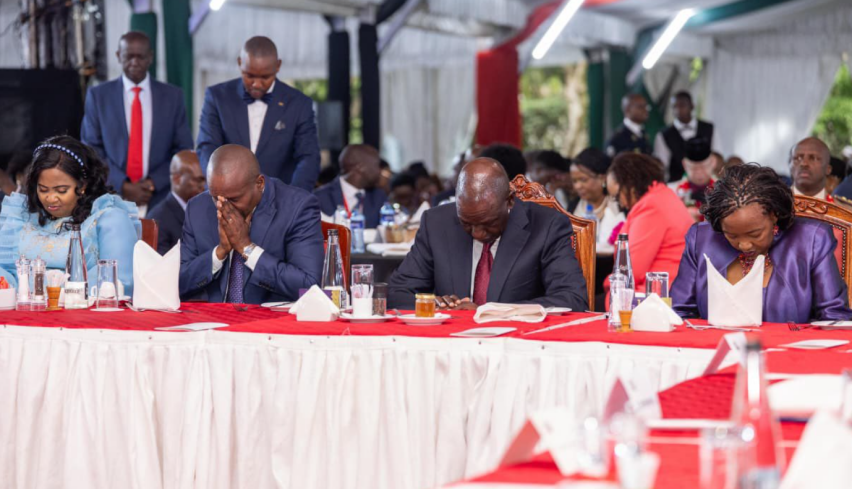
Kenya's annual National Prayer Breakfast brought together political leaders, clergy, diplomats and business leaders on May 28 amid growing concern over rising political tensions and increasingly heated debate surrounding the country's 2027 general election.
Held at Nairobi's Safari Park Hotel, the event centered on the theme of forgiveness and reconciliation. Speakers repeatedly urged leaders to lower political rhetoric and place national unity above partisan interests as early campaigning and accusations of election manipulation continue to dominate public discourse.
President William Ruto used the gathering to appeal for calm while addressing growing speculation about his re-election prospects.
“We are going to have elections and they will be peaceful, there will be no violence. And they will be free and fair,” Ruto said during the event. “Because what God has decided, no man can change. If God decides that Ruto gets a second term, he will. And if God decided otherwise, that is what will happen, and we will move on as a country,” the president said.
His remarks came as political allies and opponents continue to exchange accusations over the integrity of future elections, despite the next presidential vote being more than a year away.
Senate Speaker Amason Kingi, who hosted this year's breakfast, warned that Kenya risked repeating cycles of political hostility that have historically accompanied election seasons.
Kingi said the nation needed to embrace reconciliation before divisions become entrenched. He urged leaders to demonstrate humility and restraint in public statements, arguing that inflammatory remarks could undermine national cohesion.
The concerns reflect a broader national conversation. In recent months, several politicians from both government and opposition camps have raised questions about electoral preparedness, while some have publicly suggested that future elections could be manipulated. Such statements have fueled anxiety in a country whose democratic history includes periods of election-related violence and political unrest.
Against that backdrop, organizers presented the prayer breakfast as more than a ceremonial event. Speakers repeatedly emphasized the need for moral leadership, accountability and peaceful political engagement.
National Assembly Speaker Moses Wetang'ula, through remarks delivered on his behalf, highlighted the growing role of young Kenyans in demanding transparency and accountability from public officials.
Counting the cost of the prayer breakfast
Meanwhile, the High Court of Kenya has ordered parliament to disclose details of its annual National Prayer Breakfast expenditure.
The case stemmed from a request by lawyer Lempaa Soyianka, who wrote to the clerks of the National Assembly and Senate on March 13, 2025, seeking detailed information about the cost, funding and expenditure of the annual National Prayer Breakfast.
The court, however, declined to declare the National Prayer Breakfast unconstitutional noting that the issue had not been properly pleaded before the court.
Even so the event has not been without criticism. Some civil society groups and political commentators have questioned whether public displays of unity during the prayer breakfast always translate into ethical governance. Critics have argued that leaders who appear together in prayer often return to deeply polarized political battles once the event concludes.
The annual gathering traces its origins to 2003, shortly after the end of President Daniel Arap Moi's 24-year rule and the peaceful transition to the administration of President Mwai Kibaki.
Inspired in part by similar prayer breakfasts held in the United States, the Kenyan event was envisioned as a forum where leaders from different political and religious backgrounds could meet, pray and discuss national challenges.
Over the years, presidents, opposition leaders, judges, military officials and church leaders have shared the same platform, often during periods of significant national tension.
Following the disputed 2007 election and the violence that claimed more than 1,000 lives, messages of peace and national healing became a recurring theme of subsequent prayer breakfasts. Similar appeals were heard during election cycles in 2013, 2017 and 2022 as political competition intensified.
Several church leaders attending the event nevertheless defended the gathering's relevance, arguing that prayer remains essential during periods of uncertainty.
Women legislators who addressed the breakfast also called for moral renewal within public life. They argued that constitutional reforms and political agreements alone cannot solve Kenya's governance challenges without personal integrity and accountability among leaders.
The presence of foreign dignitaries and regional representatives further underscored the breakfast's role as an influential national platform. Delegations from neighboring countries joined Kenyan leaders in prayer and discussion, highlighting the event's growing diplomatic significance within East Africa.
As Kenya gradually moves closer to the 2027 election season, many analysts believe political competition will continue to intensify. The prayer breakfast's central message appeared aimed at countering that trend before divisions deepen further.