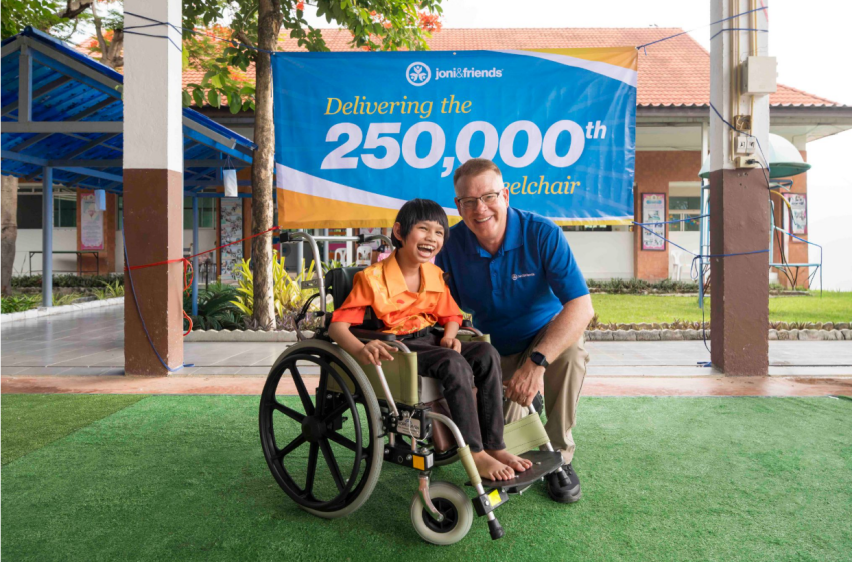
Global disability ministry Joni and Friends marked the distribution of its 250,000th wheelchair by presenting it to an 11-year-old Thai girl who previously relied on her mother to carry her everywhere.
The recipient, Nada, and her mother, Mim, met ministry President Shawn Thornton in Thailand to receive the wheelchair, which inmates participating in the Wheels for the World prison restoration program had painstakingly restored. The ministry also gave the family a Bible in their native language and a copy of disability advocate Joni Eareckson Tada’s Scripture-filled autobiography.
Nada had never used a wheelchair before, and Mim previously believed her daughter’s cerebral palsy was a curse brought on by "bad karma" from a past life under Buddhist beliefs.
“What Joni and Friends does is the whole gospel, it’s full gospel, because it’s word and deed, and Jesus never separated the two,” Thornton said.
“He preached the message of the gospel while he was at the same time picking up the children to bless them, while he was healing the blind man, while he was healing the 10 lepers. Jesus never separated the good news of the gospel apart from loving people. And there is a tendency sometimes to lean toward preaching the gospel, but not showing love, or showing love and not preaching the gospel.”
“I shared the gospel with Mim and Nada about 20 minutes after Mim said that she was under that judgment from a previous life," Thornton added. "That means I shared the gospel differently, because I first said, 'God loves you and your daughter. He made both of you special, and you were not born with something in your past that caused this disability.' Tailoring that message in the vessel of love and hope and care to the individual is the best gospel we could ever share.”
The trip marked Thornton’s first international outreach with the Wheels for the World ministry. He explained that Nada’s cerebral palsy primarily affects her physical development.
“She was contorted, so her right hand was able to reach the wheel of the wheelchair and turn it, but her left hand couldn’t do that,” Thornton told Christian Daily International. “So you just roll on one wheel, and you just go in circles. Her mother tried at one point to make it go forward, and I tried at one point just to help her go forward, but she wouldn’t have it. Nada would rather go in a circle with her controlling her own destiny of that circle than have someone pushing, and that was my answer to that question.”
Thornton noted that realizing her own mobility gave Nada a profound sense of empowerment and independence after 11 years of constant physical dependence on her mother.
“Her mother had always carried her,” Thornton said. “The way they got around town, they rode on a simple motorcycle. Her mother carried her at age 11 on the motorcycle while she drove from place to place, never apart from her. If they had to go to the grocery store, she took her and put her in a backpack.”
Thornton said the girl arrived at the outreach center without a wheelchair or a stroller. He recalled Mim’s reaction when a doctor first diagnosed Nada's lifelong condition years ago.
“We asked Mim what she thought when the doctor said her daughter has cerebral palsy and will never walk,” Thornton said. “Her response was so sad, because she said, ‘That’s when I realized, even though I don’t remember it, I must have done something evil or sinful in one of my past lives that God gave me this girl as a curse for what I did. But I love her, and my way to a better life and a future, and a better life for her in the next life, is that I show her love and undo the evil I’ve done by loving her.’”
Thornton reflected on how guilt-ridden and heavy the mother had become under this philosophy.
“How do you escape that kind of curse?” Thornton asked. “It only can be escaped if the next life is a little better than this one because you did better. You could just see that heaviness on her when she was saying this.”
Thornton praised the meticulous detail and care that volunteers dedicate to fitting each wheelchair during the Thailand outreach. Each interaction is highly personalized, demonstrating to families that they possess infinite dignity, mirroring the earthly ministry of Jesus.
“You should have seen the parents watching intently as our team made adjustments to their child’s wheelchair,” Thornton said, “and the joy in their eyes when the fit was just right, holding their loved one safe, secure and free like never before.”
Wheels for the World distributes custom-fitted wheelchairs restored at 15 U.S. prison-based refurbishment centers to recipients across 44 low-resource countries.
“Each wheelchair is lovingly and painstakingly custom-fit to each recipient to ensure that secondary issues like pressure sores and scoliosis do not arise,” Thornton said. “Each wheelchair is also given with a Bible and Joni’s story, and each recipient is connected with a local, disability-friendly church to combat the social isolation, stigma and loneliness that all too often comes with disability.”
Thornton heard much about the program before his trip but experiencing the outreach firsthand highlighted two powerful dynamics.
“One was I knew, but I didn’t really understand until I saw it, how personalized our care of the individuals is,” Thornton said. “We are not just haphazardly giving them out. We want to make sure the wheelchair helps the person, doesn’t hurt them, and is best for their well-being.”
Technicians spent eight hours adjusting one specific chair. Thornton saw a parallel between the New Testament accounts of Jesus, noting that while Christ fed 5,000 people at once, He chose to heal people individually.
“He seems to do all of his healings one-on-one with people,” Thornton said. “He could have just waved his hand over the multitude, but he connected with the people. I saw that personal approach on this outreach. That was my biggest takeaway.”
The second dynamic involved watching mothers observe their children sitting in the chairs while physical therapists and mechanics made adjustments.
“The children had arrived lying on their backs in strollers or held in their mothers' arms, and once in the chairs, the mothers kept their eyes glued on their child," Thornton said.
"If the physical therapist and the mechanic got in the way, the mothers would move around to keep eye contact. When their child smiled in the chair, the mothers would smile. They were smiling because the child was smiling. That caught me too—watching the mothers, their eyes, and their love, appreciation and gratitude.”
Thornton emphasized that reaching the 250,000-wheelchair milestone means far more than a numerical statistic.
“Every number has a name, every name has a story, and every story matters to God,” Thornton said. “It’s why I’m so grateful that we treat each wheelchair delivery as an opportunity to make an eternal impact on the recipient’s life by connecting them to a local church where they can grow in faith. So yes, let’s celebrate 250,000 wheelchairs delivered, but we can’t stop there. Join Joni and me in praising God for the love of Jesus reaching our precious recipients, their families and their communities.”
The roots of Wheels for the World date to 1989, when founder Joni Eareckson Tada witnessed a woman crawling unassisted along a dirt road in Thailand because she lacked a wheelchair.
“In that moment, the Holy Spirit moved Joni to do something for that woman and millions like her worldwide,” Thornton said. “While she worked to get that woman a wheelchair, God moved in her heart to expand that mission to the entire world.”
The ministry made its first official international wheelchair donation to a child in Ghana in 1994.
Looking toward the future, Thornton hopes to expand the reach of the program while maintaining its core focus on personal restoration.
“You can’t help everyone, but you can help the one, and Joni started with that one woman," Thornton said.
Thornton believes demographic shifts will offer new opportunities for the ministry to scale its operations through deeper community partnerships.
"As the average American grows older, there will be more wheelchairs available than ever," Thornton said. "To whom much is given, much is required, and there is an opportunity to scale up the programs and the volunteers as we partner not just with individuals, but with entire churches.”
"The wheelchairs aren’t the only thing being restored," Thornton added. "The prisoners working on the chairs are restored. The families who receive them are restored. The restoration touches every person who comes in contact with each chair."
For Thornton, this mission directly reflects the biblical character of God. He shares a deep personal connection to disability through his own family history.
"My grandfather was born without muscle in his hand, so he’s the man with the withered hand of the Bible. He also wore a brace on his leg," Thornton said. "In Mark 7, Jesus heals the man who is deaf and mute. He promises him, 'I’m here to help you.' The heart of God is very personal for people with disabilities."