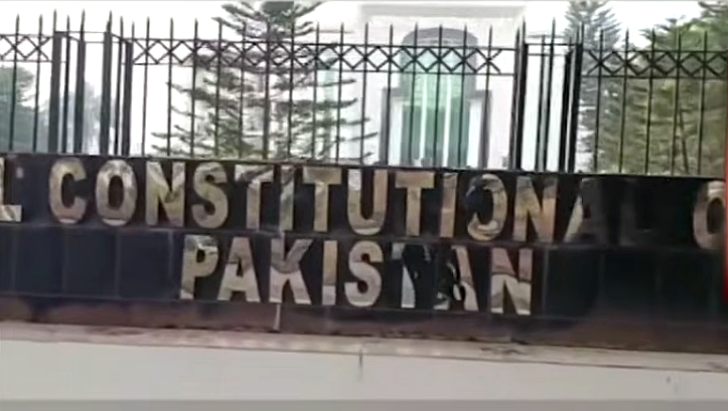
Pakistan’s Federal Constitutional Court (FCC) on Tuesday (Sept. 8) ruled that the constitutional guarantee of religious freedom is subject to law, public policy and morality.
In a ruling with consequences for Christians and other religious minorities, the FCC upheld a provincial government’s ban on a 23-volume publication of the minority Ahmadiyya community.
A division bench headed by Justice Aamer Farooq and comprising Justice Syed Arshad Hussain Shah dismissed petitions by the Ahmadiyya community challenging the Punjab provincial government’s ban, rejecting the petitioners’ claim that it violated their right to religious freedom under Article 20 of the Constitution.
The 14-page judgment, authored by Farooq, concerned the Ahmadiyya community’s “Rohani Khazayeen,” Volumes 1 to 23, which were banned and ordered forfeited under a June 25, 2014, notification issued by the Punjab Home Department under Section 99-A of the Criminal Procedure Code (CrPC).
The Ahmadiyya petitioners had challenged Lahore High Court and Multan bench decisions dismissing their cases on grounds that included considerable delay and failure to use available legal remedies within the prescribed limitation period. They argued that the executive action banning the publications infringed their constitutional right to religious freedom.
The FCC ruled, however, that determining whether Article 20 had been violated required careful examination of the validity, strength and reasoning underlying the bans and forfeiture under the CrPC and relevant ordinance.
The court said it could not proceed on assumptions because the petitioners had failed to bring the actual material before the court through the appropriate legal remedies. It also criticized the petitioners’ counsel for making broad arguments about fundamental rights and religious freedom instead of showing the court the content of the publications and explaining their alleged impact.
The judgment described the claim that the executive had violated the petitioners’ religious freedom as “an afterthought,” saying the argument amounted to a general discourse on fundamental rights and Article 20.
The FCC further rejected the characterization of the ban as an exercise of unfettered executive power. It said the proper approach was to identify the precise legal source of the authority behind the challenged action and then assess its conformity with fundamental rights.
The court distinguished between actions taken through “bare executive discretion” and those undertaken pursuant to statutory authorization, holding that the action in this case fell within the latter category. It said the authority for the forfeiture was traceable to statutory provisions in the CrPC and the Press, Newspapers, News Agencies and Books Registration Ordinance, 2002.
The court also linked religious freedom to Article 4 of the Constitution, which guarantees that every individual be dealt with in accordance with law and receive equal protection of the law. Article 4, the judgment said, provides a foundational guarantee underpinning the broader constitutional scheme of fundamental rights, including freedom of religion.
The FCC noted that the petitioners had not challenged the government’s notifications under Section 99-B of the CrPC and Section 20 of the ordinance within the prescribed limitation period. Instead, they filed petitions under Article 199 of the Constitution after considerable delay. The court found no plausible justification for the delay, noting that the petitioners had failed to provide any cogent explanation for not approaching the high court earlier.
The record also showed that an Ulema (scholars) board had examined the publications and concluded that their contents could cause hatred among Muslims, recommending their forfeiture.
The court ruled that, given the procedural failures and absence of the relevant material, it was unable to determine the constitutional question in the manner sought by the petitioners.
“We can safely conclude that there was no violation of fundamental rights of the petitioners in the facts and circumstances,” the judgment stated.
The FCC then dismissed the petitions, refused leave to appeal and disposed of all pending applications.
The ruling comes a day after six U.N. special rapporteurs expressed concern over continuing reports of discrimination, violence, and legal restrictions targeting members of the Ahmadiyya community in Pakistan.
“We are deeply concerned by persistent reports that members of the Ahmadiyya community continue to face harassment, criminal prosecution, violence, and exclusion because of their religious identity,” the experts stated in a Sept. 7 press release. “Every individual has the right to freedom of thought, conscience, religion or belief. No one should be subjected to discrimination, intimidation, or violence, nor should they be prevented from peacefully manifesting their faith, or face discrimination with respect to any of their human rights.”
The experts noted with concern reports of ongoing attacks on Ahmadiyya places of worship; desecration of graves; interference with peaceful religious observance, including in the context of the Islamic celebrations of Eid-ul-Fitr and Eid-ul-Adha; arrests and prosecutions related to religious practices or identity; and hate speech. These reports underscore the need for effective measures to prevent violence, ensure accountability, and protect vulnerable communities, they stated.
“The State has a responsibility to exercise due diligence to prevent human rights violations, investigate allegations promptly and impartially, prosecute those responsible in accordance with international standards, and provide effective remedies to victims,” the experts said.
Pakistan must break the pattern of impunity that has allowed perpetrators of attacks and incitement to hatred and violence to act without restraint, they stated.
“These attacks take place with tacit official complicity whilst the cycle of fear prevents people and institutions from upholding the rights and dignity of these minority groups,” they said, calling on the Pakistani government to ensure that all individuals, regardless of their religion or belief, enjoy equal protection under the law without discrimination.
The experts also urged the government to review legislation and administrative measures that may be inconsistent with its obligations under international human rights law, including the rights to freedom of religion or belief, freedom of expression, freedom of association and assembly, cultural rights, and equality before the law.
“Combating religious intolerance requires more than responding to individual incidents,” they said. “It requires sustained efforts to foster respect for diversity, counter incitement to hatred and violence, and create an environment in which all religious or belief communities can live in safety and dignity.”