The Foreign Affairs Committee of the Congress of Deputies (Spain’s national parliament in Madrid) has approved an initiative presented by the conservative Popular Party that seeks to strengthen Spain’s response to religious persecution. The proposal focuses on protecting Christian communities and promoting more forceful international action against massacres motivated by faith.
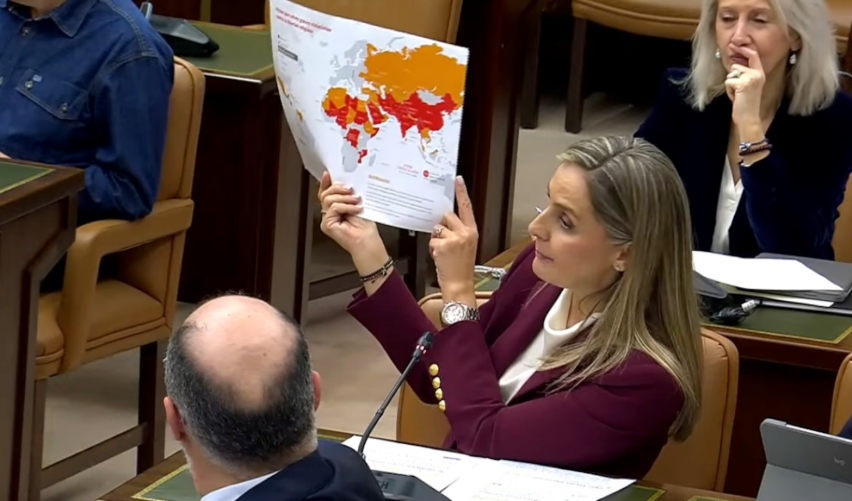
During the presentation of the initiative, Member of Parliament Maribel Sánchez stressed that religious freedom “is not a confessional privilege”, but a fundamental human right and an “indicator of democratic quality”. She underlined that this right is enshrined in Article 18 of the Universal Declaration of Human Rights, although the global reality is far from meeting this standard.
Maribel Sánchez’s presentation of the motion for the defence of persecuted Christians, followed by a debate with contributions from political groups.
Figures from a global crisis
To contextualise the urgency of the proposal, Sánchez drew on the most recent data from leading organisations in the field. She cited the World Watch List 2026 compiled by Open Doors, which indicates that 388 million Christians live in countries where they suffer high, very high or extreme levels of persecution and discrimination.
“These are not isolated incidents”, said Sánchez, but rather a structural pattern where “the rise of authoritarian governments and wars are destroying the right to religious freedom”.
In the ensuing debate, the Social Democratic PSOE spokesperson María Dolores Corujo, representing the party of Prime Minister Pedro Sánchez, was the harshest critic of the initiative presented by the opposition party. Corujo delivered an aggressive speech denouncing the PP’s “populist Islamophobia” and accusing them of “persecuting Muslims” in their local governments in Spanish municipalities.
Agustín Santos Maraver, from the leftist Sumar group, also announced his vote against the bill, although his criticism of the project was measured and he acknowledged that it is important to fight against all forms of persecution and discrimination. MP Santos defended Spain’s role at the international level through projects such as the Alliance of Civilisations as conducive to understanding and cooperation, as well as the protection of minorities.
The spokesperson for Catalan leftist group Esquerra Republicana announced his vote in favour of the measure. Jordi Salvador said that he agreed with the protection of any minority and that he thought it was appropriate to work in Congress for the respect of all. “There are no second-class beliefs, feelings or languages”, he said.
Hard right Vox concluded the round of speeches by adding its support to the proposal. Alberto Asarta delved into the situation of persecution “suffered by Christians in so many places as vulnerable minorities, with kidnappings, sexual violence, crimes and jihadist violence”.
Daily pressure for Christians
The approved initiative not only pointed to physical violence against Christians, but also to the systematic discrimination that limits the daily lives of millions of believers in dozens of countries.
In this regard, it is worth recalling the analysis that Ted Blake, director of Open Doors in Spain, shared in an interview with Spanish news website Protestant Digital recently. Blake explained that persecution is often silent and structural: “It's not that everyone is being persecuted all the time, but they live in a context where they are vulnerable and their rights are limited in their daily lives”.
This daily pressure translates into difficulties in accessing employment, education or justice, turning Christians into second-class citizens in dozens of nations.
Diplomatic action and forced migration
The approved text calls on Spain to strengthen its diplomatic action and lead condemnations within the European Union, the Council of Europe and the UN.
In addition, the proposal links respect for human rights to international agreements, pointing out that the defence of religious freedom is also a tool for preventing forced migration.
Although the vote showed the division within Parliament (the proposal was passed by a single vote and with 18 abstentions), the result puts institutional responsibility back on the Spanish political agenda in the face of a reality that, according to the 2025 Religious Freedom Report by Aid to the Church in Need, affects more than 5.4 billion people living in countries with serious violations of this right.
Originally published by Evangelical Focus