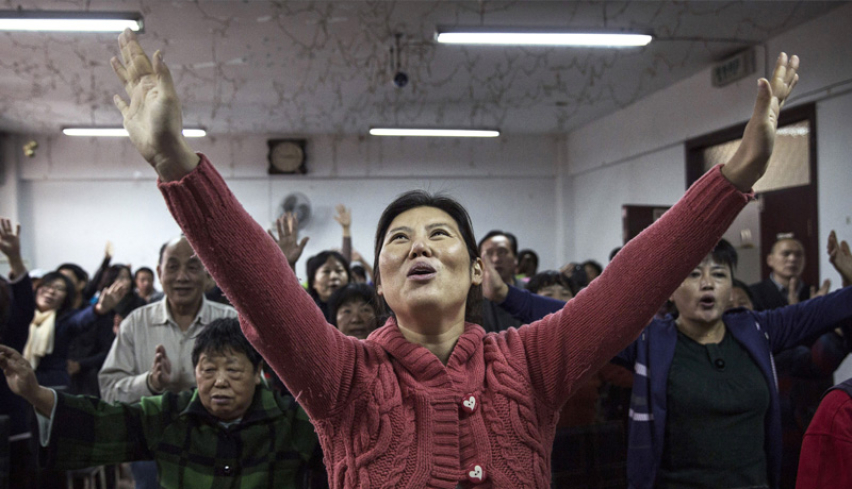
In September, Human Rights Watch documented an extraordinary development in China's campaign against religious freedom. Authorities in more than a dozen Chinese cities were encouraging citizens to report unauthorized religious activities, sometimes offering financial rewards. Hosting a prayer meeting, distributing religious literature, or organizing religious education could invite official investigation.
Why does one of the world's most powerful states regard independent Christian worship as a potential threat?
These measures raise a fundamental question: why does one of the world's most powerful states regard independent Christian worship as a potential threat to its political stability? The answer lies not primarily in what Christians do, but in what Christianity represents.
Five years ago, I argued in Foreign Policy that Christianity posed one of the most significant ideological challenges to Communist Party rule. Not because Chinese Christians necessarily opposed their government, but because their faith offered an independent source of moral authority that the Party could neither manufacture nor fully control. Recent developments have reinforced that assessment.
The problem of competing authority
Every political system requires legitimacy.
Every political system requires legitimacy. Democratic governments derive authority from constitutional institutions, electoral consent and the rule of law. Authoritarian systems depend more heavily on controlling the institutions through which political legitimacy might be challenged.
The Chinese Communist Party is particularly sensitive to this distinction because its authority extends beyond government administration. It seeks to define national identity, historical interpretation, public morality and the boundaries of acceptable social organization.
Christianity introduces a different conception of authority.
Christianity introduces a different conception of authority. Its moral obligations are not created by governments. Its institutions belong to a religious tradition extending across national boundaries and political systems. Its teachings establish principles against which human conduct, including that of the most powerful rulers, can be judged.
This does not make Christianity inherently revolutionary. Christian traditions have frequently emphasized obedience to legitimate civil authority and political stability. But political authority is not absolute. For a government determined to supervise every significant institution in society, that qualification matters enormously.
Why Beijing seeks control rather than elimination
Church... recognition comes with political conditions.
China does not formally prohibit Christianity. It recognizes Protestantism and Catholicism among five officially permitted religions. Churches can operate through government supervised religious organizations, but recognition comes with political conditions.
Under Xi Jinping's policy of sinicization, religious institutions must increasingly align themselves with Communist Party ideology and political priorities. The United States Commission on International Religious Freedom documented in May 2026 how successive regulations have expanded political supervision over religious leadership, education, organizational structures and digital communications.
The distinction between permitted and prohibited Christianity is therefore fundamentally institutional. A congregation accepting state supervision may operate. One insisting upon organizational independence risks being treated as a security problem, even when its activities are peaceful.
The crackdown on Zion Church illustrates this conflict. Established in Beijing in 2007, the church developed an extensive network of congregations and online worshipers. Its refusal to accept intrusive supervision brought it into conflict with authorities. In October 2025, police detained nearly 30 pastors, preachers and members across several cities.
Churches bring together individuals from different backgrounds, mobilize charitable activity, educate successive generations and preserve shared moral identities without government direction.
The political significance of such organizations lies in their ability to sustain networks of trust outside the Communist Party's hierarchy. Churches bring together individuals from different backgrounds, mobilize charitable activity, educate successive generations and preserve shared moral identities without government direction. These are ordinary features of religious life, but they are also foundations of independent civil society.
The lessons of Communism's collapse
China's sensitivity to independent religious institutions has a historical explanation. The Communist Party has extensively studied the collapse of communist governments in Eastern Europe and the Soviet Union.
In Poland, the Catholic Church preserved institutional independence and moral authority during decades of communist rule. Its networks helped sustain social solidarity and provided space for opposition movements, including the one called Solidarity, to develop.
Institutions capable of operating independently of the state can become politically consequential.
The lesson is not that Christianity inevitably produces democracy. Churches have accommodated authoritarian governments throughout history. Rather, institutions capable of operating independently of the state can become politically consequential when government legitimacy deteriorates.
Beijing appears to have drawn a restrictive conclusion: potentially independent institutions must be subordinated before they acquire the capacity to challenge political authority. This explains why the government regulates not merely religious political activism, but the organizational foundations of religious life itself.
The moral vacuum political control cannot fill
Since Deng Xiaoping's economic reforms, China has undergone an extraordinary transformation. Market incentives, private wealth and intense economic competition have reshaped a society governed by a party still formally committed to Marxism. This tension between official ideology and economic reality raises questions about the sources of social morality.
Christianity... a moral framework independent of economic success or political status.
Christianity offers one possible response. Its emphasis on charity, personal responsibility, human dignity and obligations towards others provides a moral framework independent of economic success or political status.
China possesses rich indigenous ethical traditions, including Confucianism, Buddhism, and Taoism. Christianity is not unique in offering moral guidance. What distinguishes it politically is its combination of universal moral claims, organized congregational life and institutions extending beyond the modern Chinese state.
A government can regulate church buildings, appoint approved religious leaders and monitor worshipers. It cannot necessarily command the convictions that give religious communities their meaning.
The paradox of persecution
Beijing's approach may undermine the stability it seeks to preserve. Many Chinese Christians have no desire to confront the Communist Party. Religious faith and national patriotism are entirely compatible. Yet when the government treats independent worship as political disloyalty, it manufactures an unnecessary conflict between religious identity and citizenship.
Repression does not inevitably generate opposition.
Repression does not inevitably generate opposition. China's surveillance capabilities and coercive institutions make collective political action extremely difficult. But persecution can weaken institutional trust, encourage religious communities to operate beyond official structures, and alienate otherwise politically disengaged citizens. The state risks creating the very antagonism it claims to prevent.
This reflects a broader limitation of authoritarian governance. Political power can compel outward conformity. It is considerably less capable of manufacturing genuine moral allegiance.
The conflict concerns two understandings of political authority.
Ultimately, the conflict is not between Christianity and China. Christianity has existed in China for centuries and forms part of the country's religious landscape. The conflict concerns two understandings of political authority. One recognizes that legitimate government operates within moral and institutional boundaries. The other seeks to make political power the final arbiter of organized social life.
The Communist Party can determine where Christians worship, which religious leaders are recognized and what religious material circulates publicly. What it cannot so easily determine is where believers locate their ultimate moral obligations.
Dr Azeem Ibrahim is the Chief Strategy Officer at the New Lines Institute for Strategy and Policy and a columnist at Foreign Policy magazine. He has written extensively on the persecution of religious minorities, including essays for Foreign Policy on the targeting of Christian communities in Myanmar and China. See Azeem's website for more information: https://www.azeemibrahim.com/.