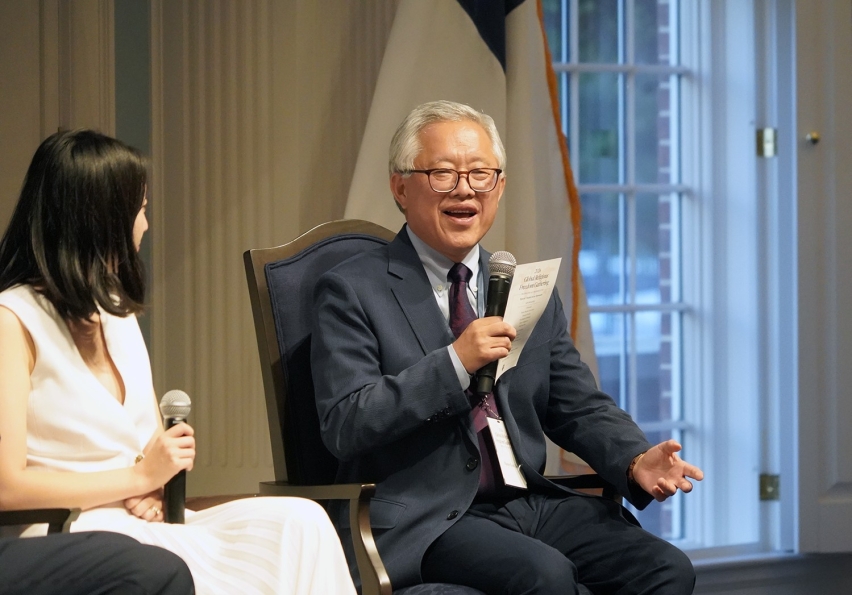
A Chinese pastor freed from prison three months ago joined advocates at a religious freedom conference in Dallas, Texas, on Monday (Sept. 28) in urging Christians to pray and speak out for those jailed for their faith. Speakers credited such pressure with helping win the pastor’s release.
Ezra Jin, founder of Zion Church, told the audience that more than 150 pastors and church leaders remain behind bars in China. He said he intends to speak for them daily so they are not forgotten.
Pastor Jin gave the keynote interview at the third annual Global Religious Freedom Gathering, hosted by the K. Randel Everett Center for Global Religious Freedom at Dallas Baptist University on Sept. 28-29. He answered questions from the center’s founder, Randel Everett, while his daughter, Grace Jin Drexel, director of advocacy at Luke Alliance, interpreted.
Pastor Jin, also known as Jin Mingri, was arrested in October 2025 at his home in Beihai, in the southern Guangxi region, during a crackdown on independent Christian worship that also targeted dozens of pastors and church members. He was released in July after direct intervention by the White House.
“Four months ago, and even shorter than that, I was still inside the Chinese prison,” Pastor Jin said, crediting his release to the prayers and advocacy of those in the room.
Years of pressure on a growing church
Pastor Jin said he started Zion Church in Beijing in 2007 with about 20 people. One visitor at the time predicted it would not survive because it defied the Chinese Communist Party’s limits, he recalled. By 2018, the congregation had grown to 1,500.
Throughout that period, he said, authorities used a range of tactics against the church. Officials most often pressured landlords to break leases. At other times, electricity and water were cut off, or police interrupted services and ordered worshippers to register.
The breaking point came in 2018, he said, when the government demanded that the church install 24 facial recognition cameras inside its sanctuary. After the church refused, Jin said, authorities sent about 1,000 people to close the site, and members could not remove even a single chair.
Charges tied to online worship and tithes
Pastor Jin said he was first charged with illegal use of information networks. During the pandemic years, the church held Sunday services on Zoom with thousands of accounts connected, and its daily morning devotionals drew 13,000 to 15,000 people, he said.
He said he studied the law while in custody and found the offense covered attacks on network infrastructure, such as hacking, or using the internet to teach people to commit crimes.
“But I’m using the internet to tell people to confess their sins and sin no more,” he said he told prosecutors.
Prosecutors shifted to fraud and illegal business operations charges based on the church’s tithes, which supported its leadership, Pastor Jin said. Under Chinese law, he said, offerings of 500,000 yuan to the church can result in a 10-year prison sentence. With donations the church received annually over seven years, he said he expected he might never leave prison.
Asked whether he feared speaking publicly at the event, the pastor replied, “I wasn’t afraid even when I was inside the prison. I’m in America now, what am I afraid of?”
‘A battle between souls’
Everett asked why the Chinese Communist Party (CCP) appears to fear people of faith, noting the treatment of Uyghur Muslims, Tibetan Buddhists and others. Pastor Jin said the root cause is that China is governed by a totalitarian system that persecutes whatever lies outside its control.
He distinguished this from China’s long history of autocratic rule. Emperors held great power, he said, but they did not control what people thought, whom they married or how many children they had. Citing political philosopher Hannah Arendt, he described totalitarianism as a 20th-century creation and said the CCP persecutes Christians in particular because the party’s ideology developed in opposition to Christianity.
Many people have underestimated the party for too long, Pastor Jin said. He argued that the conflict is “not just a battle between two nations” but “a battle between souls,” and ultimately about the gospel.
Pastor Jin also traced Western engagement with China from the end of the Cold War, when he said many believed the contest of ideologies was over and the priority became economic growth. He said Washington separated human rights from trade policy toward China in the 1990s, and that Chinese leader Xi Jinping has framed current tensions with the United States as a rivalry between great powers, including during President Donald Trump’s visit to Beijing in May.
Pastor Jin, however, rejects that framing.
“China’s rise without human rights is a disaster for China,” he said, adding that it is also “a disaster for the world.” He said this has been his central message in the three months since his release.
His generation of urban church leaders had hoped the imprisonment of pastors belonged to China’s past, but it has returned, he said.
“If you are a Christian leader, unless you are ready to be put into prison, you cannot start a church,” he said.
Challenge to churches abroad
Asked what he would say to churches in the West, Pastor Jin said Christians in the United States should speak out for persecuted believers because the church is one body.
God will care for the families of prisoners even if no one acts, he said.
“But if we do not do anything when we could have done something, then one day we must also realize we will also face God face to face,” Pastor Jin said.
Everett told the audience that Trump had raised Pastor Jin’s case with Xi when the two leaders met in China, and that many people in the room had signed petitions calling for his release. Everett said eight of Pastor Jin’s staff members remain in prison. He then led attendees in prayer at their tables for the pastor, his family and those still detained, reading from Hebrews 13:3, which calls Christians to remember prisoners as if imprisoned with them.
Persecution shared across faiths
Knox Thames, the center’s executive director and a former U.S. State Department special adviser on religious minorities, followed the interview with an overview of global restrictions on belief. Citing an annual survey of limits on religious freedom, he said three out of every four people worldwide live in countries that restrict the free practice of faith.
Drawing on 25 years in the field, 20 of them in U.S. diplomatic roles, Thames said Christians who face persecution are almost always suffering alongside people of other beliefs. He pointed to China’s Uyghur Muslims, a group of about 10 million to 11 million people. Both the Biden and Trump administrations determined that the Chinese government was committing genocide against them, he said.
He also cited arrests, home demolitions and executions of members of the Baha’i faith in Iran. In Pakistan, where Thames described the blasphemy laws as the harshest in the world, the center launched a prayer and advocacy campaign for two men, a Christian and a Muslim, who were both falsely accused of blasphemy.
Thames said the center organized a letter this summer, signed by 300 people from 13 states within a week, urging Trump to raise the cases of Pastor Jin and Ilham Tohti, a Uyghur professor serving a life sentence in China.
Pastor Jin’s case was raised, and he is now free, Thames said. Tohti remains in prison, now in his 12th year, and Thames told attendees the work is not finished.
Closing the evening, Thames rejected the idea that the spread of restrictions on faith is irreversible, calling that belief “a lie.” He said Christians working alongside people of other beliefs could see prisoners freed and oppressive laws changed.
He urged attendees to stay informed, pray and take action. Drawing on the words of 18th-century Baptist missionary William Carey, whose memorial Thames said he recently saw at Westminster Abbey, he told them to “attempt great things for God.”