Three years ago, I was browsing the internet looking for something edifying to watch with my daughter. Little did I know that night would change my life. That’s because, that night, we found The Chosen.
It was available in Portuguese, our native language, but, as so many other things are, it had been translated into Brazilian Portuguese rather than the European Portuguese we spoke and dreamed in. We decided to try it out anyway.
This needs to be translated into your language.
We watched it for three consecutive nights, and loved it more every time. And each consecutive night, I heard a voice deep in my heart tell me: "This needs to be translated into your language. You are the one to do it."
So I chased the opportunity. After interviewing and being vetted, I joined a team of more than 200 top-tier translators all over the world who help to translate and consult with the group Come and See as it supports ongoing translation of The Chosen.
And today I know better than ever before just how difficult (and important!) the work of translating God’s story and word is.
The work of translation has helped me to better understand the Bible.
The fact is, the work of translation has helped me to better understand the Bible. I believe this is true for my fellow translators, as well.
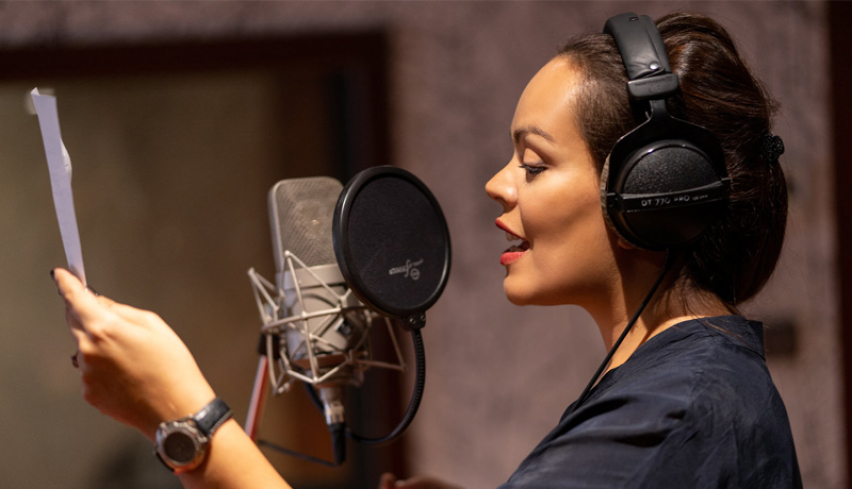
As humans, we easily get distracted by work that isn’t what God wants us to do. For 20 years I toured as a secular musician. I always thought music would be how he used me. But now, in translation, I feel true joy—as if I am serving him in an even deeper and truer way.
Translation is about preserving the word, protecting its truth, and serving others by making sure they can meet Jesus in their own language. God kept my heart through decades of discouragement and distraction for this work.
Translation is also about making Jesus intimate, accessible, immanent.
Translation is also about making Jesus intimate, accessible, immanent. It’s a joy, certainly, but it’s also hard work. There often aren't perfect answers to translation issues. There are only the judgments you make, word by word.
And so, with each new episode of The Chosen, I get into the script and I read my Bible alongside it. Every translator, myself included, is balancing fidelity to biblical truth and the creative vision of the Creator/Director, Dallas Jenkins and the writing team with joyful, faithful translation of the text.
I imagine Jesus speaking in Portuguese and I learn what He wants to say.
Often, as the starting point of translation, I imagine Jesus speaking in Portuguese and I learn what He wants to say. From there, the translation is further refined.
Of course, the Bible isn’t the only text we rely on. Every member of the team has to rely on historical and social context to help flesh out the translations. That learning, in turn, enriches our understanding of God’s word.
Imagine you’re speaking as Mary Magdalene, for instance. If you’re trying to speak as Mary Magdalene in European Portuguese, you need to use different forms of the word “you” to address the people around you. One is more formal, the other more intimate.
So how, then, would you address Christ in European Portuguese? How would Mary Magdalene address our Savior in my native tongue, if He were standing before her? Which “you” best reflects her relationship with Jesus, in that language, and in her original context?
In Romance languages (languages that developed from Roman Empire Latin), the use of “you” depends on whether we know the person, whether we want to show closeness or keep a distance, the social setting and strata, and whether they’re older or younger.
So, when it comes to Christ, I would naturally choose the more intimate form, “tu.” It’s not about a lack of reverence, but about nearness. In my language and cultural context, using “tu” also expresses love, trust, and a desire to be close to the one who knows and loves me best.
Through their native or heart language via translation lets God speak to them directly, and powerfully intimately
Bringing scripture and God's story close to others through their native or heart language via translation lets God speak to them directly, and powerfully intimately—in a way few other things can.
The impact of translation first touched me in my own home. Watching The Chosen in European Portuguese with my daughter, I saw how language makes God’s story accessible, immediate, and alive. However, during the Season 5 premiere in the theater, I felt it on a bigger scale.
I watched others around me reacting just as my own family had. They were drawn closer to Jesus because the story spoke their language with emotional relevance and high production quality.
And I thought: If this can happen here, what happens when it is multiplied across the world? Come and See is working toward translating The Chosen into 600 languages. That means that thousands of families, in living rooms and cinemas around the globe, can have that same encounter.
It was in that moment that the mission became real to me—not just my work, but God’s work unfolding through translation.
When we undertake translation at scale, we are first and foremost working to break down the remaining barriers between God’s word and the people he created and loves.
The Great Commission is a real and living commission for God’s people. It is not a marginal fact of our Christian life, or of Christian history. We are each called to bring God’s word to people who haven’t heard it yet.
There are 544 remaining languages with no Bible available at all.
And there are 544 remaining languages with no Bible available at all, representing 36.8 million people. That is 36.8 million people for whom the Bible doesn’t yet feel like home.
When we translate projects like The Chosen, we help break down the barriers between the story of Jesus and the hearts and minds of men, women, and children all around the world. We are working to help bring Jesus’ love, hope and joy as close to them as we possibly can.
Translation that arrives in another person’s language is more than translating words. It is an act of drawing near. To do it well, we have to ask questions, notice the nuances, respect the culture, and truly care about all the layers that shape how people speak and understand.
When we do this, we not only bring the person closer, but we bring Jesus closer, in a way that feels intimate, natural, and deeply comprehensible. Translation brings us closer: Closer to each other, and closer to Jesus.
Rita Damásio, born in Normandy, France, and living in Portugal, is a grace-led single mother, singer-songwriter, and Global Content Localization Project Manager at Come and See. Fascinated by how faith and culture intertwine, she uses her voice—spoken and sung—to build bridges of faith, creativity, and hope.