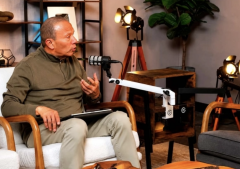
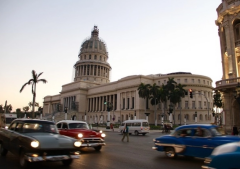
Cuban pastor in exile criticizes silence of Christian leaders amid repression of youth
In a context of growing social and political tension on the island of Cuba, the voice of the evangelical church finds itself at a moral crossroads.

Javier Bolaños is a journalist with 20 years of experience in radio, television and print media. He has extensive knowledge of the Latin American reality, having traveled to practically every country in the region. He has been the Regional Producer for Latin America of the Global News Alliance (GNA), a news cooperative that is currently a partner of Christian Daily International. He was General Producer of CBN News' Mundo Cristiano newscast for 10 years and until recently also served as director of Evangélico Digital, an online publication focused on Latin America connected to the Spanish Evangelical Alliance. He has been an international correspondent for various media covering presidential elections, natural disasters, and major sporting events such as the Olympics and World Cups.

In a context of growing social and political tension on the island of Cuba, the voice of the evangelical church finds itself at a moral crossroads.

Amid deepening economic hardship, social strain and rising migration, a major Baptist body in Cuba has issued a statement urging churches to remain spiritually grounded while continuing practical support for communities facing mounting challenges.

Evangelical leaders in Costa Rica are raising concerns that a proposed “dignified death” bill could expose vulnerable patients to increased risk, as lawmakers continue debating the measure in the country’s Legislative Assembly.

Northern Iraq, specifically the city of Erbil, has experienced constant military operations amid the current escalation in the region. A member of the leadership of an Ibero-American missionary movement serving in Iraq spoke with Diario Cristiano, the Spanish edition of Christian Daily International, about the situation on the ground. His name is being withheld for security reasons.

Mexico’s political landscape may be poised for a reconfiguration as sectors promoting biblical values seek a greater role in national politics as the National Electoral Institute (INE) received applications from four associations seeking to become national political parties. According to La Jornada, at least two of them have support bases closely aligned with evangelical and conservative communities.

In an unprecedented editorial effort for Latin America, Grupo Nelson has announced newly updated editions of two pillars of Christian literature: Mere Christianity and The Screwtape Letters, both by British author C.S. Lewis, widely known for The Chronicles of Narnia. To explore the impact of the relaunch, we spoke with Juan Tomás Widow, president of the Faith, Art and Myth Association, who collaborated on the project to introduce Lewis’s legacy to new generations in Latin America.

At a vibrant presentation of the Latino Media Summit during the international Christian media convention of National Religious Broadcasters 2026, author and mentor Sonia González Boysen called on Christian communicators to connect with the source of their message.

Northern Colombia is facing a humanitarian crisis of historic proportions after heavy rains devastated departments including Córdoba, Santander, Chocó, and Antioquia. According to press reports and the Evangelical Confederation of Colombia (CEDECOL), 80% of municipalities in Córdoba are underwater, leaving thousands of households with total property loss.

After her electoral victory Sunday, Feb. 1, with more than 48% of the vote, Costa Rica’s president-elect, Laura Fernández, held her first news conference, outlining how her administration will relate to the country’s religious sector.

Laura Fernández Delgado of the Pueblo Soberano Party (PPSO) won Costa Rica’s presidential election Sunday with a first-round victory, surpassing the threshold needed to avoid a runoff and becoming the country’s next president.

During the reopening of a hospital in Bogotá, Colombian President Gustavo Petro delivered a speech that sent shock waves through the country’s religious community. In his remarks, Petro said he does not refer to Jesus as “Christ,” arguing that the term is a Greek name used to transform the figure of the Redeemer into a symbol of “power and kingship,” something he said Jesus never represented.

A dense cloud of smoke covered the sky over southern Chile yesterday, as thousands of families in the towns of Lirquén and Penco faced the aftermath of recent wildfires. The fires have killed at least 20 people and burned more than 34,000 hectares, affecting communities across the region, including faith-based groups.