
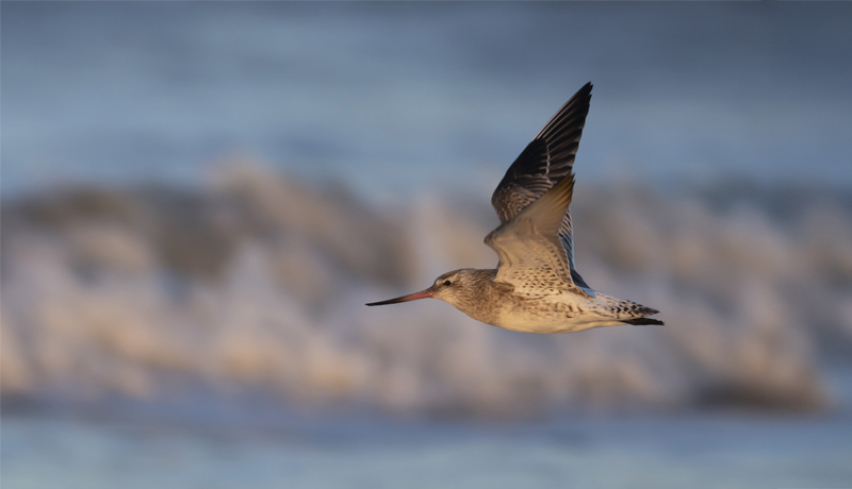
Through 2025, the team at A Rocha International have been looking at the natural world from micro to macro, from tiny organisms to global ecosystems. Migration is a theme that links both. Butterflies cross continents; songbirds weighing a few grams fly thousands of miles. Some of the statistics are extraordinary...
- Arctic Terns Sterna paradisaea regularly fly 90,000 km per year between the Arctic and Antarctic, which means in a lifetime they may fly the equivalent of to the moon and back three times!
- A satellite-tagged Bar-tailed Godwit Limosa lapponica entered the book of Guinness World Records after flying 11 days nonstop from Alaska to Tasmania, Australia, a distance of 13,560 kilometers. The juvenile bird is thought to have veered off course from regular breeding grounds in New Zealand, traveling a further 1,500 kilometers.
Another kind of migration has also been in the news. Humans have always migrated, locally and globally, driven by conflict, economic, and environmental factors. The biblical people of Israel remembered, "my father was a wandering Aramean" (Deuteronomy 26:5 ).
We live in an era of unprecedented human migration.
Yet today, we live in an era of unprecedented human migration. The number of international migrants within the Americas alone grew from 34.8 million in 1990 to 78.7 million by mid-2024.
Environmental changes, particularly human-induced climate change, have become "the great displacer". Predictions of climate refugees and migrants by 2050 vary hugely, with some suggesting over 1 billion. A median estimate, based on multiple studies, suggests over 170 million migrants within regions—not including intercontinental migrants.
Both human and nonhuman migrants are suffering.
I’ve been reflecting on how migrating birds and butterflies cross national borders with impunity whilst human migrants face political barriers. Yet, on a changing planet, with increasingly unstable ecosystems, both human and nonhuman migrants are suffering.
More than 30,000 people drowned trying to cross the Mediterranean between 2014 and 2024, with at least another 12,000 missing, presumed drowned. The western race of the Monarch butterfly has lost an estimated 99.9% of its population.
The latest estimate of the annual Wildebeest migration in the Serengeti-Mara is under 600,000, less than 50% of previous estimates. Migratory birds face huge challenges with increasing desertification, extreme weather and changes to phenology (the flowering dates of plants).
How should we respond to migration?
So, as Christians, how should we respond to migration? I want to suggest three simple ideas that perhaps relate to both human and wildlife migration.
Wonder
As a bird-ringer (bander), I have the privilege of holding tiny warblers that have navigated across oceans, mountain ranges and deserts to return to their breeding grounds. Even the most hardened atheist can have moments of awe at the miracle of migration.
Let’s reawaken that childlike sense of joyful wonder. Let’s also reflect on the dangerous, desperate journeys made by those whose crops have failed, whose land is flooded or dried out, and who seek a better life.
Worry
We should lament and mourn at what our human choices have done to God’s world.
The statistics on wildlife migration are deeply disturbing in a world of habitat destruction, chaotic weather and changing climate. Worry may not be the best word, but we should lament and mourn at what our human choices have done to God’s world.
Surely, we should also be deeply concerned at the suffering of vulnerable refugees and asylum seekers and the very real political challenges caused by mass migration? Words written thousands of years ago still speak to us: "The foreigner residing among you must be treated as your native-born. Love them as yourself" (Leviticus 19:34).
Welcome
The practical result of wonder and worry is welcome. We are called to create spaces and communities where migrants can thrive. Jesus said, "For I was hungry and you gave me something to eat, I was thirsty and you gave me something to drink, I was a stranger and you invited me in." (Matthew 25:35) I like to apply those words to both nonhuman and human migrants. Our little London church faced this very recently when our newest member, an Iranian refugee, was suddenly made homeless and needed very practical help.
We are called to create a welcoming home for all.
Whether it’s putting up nest boxes for Swifts, planting for pollinators, protecting overwintering sites in Mexico or Congo, or supporting A Rocha’s critically important projects and research, we are called to create a welcoming home for all.
Finally, the prophet Jeremiah wrote: "Even the stork in the sky knows her appointed seasons, and the dove, the swift and the thrush observe the time of their migration. But my people do not know the requirements of the Lord." (Jeremiah 8:7) For 2026 and beyond, this somewhat unfavorable comparison with migratory birds should challenge us to seek God’s heart for all migrants, whether insects, birds, or our fellow human mammals.
Originally published by A Rocha Blog. Republished with permission.
Dave Bookless is Head of Theology for A Rocha International, advising the worldwide A Rocha family theologically, and embedding creation care into global and international Christian organizations, theological institutions, and mission movements. In relation to this he serves as Lausanne Global Catalyst for Creation Care, co-leading the global Lausanne / World Evangelical Alliance Creation Care Network. He is also on global boards or advisory groups for Season of Creation, Renew Our World and the Oikos Network.
A Rocha is a global family of conservation organizations working together to live out God’s calling to care for creation ?and equip others to do likewise. A Rocha means ‘The Rock’ in Portuguese and the initiative is present in more than 20 countries around the world. They provide a missional response to the global crisis of biodiversity loss by carrying out community-based conservation projects, aiming to protect the environment through local, community-based conservation, scientific research, and environmental education.








