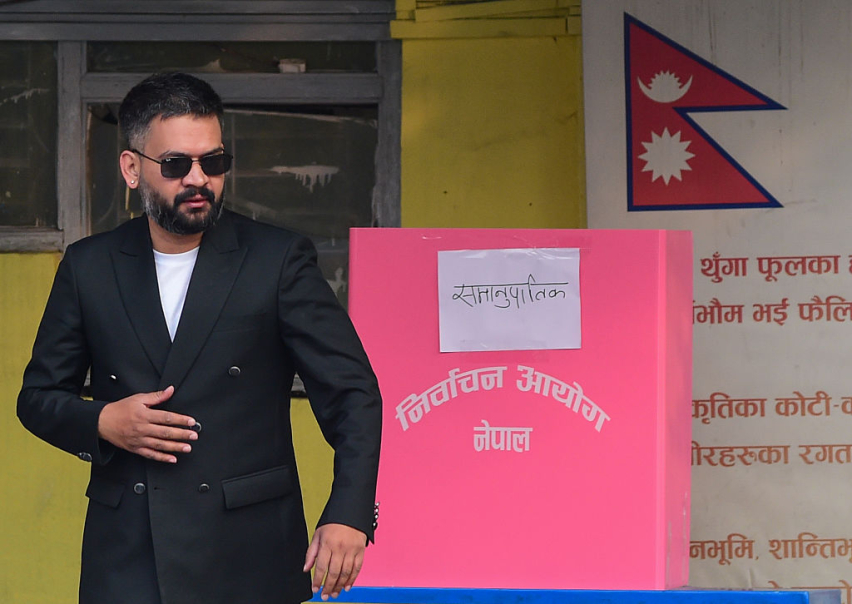
Nepal’s Christian leaders say they are cautiously hopeful after the Rastriya Swatantra Party’s landslide election victory, even as past actions by some party figures raise concerns about religious freedom and churches renew calls for equal rights, burial grounds and an end to false legal cases.
The RSP’s landslide on March 5 removed the community’s most explicit political adversary. The near collapse of the Hindu nationalist Rastriya Prajatantra Party, reduced from 14 seats to just one, ended the most direct parliamentary threat to Nepal’s secular constitution. But the records of the two men now set to lead the country have given church leaders reasons to pray carefully before celebrating.
Read Christian Daily International's earlier in-depth report on the election in Nepal.
“We can be hopeful, but not certain”
Manoj Pradhananga, director of the leadership training department of the National Christian Fellowship of Nepal, told Christian Daily International that he was satisfied with the election outcome overall but urged patience on the question of religious freedom.
“We still have to ‘wait and see,’” Pradhananga said. “RSP has not spoken much about religious freedom. Constitutionally, Nepal is a secular country, so RSP has to provide religious freedom for Christians as well. Most of the candidates from RSP who won the election are young people who are in favor of religious freedom. There was a time when the present chairman of RSP spoke against Christians. So, we can be hopeful but not certain.”
Pradhananga was careful to frame the Christian community’s aspirations in broad civic terms. “More than religious rights, we want job opportunities, a corruption-free system and access to resources for the poor and vulnerable,” he said. “The government should equally treat Christians and must give the freedom to preach the gospel. The government must protect Christians and should not be influenced by Hindu fundamentalist groups.”
Past records raise concerns for church leaders
For many of Nepal’s church leaders, the unease centers on two men: RSP founder Rabi Lamichhane and prime ministerial candidate Balendra Shah, and actions each took while previously in public office.
Pastor Sher Bahadur AC, general secretary of the National Churches Fellowship of Nepal and pastor of Koinonia Imadol Church in Kathmandu, laid out both cases directly in a conversation with CDI.
“When Mr. Rabi Lamichhane served as Home Minister, he reportedly instructed Chief District Officers to stop Christian activities,” Pastor Sher Bahadur said. “Similarly, when Mr. Balendra Shah was the Mayor of Kathmandu, he reportedly announced that plastic Christmas trees should not be sold in the market.”
Speaking to CDI, Rev. Mukunda Sharma, senior pastor of Bethel Assembly Church in Bhaktapur and executive secretary of Nepal Christian Society, also pointed to Lamichhane’s Home Ministry directive. According to Sharma, Lamichhane circulated a written letter from the ministry instructing that no Christian training gatherings be permitted and that no foreign visitors be allowed into the country to support Christian leadership development.
Surendra Bajracharya, a Kathmandu-based writer and translator, told CDI that what RSP candidates said on the campaign trail was as troubling as what its leaders had done in office. “Prior to the election, I heard a couple of candidates from the now-winning party state publicly that they would do their best to curb what they perceive as rapid proselytization in Nepal,” he said. “Therefore, at this stage, it is difficult to say whether the new government will bring meaningful relief for religious minorities.” He added that the RSP manifesto contained nothing that specifically addressed relief for churches or religious minorities.
Pastor Sher Bahadur commented that “many leaders in [the RSP] are known to hold anti-Christian views and are uncomfortable with Christian activities in the country. Personally, I believe we may not experience as much freedom during their leadership as we have in the past.”
He identified one counterweight within the new parliament, however. “At present, we have many educated and young people in parliament. Many of them are not strongly opposed to Christianity or other minority religious groups,” he said. “I have also heard that a few pastors are actively involved in this political party. If that is true, they may help guide the leaders and challenge them if wrong decisions are made.”
A constitutional fault line
Prakash Karki, who campaigns for the formal registration of churches as religious trusts, pointed to an ambiguity in Nepal’s constitutional text itself. “The 2015 Constitution of Nepal defines secularism as both religious freedom and the protection of ancient traditions,” he said. “However, in practice, this dual definition often appears to favor Hindu and Buddhist traditions over minority faith groups.”
Karki called for a neutral legal framework protecting all religions equally and a review of anti-conversion laws to prevent their misuse. “In recent years, there have been several allegations of ‘forceful conversions’ against Christians, many of which could not be substantiated,” he told CDI.
He calls on the new government to facilitate church registration as religious trusts; allow churches to transfer properties held under individual names back to congregations, with at least a 50 percent fee exemption; dismiss false legal cases filed against Christians; allocate state budgets to Christian communities on the same basis as other faiths; and establish a national cemetery accessible to Christians.
The last point addresses one of the community’s most enduring grievances. Nepal has no national burial ground for non-Hindu communities, and Christians have repeatedly struggled to find adequate land to bury their dead.
A theologian’s perspective
Dr. B.P. Khanal, a theologian, educator and Christian political thinker, read the moment in broader terms. “Citizens appear to be expressing both frustration with past political practices and hope for a more transparent and responsible governance,” he told CDI. “From a Christian perspective, such a moment should remind us that political transitions often reveal the moral and spiritual longing of society.”
His message to Nepal’s churches is blunt. “This is not a time for fear or withdrawal but a time for deeper commitment to prayer, integrity and constructive participation in society,” he said. “The Church must continue to be a witness of Christ’s love through service, compassion and truth. Regardless of political changes, our calling remains the same: to seek the welfare of the nation, to stand for justice and peace.”
He pressed the case for Christians to be recognized as contributors to national life rather than a community to be managed.
“A truly democratic society must ensure that people of every faith can worship, serve and contribute to national life without fear or discrimination,” he said. “My prayer and expectation is that the government will adopt a posture of fairness and inclusivity, recognizing that religious communities, including Christians, play a constructive role in promoting peace, social service, moral formation and national unity.”
What the youth voted for
The Gen Z uprising that brought down the previous government is not lost on Nepal’s church leaders. Several see the youth of the new parliament as its own form of quiet reassurance.
Bajracharya and Karki, speaking jointly to CDI in what they described as a unified community voice, noted that Nepal’s population between 25 and 40 exceeds ten million. “Young voters have been increasingly vocal about their desire for leaders who can create jobs, curb corruption and modernize education and technological access,” they said. “Many young people are tired of seeing the same older political figures dominate leadership without a clear vision for generational transition.”
Pradhananga commented that the scale of youth participation in this election was unprecedented in Nepal’s political history and that the RSP had deliberately reflected Gen Z demands both in its manifesto and in the age of its candidates. The result, he said, clearly expressed the aspirations of the youth.
Pastor Sher Bahadur noted the diaspora’s quiet but significant role. Young Nepalis working abroad pushed their families at home to support the new party, he said. “The younger generation, both those living in Nepal and those working abroad, encouraged their parents and families to vote for this new party, hoping it would bring positive change in the days ahead.”
Praying for those in power
With government formation still ahead, church leaders are calling their congregations to focused, sustained prayer for the new leadership.
“We should pray that the leaders will not misuse their majority power,” Pastor Sher Bahadur said. “Although they hold a strong majority and many of them are educated, we need to pray that they will govern without partiality and serve all people fairly. We should also pray that God will give them wisdom and knowledge so that they can lead the country well.”
Dr. Khanal hopes the government will look beyond any single community’s interests. “Our prayer should be that leaders will govern with humility, seek the welfare of all citizens, protect fundamental freedoms and resist corruption and division,” he said. “We should also pray for unity among the people of the nation, that differences in politics, ethnicity or religion will not lead to hostility but instead inspire dialogue and cooperation for the common good.”
Pradhananga addressed the new government directly. “The new leadership should implement their manifesto,” he said. “They have a chance to bring a change with a majority government. We do not expect a dramatic change overnight, but at least some changes that the civilians can experience in the area of a fair system, employment and opportunities for the marginalized.”
Nepal’s Christians say they will watch the moment Shah is formally invited to present himself as prime minister with particular attention. For them, it will be an early test of whether the transformation the country voted for reaches as far as the freedoms they have long sought.
The National Churches Fellowship of Nepal and the Nepal Christian Society are among the country’s principal Christian bodies representing Evangelical and Protestant churches.
A previous report covered the election results and the broader political shifts in Nepal. Reporting for this article was contributed by church leaders and community voices in Kathmandu, Bhaktapur, and Pokhara.