The National Federation of Churches in India (NFCI) seems to have attracted controversy within days of being formally launched on 8th May 2026 at the Fourth National Ecumenical Bishops' Fellowship Meeting at St. John's National Academy of Health Sciences in Bengaluru.
Cardinal Anthony Poola was elected its inaugural chairman... of the National Federation of Churches in India.
To no one's surprise, Cardinal Anthony Poola, the first Dalit Cardinal in the College of Electors (of the Pope), Archbishop of Hyderabad and President of the Catholic Bishops' Conference of India (CBCI), was elected its inaugural chairman in what the CBCI public relations department called "a significant step towards Christian unity, a milestone in the ecumenical journey, and a new chapter in the fraternity and solidarity of the Churches in India."
The most recent of several historic attempts to forge unity among one of the most diverse collections of denominations...
Forty-five participants (archbishops, bishops, some self-styled archbishops, heads of a few independent evangelical and Pentecostal churches, and their delegates) gathered to formally birth the NFCI, the most recent of several historic attempts to forge unity among one of the most diverse collections of denominations, rites (East Syriac and West Syriac Christian traditions), dissent, and reform movements, and several who wanted to return to the simplicity and direct connection with God seen in the early churches.
Some of them are deeply mired in controversies, including charge sheets by the Enforcement Directorate, India's central government financial crimes agency, and investigations by state and national agencies.
The secretariat will be manned by CBCI National Secretary for Ecumenism and Interfaith Dialogue, Father Anthoniraj Thumma, who had earlier stitched together the Federation of Telugu Churches based in Hyderabad, covering Andhra and Telangana.
It is the first time a Catholic Bishop will share office with an evangelical "bishop" whose title the powerful Catholic group in India vigorously contests.
Archbishop Joseph D'Souza of the Good Shepherd Church, International President of the Dignity Freedom Network and President of the All India Christian Council, is one of the conveners of the new body, together with Palai Catholic Bishop Joseph Kallarangat, and Church of South India's Karnataka Bishop Vincent Vinod Kumar. It is the first time a Catholic Bishop will share office with an evangelical "bishop" whose title the powerful Catholic group in India vigorously contests.
The timing of the new united entity... was described... as urgent, even inevitable, in view of the attempts to seize church properties.
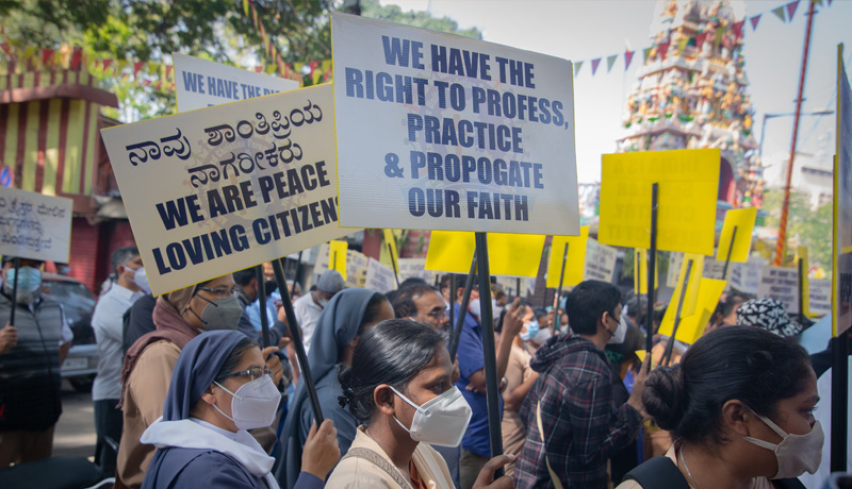
The timing of the new united entity, which still does not cover every church group in the country but only those with Foreign Contribution (Regulation) Act accounts, was described by its architects as urgent, even inevitable, in view of the attempts to seize church properties through amendments to the FCRA and the proposed Christian Welfare and Property Board, a government-controlled oversight body. There was also the matter of churches facing violence, attacks on pastors and the faithful, and stringent anti-conversion laws in twelve states.
In reality, the solitary panic button was the Foreign Contribution (Regulation) Act regulation being used in its most ruthless form, allowing the government to confiscate properties and other assets bought or built with money received from foreign donors if the government cancelled registration, did not renew it for another five-year term, or if the church or NGO ceased to function.
The proposal to appoint a centrally governed "Designated Authority" to oversee these assets follows the same template the government used for Muslims through the Waqf Board amendments of 2025. The Waqf Board amendment gave the government sweeping powers to oversee, audit, and effectively control Muslim charitable endowments and properties—a move that faced fierce and united resistance from Muslim communities and opposition parties across India.
A profound failure of minority solidarity.
Yet the Catholic Church in Kerala, in what can only be described as a profound failure of minority solidarity, enthusiastically supported those very amendments. That support may yet prove costly.
The same principle of state oversight that the Catholic Church in Kerala cheered when it was aimed at Muslims is now being turned on the Church itself, through the Foreign Contribution (Regulation) Act's proposed Designated Authority. As the saying goes, the cat, belatedly, is among the pigeons.
Vast properties have been built across the country by Christian groups since Prime Minister Indira Gandhi introduced the Foreign Contribution (Regulation) Act during India's constitutional Emergency of 1976 to monitor the flow of funds from German church and political groups to George Fernandes, a prominent opposition leader, and other opponents of the Nehru-Gandhi political family.
Some institutions built were exemplary.
Some institutions built were exemplary. Mother Teresa's ashrams and orphanages, schools, colleges and dispensaries for example. But about as many were homes and prayer halls constructed by what are commonly called "mom and pop" or "father-son" NGOs operating on church FCRA licences. FCRA licenses were also cancelled for several Catholic groups, including the apex charity Caritas and many diocesan trusts, as well as entities of the Churches of South India and North India.
Several family-managed groups in particular are now charged by the Enforcement Directorate (ED) for buying land in prime locations including Goa, Bangalore, Chennai, Coimbatore, Hyderabad, and cities in Kerala, Punjab, and Uttarakhand.
An ED probe alleges that they and other office bearers diverted approximately 297 billion rupees (around USD 31 million) in foreign and domestic donations.
The most prominent case, which has received massive national media coverage, involves an archbishop and his son. Based on evidence from a Telangana Crime Investigation Department (CID) chargesheet, an ED probe alleges that they and other office bearers diverted approximately 297 billion rupees (around USD 31 million) in foreign and domestic donations from donors in the US, Canada, and UK originally intended for the education and betterment of Dalit.
Specific allegations include manipulation of student sponsorship records, collection of full fees from supposedly sponsored students, misappropriation of Right to Education (RTE) reimbursements and scholarships, and diversion of funds via commercial invoices after Foreign Contribution (Regulation) Act licenses were not renewed.
One of the most disturbing charges is that ordinary school students were misrepresented as "joginis" (girls subjected to sexual exploitation in temples) on donor websites and social media to attract higher sponsorship amounts of 60 to 68 dollars per month instead of the regular 20 to 28 dollars.
No actual rehabilitation program for such girls existed. In December 2025, the ED provisionally attached 12 immovable properties valued at 3.58 billion rupees (USD 37.2 million), with an estimated market value of around 15 billion rupees (USD 156 million).
The case has dominated headlines in major national newspapers and channels in India for weeks, significantly overshadowing the launch of the new NFCI umbrella federation.
State CIDs have filed criminal cases against some senior non-Catholic "bishops" in the new umbrella.
State CIDs have filed criminal cases against some senior non-Catholic "bishops" in the new umbrella, accusing them of misleading foreign donors, siphoning funds, money laundering, and buying real estate in prime locations through what the government believes to be "proceeds of crime."
Similar probes and cases have surfaced against Evangelical pastors and church leaders in Karnataka, Tamil Nadu, Andhra Pradesh, and Kerala, with several facing allegations of Foreign Contribution (Regulation) Act violations and property-related irregularities.
High courts have refused to entertain appeals against ED action.
Many properties have been seized, and high courts have refused to entertain appeals against ED action. The Telangana High Court held ED actions to be "within criminal jurisdiction, and not amenable to intra-court appeal under Clause 15 of the Letters Patent," with interim restraints on alienating properties remaining in force.
Recently, the Hyderabad High Court rejected the appeal against the ED's attachment of properties. This decision, widely reported across the country, upholds the attachments and has added to the intense scrutiny on the new NFCI federation.
The exclusion by the NFCI of two major church groups in the country with historic roots remains unexplained.
The exclusion by the NFCI of two major church groups in the country with historic roots remains unexplained. The two groups are The National Council of Churches in India (NCCI) and the Evangelical Fellowship of India [EFI], which were in alliance in the Catholic Bishops’ Conference of India until recently in the National United Christian Forum [NUCF], an earlier and now dormant ecumenical alliance. Also not invited are massive Laity groups like the All India Catholic Union which was founded in 1919 and is the oldest and largest Catholic laity perhaps in all of south Asia.
The NCCI is the oldest ecumenical body in the country. Established in 1914 as the National Missionary Council, it constituted itself in 1923 as the National Christian Council of India, Burma, and Ceylon, and transformed in 1979 into the NCCI.
NCCI brings together thirty-two member churches, eighteen regional Christian councils, and eighteen all-India Christian organizations, headquartered in Nagpur, in central India, affiliated to the World Council of Churches and the Christian Conference of Asia. It cannot simply be waved aside in institutional arrogance as insufficiently inclusive.
The Evangelical Fellowship of India Religious Liberty Commission publishes annual reports with authoritative data on violence against pastors, churches, and communities across the country.
The Evangelical Fellowship of India, founded in 1951 in Yavatmal, Maharashtra, represents over 54 Protestant denominations and some sixty-five thousand churches, and is now celebrating its 75th year. Its Religious Liberty Commission publishes annual reports with authoritative data on violence against pastors, churches, and communities across the country.
The Catholic Bishops’ Conference of India itself is, ironically, the youngest of the three founding pillars of Indian ecumenism, constituted at the Metropolitans' Conference held in Madras in September 1944. Formidable and government-recognized, it has often waged peaceful war against evangelical groups "converting" Catholics (called "sheep-stealing") a major issue in Goa, Karnataka, Kerala, and Punjab. By canonical definition, it remains a body of one denomination, albeit the largest.
The Catholic Church has further complexity in the Syro-Malabar (East Syrian) and Syro-Malankara (West Syrian) Rites operating across all of India, and in the Conference of Catholic Bishops of India (CCBI), the Latin Rite body, which is the largest bishops' conference in Asia and the fourth-largest in the world.
The question of what in reality the NFCI federation is for cannot be separated from what it is reacting to—the Foreign Contribution (Regulation) Act amendment of 2026 as the proximate cause. Since the Modi government came to power in 2014, more than 20,000 Foreign Contribution (Regulation) Act registrations have been revoked or suspended, with more than 70% of lapsed religious-category licenses aligned with Christian programs.
A sword that could slice through a century of Christian social service.
The amendments are a sword that could slice through a century of Christian social service.
Cancelling registrations seems to be the NFCI's main focus, rather than the cause of Dalit Christians, persecution of pastors and churches, or violence against Christians. Yet, last year, more than 1,000 persecution cases were registered by Christian minority groups including the EFI and the UCF, with 125 more on Christmas Day 2025 alone—even as Mr Modi was seen praying at the Cathedral Church of the Redemption in New Delhi, the historic Protestant cathedral in the heart of India's capital.
Hundreds of pastors have spent months in jail.
Hundreds of pastors have spent months in jail in Uttar Pradesh on charges of forcible or fraudulent conversions; others have been killed in the tribal belt of Central India and Odisha.
The Catholic Church does not document violence against fellow Christians and responds only when its own institutions, priests, or nuns are impacted.
Cardinal Poola is a man of dignity and learning, and his election as CBCI president, representing the historic Hyderabad See, commands respect; especially in the large Dalit Christian community across denominations. Having assumed the CBCI presidency only on 7th February this year, he had not been privy to the consultations, or lack thereof, leading to the St. John's meeting of the new NFCI federation.
Together with the NCCI and EFI not being included, there is cause for deep concern, even as the new body's leaders argue that the existing bodies lacked full denominational representation or a specific platform for bishops and heads of churches.
India's Christians... 2.8 billion... 2.3% of India's 1.40 billion people.
India's Christians—all 2.8 billion of them, about 2.3% of India's 1.40 billion people—surely deserve a federation that is truly national, genuinely and fully ecumenical, and constitutionally impeccable in its internal conduct and integrity.
Dr John Dayal is a journalist and human rights activist based in New Delhi. He a member of the National Integration Council, Government of India and former Secretary General of the All India Christian Council. He has been outspoken in opposition to the spread of hatred between religious communities.