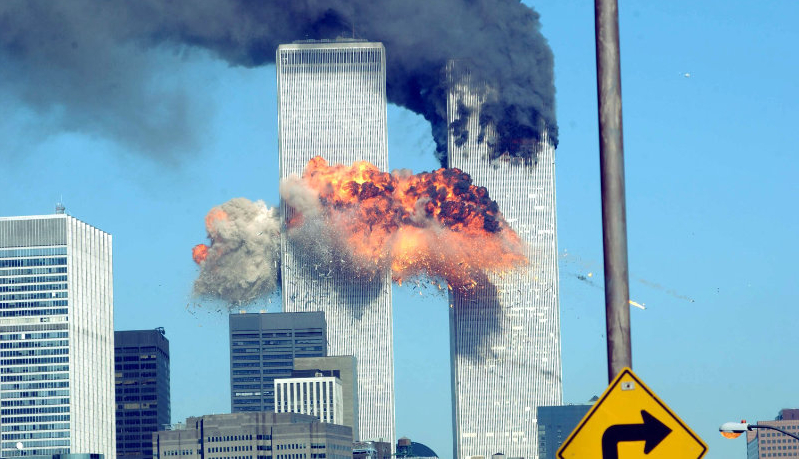
I was booking a trip to the USA at the time. “Oh,” said the travel agent, “I don’t think we are going to be able to complete this ticket!” Why not? I asked. “Turn on your TV,” he said, “There are tens of thousands of dead in New York.”
It turned out thankfully not to be tens of thousands, but we watched the deaths of three thousand it seemed like tens of thousands of times. I remember thinking, “Must they show—so often—the impact of the planes into the towers and the people tumbling to their deaths?” In one half hour of coverage alone, the planes hitting the towers were shown five times a minute.
When terrorists commit an outrage, they are wanting three things—revolution, renown, and reaction.
Irresponsible, I thought, and remembered Louise Richardson’s three “R’s”. When terrorists commit an outrage, they are wanting three things—revolution, renown (among their own), and reaction, or rather, overreaction. They usually get the last two. They never get the first one.
And so it proved. I did an interview that very day and predicted four things would happen as a result.
1. An over-reactive US response
The best solution was to force the Afghan Taliban to hand over Bin Laden.
The first, that the US would lash out and overreact. I was a bit sad about this because for a brief time the USA had the sympathy of the world. In a slight way I was involved in proposing that the best solution was to force the Afghan Taliban to hand over Bin Laden.
This would sow discord in the ranks of Islamic extremists and the disunity would weaken it. Alternatively, it would be a gross betrayal of the hospitality culture to hand him over when he was under protection as an honored guest; but, if the alternative was annihilation, they might do it.
I still believe this could have worked but it required the American administration to be very patient and let this play out. To their credit, they started out patient, seeing the value of the strategy, but after six weeks, they gave up and started carpet bombing.
The huge bunker bombs did not dislodge the leaders of Al Queda. But the Bush administration felt the pressure to mount a spectacular military response. To their credit though, they did put boots on the grounds in the country and made a huge difference for twenty years.
2. A hysterical Western reaction
A hysterical overreaction in Western culture.
The second, there would be a hysterical reaction in Western culture that would tag religious belief as the presenting problem for 21st century society. Two British commentators—one a scientist and the other a journalist (Richard Dawkins and Christopher Hitchins)—that would lead the charge. In the USA they were joined by Sam Harris and Daniel Dennett. All produced best sellers.
Dawkin’s The God Delusion, published in 2006, had the distinction of the being the only book that sold as many copies as Rick Warren’s The Purpose Driven Church in this period. Still, as Christian Smith wrote in his 2025 book, Why Religion Went Obsolete, “in less than ten years, the New Atheism movement ran out of steam… but, during its brief time in the spotlight, it inflicted real damage on American religion.”
It’s interesting how the arguments of these atheists now carry so little weight when they seemed to have religion on the ropes. Lemorna Ash, surveying the spiritual lives of young people in the 2020’s, talks of how unimpressed her generation is with their arguments; “Young people today see how lazy those guys were—they had no idea or no interest in lived religion, everything was an abstract dismissal, but it was clear they had no idea how religion helped people and was practiced.”
I braced myself for dealing with harsh and insulting atheists.
For a time though, every time I would speak in larger public settings, I braced myself for dealing with harsh and insulting atheists who basically accused all religious people of being potential terrorists, until (quite suddenly, after 2015 or so) they seemed to ebb away as a distinct audience.
3. Religion returns to world affairs
Geopolitical calculation after 9/11 had to take Islamic extremism into account as a major factor.
The third, that regarding religion as an independent factor in world affairs would muscle back onto the geopolitical stage. Kissinger used to claim that the 1648 treaty of Westphalia was the beginning of modern politics because it created a politics that drastically reduced religion’s role in the state. But it was probably the British Prime Minister at the time (Tony Blair) who realized that geopolitical calculation after 9/11 had to take Islamic extremism into account as a major factor and not merely understand it as a result of other factors.
After Blair left office, he dedicated his time to creating an Institution in 2008, The Tony Blair Faith Foundation, that sought scholastic input on advising governments on the importance of religion in ensuring national security. Sadly, this didn’t last long, though he replaced it with a much broader entity, The Tony Blair Institute for Global Change. Oddly though, Blair’s outfit rarely reached out to the experts in the area of religion.
4. The blindness of a religiously illiterate media
The fourth, that the media commentariat (the collective word for global analysts and opinion makers)—blithely unaware of its religious illiteracy—would parrot the official government line that Islam was a religion of peace, and that those who perpetrated violence in the name of Allah were betrayers of the religion.
Religions are not monolithic with simple catechisms that all agree on.
The problem with this is its startling unawareness that religions are not monolithic with simple catechisms that all agree on. People like me knew that religions were great promoters of peace, but that each religion also had its committed adherents who held that violence was compatible with obedience to God. Sorry, but it's true.
There are minority traditions in Christianity and Islam in which violence is justified. You can’t just say they are simply not Christians or Muslims. We might not like their reasoning, but there is an internal coherence. You might not agree with him, but Sayyid Qutb (whose radical writings helped shape modern Sunni Islamist militancy and jihadism) was a Muslim. And don’t forget the Protestant reformer Martin Luther justified the killing of Anabaptists.
Some of the greatest thinkers in comparative religion, like Anglican theologian and scholar John Bowker, had taught for years that violence was inherent even in the understandings of many of the faithful. No one among the media commentators bothered to get the nuance of where lived religion was at.
There were four things I did not foresee.
That was all predictable. But there were four things I did not foresee.
1. Media did not ask for help
First, I looked forward to the media’s commentariat asking for help. I was a specialist in religious conflict. That was the hot topic. Surely many would reach out for a briefing? Not a one. Suddenly they were all experts in religious conflict. It made me realize how poorly informed our opinion writers and op-ed journalists choose to be. They have their template—usually outrage based—and squeeze their thimbleful of knowledge into it.
2. The ignorance of the policy elite
Second, the policy elite never realized how unaware they were of the dynamics of the bottom tier of society. I remember a US General in Afghanistan saying to me, “I’ve just had a briefing at Georgetown University from Professor Esposito, who tells me that all Muslims are utterly peace-loving. But my troops enter villages in Afghanistan and encounter hordes of people wanting to kill them in the name of God. No one seems to be able to explain this picture.”
A lesson in how to misunderstand what was going on.
The twenty-year occupation of Afghanistan by US and allied forces had its undoubted successes, but it was also a lesson in how to misunderstand what was going on, especially in the rural and lower layers of society. Much good was done, but so much went grossly misunderstood.
3. The invasion of Iraq as a seminal moment
Third, the 2003 decision to oust Saddam Hussein in Iraq was a seminal moment. The case was made he had weapons of mass destruction (WMD's) that could reach London in forty-five minutes. That was the justification. I remember a million people in London marching against the war. Personally, I was not against the removal of Saddam. But the people rightly smelled a rat. We knew the justification of the hidden WMD’s was dodgy at best.
We resented the leaders of our countries pretending their intelligence was stellar.
We resented the leaders of our countries pretending their intelligence was stellar. We now know all the details, that it was based on weak intelligence by an Iraqi source named appropriately named “Curveball”.
I was on a plane the day after Colin Powell, then Secretary of State, presented the case to the UN Security Council and happened to be sitting beside a high-flying lawyer. He leaned over and said to me, “If any of my staff had made that standard of case in court, I would fire them the same day.”
A rupture occurred in the social contract as a result of this.
Before Powell died, he was to state his regret that he did not more aggressively push back on his script. I think (at least in the UK) that a rupture occurred in the social contract as a result of this. The Establishment pretend to know, and said, “trust us”. The people said back, “you don’t know anything” and subsequent events proved them right.
From that moment a vacuum of distrust appeared that has led to a steep rise in populism, and a disdain for elite and establishment attitudes, and a conviction that this class are no longer on the side of the people.
At least, that’s what I saw in the last 25 years from my vantage point. I may be wrong. And I certainly did not have an elite perspective. My view was from the bottom rung, usually where the church operated and the state could or would not go. It is a shame that there was not more awareness of this gap.
4. The rise of China
A more important event took place in the same year—China joined the World Trade Organization.
That said, I don’t think that 9/11 was the most important geopolitical event of the last 25 years. For me, a more important event took place in the same year—China joined the World Trade Organization. The architect of that has just died at the age of 92, Zhu Rongji.
China... had no intention of keeping to the rules.
Presidents Clinton and Bush made it possible, believing that if Communist China joined the globalized trade system it would gradually give up its repressive principles domestically. It’s now clear that Zhu and the President of China at the time, Jiang Zheming, had no intention of keeping to the rules they had signed up for.
From that moment on, the unipolar world of America as a sole great power came to an end. After 1990, the USA was supreme. The USSR was no longer an equal adversary. This unipolar moment did not last longer than a decade and a half.
The Chinese economy ballooned to become the world’s second largest and left the rest of the world behind. The USA still has the largest economy by GDP, roughly 32 trillion dollars, but China is at 22 trillion today, and the next largest economy (Germany) is way back at 5.4 trillion.
We now live in a world of two superpowers again.
We now live in a world of two superpowers again, and China, for all its international economic linkages, has entrenched the rule of the Communist party domestically, and with the rise of Xi Jinping created an alternate world order to the Western alliance.
9/11 woke us up to one perpetual war: the danger of religious and especially Islamic extremism. But 2001 also gave us another war, not as hot, but maybe more important: the USA vs China. This economic and political rivalry will continue to define our geopolitical reality.
The unstoppable rise of super intelligent AI, a potential entity to make empires obsolete.
And into this comes a third war perhaps—the unstoppable rise of super intelligent AI, a potential entity to make empires obsolete, and even render humans extinct. At least with a 9/11 event, you wake up to the stakes.
Sadly, we may need another terrifying wake up event to get real and deal with these defining threats.
Originally published by on the Five4Faith Substack. Republished with permission.
Dr Ronald MacMillan has forty years as a journalist, scholar and activist in helping the persecuted. He co-founded the world’s first news agency to focus on religious conflict, News Network International, and authored the definitive book on persecution in 2006, entitled Faith That Endures: The Essential Guide to the Persecuted Church. He is currently President of a Speech Tuition Company enabling leaders to change the world for the better through their words, and Chairman & Global Analyst of the world’s first Think Tank focusing on religious freedom, The International Institute for Religious Freedom. He is based in the UK.
The International Institute for Religious Freedom (IIRF) was founded in 2005 with the mission to promote religious freedom for all faiths from an academic perspective. The IIRF aspires to be an authoritative voice on religious freedom. They provide reliable and unbiased data on religious freedom—beyond anecdotal evidence—to strengthen academic research on the topic and to inform public policy at all levels. The IIRF's research results are disseminated through the International Journal for Religious Freedom and other publications. A particular emphasis of the IIRF is to encourage the study of religious freedom in tertiary institutions through its inclusion in educational curricula and by supporting postgraduate students with research projects.