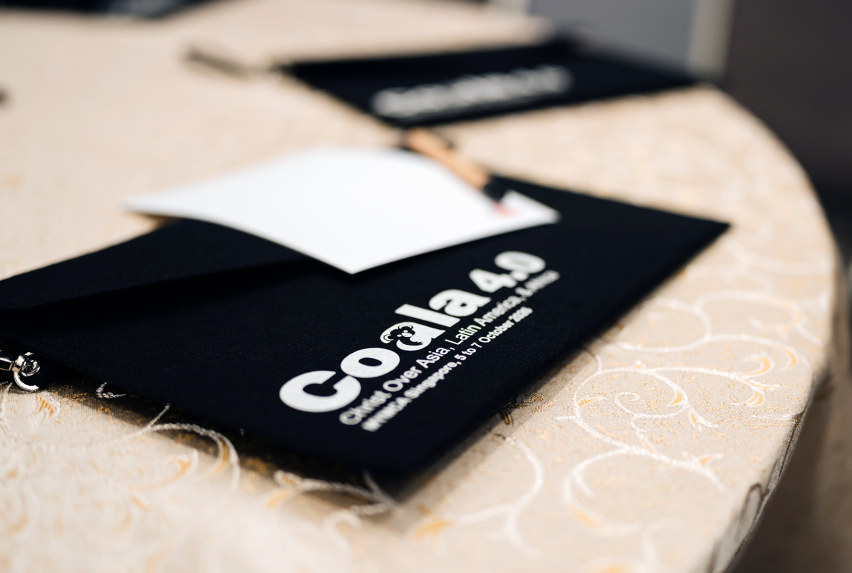
Mission leaders from Asia, Africa and Latin America have called on churches and mission movements in the Majority World to build locally sustained mission and reduce their reliance on foreign funding, approval and training models. The call came in a statement released after COALA 4.0, the network's fourth major gathering, held in Singapore.
The Singapore Statement, issued by COALA (Christ Over Asia, Latin America and Africa) following its Oct. 5-7 meeting, sets out definitions and principles for three areas: sustainability, missionary training and South-South collaboration.
The gathering also produced four memorandums of understanding between mission bodies, the launch of four focus groups and a decision to hold regional rather than global meetings in 2027.
According to a communique released with the statement, 76 participants from 25 Majority World countries attended, along with 24 local leaders from Singapore. The Singapore Centre for Global Missions (SCGM) hosted the event under the theme "Sustainability and Training of Majority World missions."
Statement addresses reliance on outside support
The statement's preamble says many Majority World mission leaders were trained in the West or still rely on regular Western financial and institutional support. While expressing gratitude for past contributions, it says this legacy, unless changed beyond "token acts and words," sustains "unequal influence and power" by Western organizations over churches and mission movements in the Majority World.
Its response is a call for what it terms polyphonic and polycentric mission, built on mutual resourcing and "horizontal accountability" among Majority World movements. The document also affirms partnerships between South and North, which it says call for mutual humility, reciprocity and careful attention.
On sustainability, the statement defines the goal as ministries that are locally led, resourced and multiplied, without critical dependency on foreign support. One of its seven principles calls on Majority World movements to move away from systemic reliance on regular foreign funding, structural approval and control, while remaining open to gifts from other regions. It lists local church support, bi-vocational work and business-based models among possible paths, and calls for younger leaders to be freed from "stifling scarcity mindsets" and traditional power structures.
The training section places missional obedience, spiritual formation and discernment above academic achievement. It encourages training programs to move away from seeking Western validation in certification and branding, while also building credible platforms marked by "excellence, integrity and faithfulness to the Scriptures."
On South-South collaboration, the document cautions Majority World networks against reproducing patron-client patterns in their own relationships. It says participants hope to see joint field projects grow out of COALA relationships.
Four agreements signed on final day
Four memorandums of understanding were signed on Oct. 7, the last day of the gathering. SCGM signed agreements with ALUSIA, the Indonesian Alliance for World Mission, and with another mission organization. The Korea World Missions Association (KWMA) also signed with ALUSIA.
A fourth, multilateral agreement brought together SCGM, KWMA, ALUSIA, the Movement for African National Initiatives (MANI) and another mission organization. Paul Noh, COALA's international secretary, told participants that practical projects under the agreements would begin. He said KWMA had offered to introduce missionaries coming to South Korea to local churches and organizations, and that SCGM planned to hold annual meetings with regional mission leaders in Southeast Asia.
The agreements follow the first COALA-linked memorandum, signed in 2025 between the Latin American mission movement COMIBAM and an Asian mission group, which Christian Daily International reported after the Panama gathering.
In comments following the Singapore meeting, Jonas Kang, COALA's chairman and general secretary of KWMA, described the approach behind such agreements as "local-led partnership mission." Under the model, a member organization in the receiving country hosts missionaries sent by another member, helping with ministry placement and care. Kang said the missionary's task is to work with the local church rather than for a personal ministry or the sending church.
He said the model also answers a financial problem facing churches in the Global South, which often cannot fund schools, hospitals or development projects abroad. Mission needs money, Kang said, but money "is not the center of world mission."
Regional gatherings and focus groups
Noh announced that COALA will not hold a global gathering in 2027 and will instead move to regional and national meetings to widen participation by church and mission leaders. The communique lists three for next year: Jakarta, Indonesia, on Sept. 23-24, hosted by ALUSIA; Fiji on Nov. 10-12, hosted by Mission Interlink New Zealand; and Taipei, Taiwan, on Nov. 17-19, hosted by the Global Chinese Missions Association.
The four focus groups launched at the gathering will address South-South partnership, diaspora communities as agents of mission, local church ownership and cultural sensitivity, and the leadership of women and the next generation.
Manik Corea, who leads SCGM, described the network's purpose after the gathering. "We are learning how to work across the diversity of the Majority World to bring us together, to collaborate, to reflect, and to act in ways that we believe God is calling us to do together with him, to be under him, to be charged by him, filled by him, empowered by him to do global missions to the ends of the earth and to do it together," he said.
Peter Oyugi of MANI said COALA gives African mission leaders a place to build friendships with counterparts in Latin America and Asia. He expressed hope that it would mark the start of a movement of missionaries sent from Africa "not just within Africa, but even into the other continents."
Allan Matamoros, a Costa Rican who serves with COMIBAM from Spain, said Latin America once depended on the Western church to understand ministry among other religious groups. "In the past, we used to be a missions field, but then we began to pray to become a missions force," he said.
Speakers address training and partnership
Plenary sessions explored the gathering's themes in depth. Patrick Fung of OMF International, who gave the opening address, said missionary training over the past century had been shaped largely by Western philosophy, theology and missiology, even as the center of global Christianity has moved south.
"We must present a global Christ, not a Western Christ," Fung said in comments on the sidelines of the gathering. He proposed that trainers from the Majority World share ideas through regular online meetings, exchange trainers across regions and convene a consultation of trainers within the next one to two years.
In the plenary sessions, Oyugi spoke on sustainability and partnership, comparing mission work to scaffolding that should be removed once a building can stand. Corea argued for bringing churches, mission agencies and the marketplace together, saying the three have often worked in separate spheres and that mission should involve every believer rather than be left to missionaries alone.
Alongside the plenaries, the program featured case studies, a panel discussion and table discussions on sustainability, training and South-South collaboration.
From Bangkok to Singapore
COALA was formed in 2023 in South Korea as a network of national and regional Majority World mission movements. Its second gathering, in Bangkok, Thailand, in May 2024, produced recommendations for mission practice in the Majority World, which about 100 leaders reviewed at COALA 2.5 in Busan, South Korea, later that year.
At COALA 3.0 in Panama in April 2025, participants issued the Panama Partnership Statement and a Statement of Our Common Faith, defining COALA as "a network of regional and national majority world mission movements." A further session was held alongside the World Evangelical Alliance General Assembly in Seoul in October 2025.
In his opening address in Singapore, Fung said COALA does not aim to set a Majority World Christianity apart from the rest of the Church, but to foster "a truly global Christianity" in which churches from every region work together. "Independence should never be the goal," he said. "The goal should be interdependence."
The full text of the COALA 4.0 Singapore Statement follows:
COALA 4.0 Singapore Statement
A. Preamble
We live in an era of great change with many challenges and disruption. At the same time, the gospel is going forth in the power of God’s Spirit with purpose, greater measure and speed in the nations of the Majority World (MW) like never before. Despite the rise of persecution in parts of the MW, and myriad other challenges including endemic poverty, corruption, poor leadership, the rise of geo-political conflict, environmental disasters and economic uncertainty amidst the rush of technological-driven changes, God continues to be on unstoppable mission to redeem a people for Himself, to His eternal glory.
In His sovereign grace and work, the COALA network was formed in 2023 in South Korea as a network of national and regional MW mission movements. COALA was founded on, and continues to thrive on friendship. Jesus called us His friends who do what He says (John 15:14-15). As brothers and sisters in Christ in a global family, we recognise that His gift of friendship includes each other, and calls us to value the insights and gifts that each brings to share at His table, across age, gender and ethnicity.
COALA then seeks to brings together MW mission leaders to reflect, listen, and act together — affirming that global missions today must move beyond Christendom and Western-centred paradigms toward truly global missions, where multiple regions share equal responsibility, voice, and leadership in God’s mission.
Furthermore, we recognize that historically—and continuing into the present—many MW mission leaders have received theological training in the West and/or remain reliant on regular financial and institutional support from Western sources. While acknowledging with gratitude past contributions, this legacy if not critically altered beyond token acts and words, maintains unequal influence and power of Western organisations and leadership over churches and mission movements in the MW. Rather, what is needed is the cultivating of deep, mutually transformative partnerships within the MW and beyond.
We affirm that true polyphonic and polycentric mission requires MW movements to break free from these patterns of dependency, intentionally nurturing robust South-South collaboration, mutual resourcing, and horizontal accountability across the MW. Furthermore, South-North partnerships require mutual humility, reciprocity and careful tending.
B. Declaration
Emboldened by the Word of God, strong fellowship in the Spirit, and a posture of humility, encouragement and expectation, 100 MW leaders met in Singapore from October 5-7, 2026 for COALA 4.0, the fourth dedicated annual gathering of MW leaders in the COALA network.
C. Resolutions
COALA 4.0 featured presentation in the form of plenaries, case-studies and table discussions around the key themes of Sustainability, Training, and South-South Collaboration in MW missions.
Definition for Sustainability:
The development of Christian missions, ministries and churches that are locally led, resourced and multiplied, ensuring long-term viability without critical dependency on foreign support, but reliant fundamentally on the provision of God through the gifts, stewardship, service, generousity and supernatural faith of God’s people as He leads them.
Principles for Creating long-term locally-sustainable MW missions:
- Divine Initiative and Ownership: The Mission of God is initiated, sustained and directed by our all-sufficient triune God - Father, Son and Holy Spirit – who is actively on mission in the world. We are authorized by our Lord Jesus Christ as the Lord of heaven and earth to go to all places and all people to make disciples, accompanied by His presence and power (Matthew 28:18-20).
- Stewardship of Creation: God is the ultimate owner of all things that he has created, and calls us to be stewards of our lives, times, possessions, and environment for His glory and purposes.
- Sufficient Provision: God will richly provide all that is necessary for God’s people to participate and bring forward God’s mission in the world.
- Sacrificial Local Leadership: We are called to participate sacrificially, wisely and creatively not only to support God’s mission, but to help build sustainable mission initiatives that are ultimately locally led and provided for.
- Diverse Sustainable Models: There are many ways to build sustainable models for MW missions, whether through local church support, partnerships, collections, bi-vocational work, business-supporting models or at times, trusting God to provide supernaturally.
- Next Generation: The encouragement and involvement of young, emerging leadership in developing new, sustainable forms of missions for a new day and age must be a priority in the MW, helping to move them beyond the constraints of stifling scarcity mindsets and traditional power structures that often render young people powerless. Jesus sets us free by His truth to participate in His expansive mission.
- Autonomy from Foreign Dependency: MW movements must actively break away from systemic reliance on regular foreign financial funding, structural approval and control. Sustainability is realized when MW churches and agencies rely primarily on God's provision within their own regions while remaining open to gifts from other regions prompted by God’s direction in recognition of God’s sovereign work and greater Kingdom purposes in the world.
Definition for Training:
The intentional process of calling, equipping and maturing disciples of Jesus for local and cross-cultural missions, focusing on spiritual formation; biblical and missiological grounding; cross-cultural, interpersonal and intergenerational competency; and practical skill acquisition. These can occur in differing ways and modes, but priority must be given for more reflective, adaptive, practical-based contextual training and mentoring as the norm for MW missions.
Principles for effective training for MW missions:
- Missional Obedience over Intellectual Acquisition: Knowledge acquisition and intellectual competence is not the goal of effective MW training. Worship, formation and discernment that fuels missional vision and obedience is.
- Relational and Embodied Discipleship: Discipleship in the way of Jesus through contextual and reproducible training methods must be both caught and taught through relational communities and wise mentoring. Classroom learning must be coupled with embodied ministry.
- Contextual Theological Grounding: Theological training must address the unique cultural, economic, and spiritual realities of the host context, rather than simply presenting the theological and historical perspectives and systems of Western theological thought and abstractions.
- Spirit-Empowered Practice: It must exhibit a high view of Scripture alongside a robust, practical expectation and leaning on the work of the Holy Spirit.
- Holistic Integration: Ultimately, MW training will be in favour of in-context, obedience-based training rather than abstracted, knowledge-centric teaching. It will aim for a holistic integration, with structured but flexible training based on outcome-based, contextual standards that unify knowing (grounding in the metanarrative, truth and wisdom of God’s Word), being (spiritual formation into godly character), and doing (missiological engagement and cultural adaptability).
- Validated Locally: Training programs in the MW must consciously address and unlearn the subconscious inclination to ascribe greater value, seek validation, persists in patron-client relationships, or accept excessive oversight from Western institutions when it comes to training methods, programmes, certification and branding. At the same time, MW training institutions should aspire and work towards ensuring credible training platforms that function with excellence, integrity and faithfulness to the Scriptures.
- Dynamic and Adaptive Learning: Mission training - both formal and informal - must be highly relational and relevant in form and substance. Whether long- or short-term, they should utilise multi-disciplinary approaches that are inductive and integrated, fit for understanding complex settings, for developing intercultural insights, mobilising grassroots assets and building resilient missional engagements.
Definition for South-South Collaboration:
The intentional, reciprocal, and strategic networking of MW churches, agencies, and leaders to share wisdom, personnel, technology, and financial resources across the MW—fostering interdependent partnerships that advance the gospel without requiring foreign mediation or endorsement.
Principles for South-South Collaboration:
- Mutual Recognition and Validation: MW leaders and movements must intentionally honour, learn from, and celebrate the gifts, strategies, and theological reflections originating within other MW contexts, treating one another as primary co-workers in global mission.
- Relational Reciprocity over Patronage: Collaboration within the MW must be built on trust, humility, and mutual accountability, resisting the replication of foreign patron-client dynamics within MW networks.
- Collective Resourcing: MW movements commit to sharing knowledge, training platforms, cross-cultural experience, and indigenous financial support across regional borders, proving that the MW possesses sufficient grace and gifts given by God to participate fully in God’s mission.
- Tangible On-field Outcomes: We aspire to see on field collaborative projects arising out of COALA partnerships and friendships.