

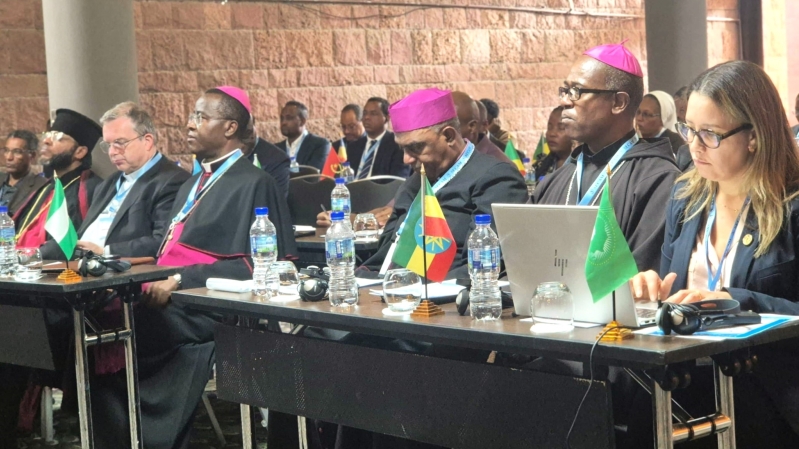
The Symposium of Episcopal Conferences of Africa and Madagascar (SECAM) and the African Union signed a renewed memorandum of understanding on Feb. 13 in Ethiopia’s capital, formalizing a partnership focused on peacebuilding, governance, humanitarian response and social development across the continent, officials said.
The agreement, signed at the African Union Commission headquarters in Addis Ababa, updates a previous accord first concluded in August 2015 and is intended to provide a structured framework for cooperation between the Catholic Church’s continental leadership body and Africa’s principal intergovernmental organization.
The document was signed by SECAM President Fridolin Ambongo Besungu, the archbishop of Kinshasa, and AU Commissioner for Political Affairs, Peace and Security Bankole Adeoye, according to pre-event announcements.
In statements issued before the ceremony, AU officials said the renewed agreement reflects a shared commitment to strengthen dialogue, coordination and mutual support between continental institutions and faith-based organizations working at community level. The AU described religious networks as key partners in addressing conflict, humanitarian emergencies and social development challenges across member states.
In a post-signing interview, Ambongo described the memorandum as “more than a simple administrative formality,” calling it a strengthened alliance designed to address urgent challenges facing African societies.
Ambongo said the partnership centers on five main areas of cooperation: conflict prevention and mediation, electoral observation and civic education, reconciliation and social cohesion, interreligious dialogue, and the promotion of human rights and good governance. He said these pillars reflect longstanding activities already carried out by Catholic institutions across Africa but now placed within an officially recognized collaborative framework with governments.
“You know that across Africa today there are conflicts everywhere,” Ambongo said in the interview. He added that the Church can assist states in preventing violence through mediation efforts and peace initiatives conducted at community and national levels, especially in fragile regions.
Peace-building collaboration
A SECAM statement similarly emphasized conflict prevention and peacebuilding as core priorities of the partnership, noting that collaboration with grassroots institutions could strengthen early-warning efforts and local mediation initiatives.
Ambongo said election monitoring and civic education programs run by Catholic organizations in several countries have helped strengthen democratic processes and transparency. Such initiatives, he said, aim to ensure that “the will of the people is always respected” in leadership selection.
Another focus of the agreement is reconciliation in societies affected by tensions or divisions. Ambongo said church institutions intend to work with AU peace and security structures to support dialogue initiatives and social cohesion programs. He added that Africa’s religious diversity should be harnessed as a constructive force rather than a source of rivalry.
Humanitarian and human-rights concerns also feature prominently in the memorandum. AU officials said ahead of the signing that the Church’s extensive presence in local communities positions it as a practical partner in responding to crises such as displacement, poverty and disaster relief, where faith-based groups often provide frontline assistance.
Ambongo said the accord highlights protection of vulnerable groups, including women, children, the elderly and marginalized communities, and links these priorities to broader governance reforms. He described the Church’s role as that of a “social partner based on moral values,” rather than a political actor.
According to Ambongo, the memorandum does not function as a binding legal treaty but instead establishes a formal platform for cooperation. He said that while Catholic institutions have long engaged in development and peace efforts, they previously lacked a continent-wide framework formally recognizing collaboration with AU member states.
Church vs State
“Sometimes, in certain countries, it gives the impression that the Church is in competition with the state,” he said. He clarified that the agreement is meant to prevent that perception and encourage joint action in sectors that directly benefit citizens.
The cardinal also acknowledged criticisms that the African Union has at times struggled to respond effectively to crises. Speaking from the perspective of Africa’s Great Lakes region, he said observers have wished for greater dynamism from the continental body but noted that competing national interests can complicate collective decision-making. He said the new partnership could help strengthen AU initiatives by contributing grassroots networks and mediation capacity.
Beyond governance and peacebuilding, the memorandum includes development components. During the same week as the signing, SECAM organized a meeting of religious and civil-society actors focused on water sustainability and sanitation. Ambongo said the gathering produced a declaration aligning with AU thematic priorities for 2026 on water access and sanitation.
He said those issues could become a practical area of collaboration between church institutions and AU bodies, particularly in communities lacking reliable access to clean drinking water, describing such cooperation as essential for improving living conditions for populations facing basic resource shortages.
Ambongo framed the agreement as part of a broader message of encouragement to Africans confronting instability or hardship. Despite ongoing crises in parts of the continent, he said, leaders involved in the discussions believe there is reason for optimism and collective action.
“If we are the continent of hope, we must not give up or lose heart just because things are difficult today,” he said. “Tomorrow depends on us.”
The renewed memorandum comes as the African Union continues efforts to deepen partnerships with civil society, faith-based organizations and regional institutions under long-term frameworks such as Agenda 2063, which envisions a peaceful and prosperous Africa driven by its citizens.
Officials have not yet released the full legal text publicly, but statements from both sides indicate it is intended to guide joint initiatives, policy dialogue and coordinated responses to humanitarian and social challenges across member states.
The signing marks a decade since the original SECAM-AU agreement and signals both institutions’ intention to expand cooperation at a time when African leaders face mounting demands related to conflict resolution, democratic governance, migration pressures, climate stress and humanitarian emergencies.


