
On February 12, 2026, President Trump, who frequently refers to climate change as a “hoax,” reversed the US government’s prior “endangerment finding” that had undergirded actions to reduce production of greenhouse gases.
Globally, Christians... overwhelmingly support efforts to combat climate change.
Globally, Christians, including evangelicals, overwhelmingly support efforts to combat climate change. The World Evangelical Alliance even has a Sustainability Center in Bonn, Germany. But many US evangelicals have tended to associate government actions on climate change with liberal efforts to control the economy and reduce individual freedom.
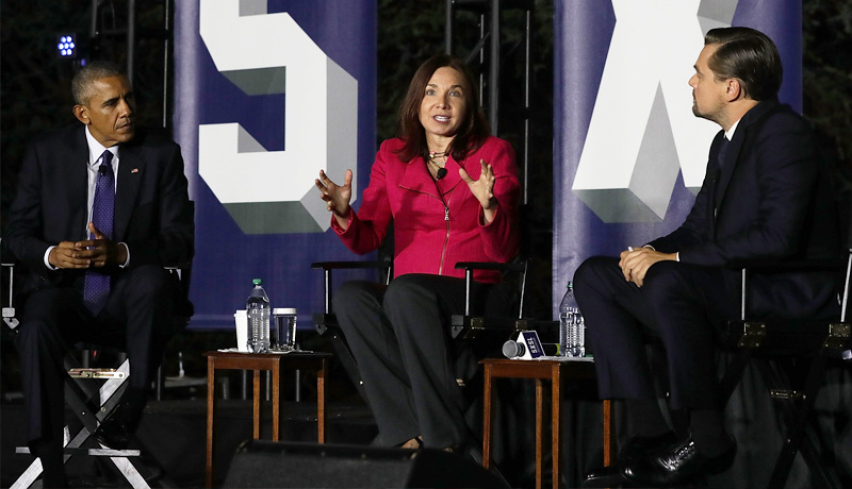
No one spends more time thinking about these issues than Katharine Hayhoe, a climate scientist and superb communicator who has served as the World Evangelical Alliance’s climate ambassador. Her expertise on climate change advocacy and how to discuss the topic has attracted wide attention, including a 2021 interview with comedian and talk-show host Jimmy Kimmel.
The extensive FAQ page of Hayhoe’s website answers almost any question you might want to ask on this topic, but it didn’t answer all of mine. So she graciously answered my queries. I hope this interview receives wide distribution.
What have you seen evangelical Christians doing about climate issues that makes you happy and proud of them?
There is so much hopeful work happening globally that doesn’t always make headlines. Organizations like Tearfund, A Rocha, Operation Noah, World Vision, Compassion International, the Lausanne Movement and many more are actively building climate resilience among many of the world’s most vulnerable people, working to protect and restore God’s creation, and equipping churches to care for both people and the planet in practical, tangible ways.
I’ve been especially encouraged by Tearfund’s work.
I’ve been especially encouraged by Tearfund’s work mobilizing churches around the world, including the video resources we developed together to help congregations understand why climate action is part of loving our neighbor, that have been watched by hundreds of congregations in the UK, Germany, Australia and Canada.
A Rocha’s long-standing investment in nature, conservation and food, usually in partnership with local communities, continues to be a powerful example of faith in action. And World Vision and Compassion International are helping Christians connect the dots between climate impacts and the children and families they serve every day.
One of my favorite stories is Tony Rinaudo’s work with farmer-managed natural regeneration across the Sahel. Millions of trees have been restored while boosting agricultural production in areas where people depend on their land for their livelihoods.
And the church forests of Ethiopia are another beautiful example: communities protecting biodiversity for generations because they see creation care as part of their calling.
Taken together, these efforts show us how many Christians around the world are already living out what it means to love our global neighbors in a warming world.
Have you been able to engage with any thoughtful US evangelical climate skeptics (not conspiracists) and if so, what do they say to you?
A true skeptic is someone who lacks information and is open to evidence.
A true skeptic is someone who lacks information and is open to evidence. In my experience, very few people who reject climate science fit that description. In fact, I don’t think I’ve met more than one or two true skeptics in over three decades of conversations with thousands of Christians about this topic.
Most people I encounter already have access to information, if they want it. But they don’t. What’s happening instead is what psychologists call “motivated reasoning.” That means we’ve already made up our minds (based on the tribe we see ourselves belonging to, or our identity) and we are using our smarts not to discover what’s true, but to defend what we already believe or what aligns with our identity or ideology.
In the evangelical space, this often shows up in two forms: sciencey-sounding objections and religiousy-sounding objections. I’ve unpacked responses to each of these in these two Global Weirding episodes (episode one and episode two).
Most Christians who have already decided to reject the reality of climate change or the need for action aren’t looking for a conversation or information.
When people are genuinely curious, I’m always glad to have a conversation. But most Christians who have already decided to reject the reality of climate change or the need for action aren’t looking for a conversation or information.
Instead, they’re looking to dismiss the science or question my faith. That’s a very different kind of engagement and not one that I often participate in, because I’ve never seen it yield positive results. In fact, research shows that when we argue with people who hold an ideological position that they believe informs their identity, arguing just strengthens their position.
When you tell climate skeptics about communities in Fiji, Tuvalu, Kiribati, or even New Zealand being affected by rising sea levels, what do they say to you?
Again, the reason Christians in the US reject the reality or severity of climate change usually isn’t a lack of information. Many people who reject the reality or risks of climate change have already decided, consciously or unconsciously, to filter the evidence through an ideological lens.
When our identity or worldview feels threatened, our brains are remarkably good at dismissing inconvenient facts.
When our identity or worldview feels threatened, our brains are remarkably good at dismissing inconvenient facts. That’s why simply providing more facts rarely changes minds.
For those on this spectrum who are cautious, concerned, and maybe a few who are disengaged or doubtful, I’ve found conversations can be productive when we begin with shared values. Those values can include caring for our neighbors, protecting what God has entrusted to us, and reducing harm to the most vulnerable, with examples from how climate change affects our brothers and sisters around the world.
For the dismissive, though, I truly believe it takes a miracle to change their minds; and while I may have seen one or two miracles in thirty years, I don’t think I had anything to do with them!
Do you have any suggestions for evangelical Christians disturbed by the close alliance between Trump and many evangelicals?
I believe they should be disturbed, because even a simple comparison between the fruit of the Spirit versus the deeds of the flesh shows which side most politicians are on. And for Christians to not only turn a blind eye to that but actually try to represent black as white is fundamentally anti-Christian.
Of course, we also have to realize that many who identify as evangelical in the US (40 percent in one survey) don’t even go to church, because it has now become a political rather than a theological term for many.
Our identity is not defined by any political party or leader.
For the many evangelicals I speak with who are wrestling with this, I encourage them to remember that our identity is not defined by any political party or leader.
Scripture calls us to care for the poor, love our neighbors, pursue truth, and be good stewards of creation. Those responsibilities transcend any moment in political history and, in times of high contrast such as today, allow us the opportunity to consider more deeply what we believe and how we are called to share God’s love.
What else would you want to share with the global Christian community at this time?
Profoundly human issues, affecting our health, our well-being and our livelihoods.
To summarize my talk at the Lausanne Congress in 2024, I would say this. Climate change, loss of nature, and pollution are not only environmental issues. They are profoundly human issues, affecting our health, our well-being and our livelihoods.
Around the world, the people most affected are those who have contributed least to the problem. As Christians, we already know that we are to be recognized by our love for others and to care for the most vulnerable.
The good news is that we are not starting from scratch. Many churches and ministries are already leading the way. I hope and pray that more of us will see climate action not as a political distraction but as a loving expression of living out our faith in today’s world.
Originally published on Bruce Barron's "Gently Provocative Thoughts" Substack. Republished with permission.
Bruce Barron has had a varied career that included investigating the charismatic movement, dominion theology, political campaigning and public policy in the USA. From 2015-2024 he volunteered for the World Evangelical Alliance as a communications aide and was executive editor of the WEA's theological journal from 2018-2024. Among other activities, he directs editorial services for the Society of Christian Scholars. Bruce writes a regular Substack blog, which can be subscribed to here: https://brucebarron.substack.com.








