Growing up in South Asia as the son of missionaries, I knew I was an American, but it seemed distant and mysterious. I felt America everywhere—in embassies, newspaper headlines, on Voice of America radio—but did not know it from personal experience.
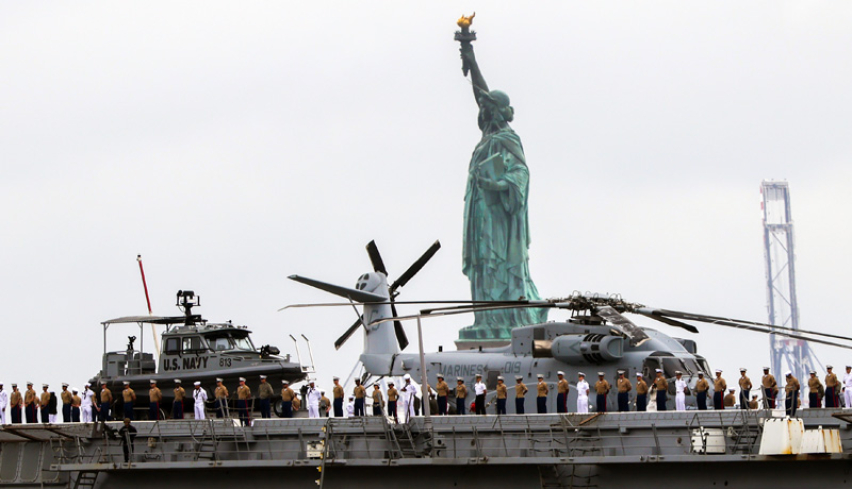
When I moved to the United States at the age of sixteen, I began to wrestle with this enigmatic and compelling country. I marveled at the Statue of Liberty in New York… and recoiled at racism in Indiana. I stood in awe before the Lincoln Memorial in Washington, DC… and blushed in shame at anti-immigrant slurs in Tennessee.
Which country are we?
I would often retreat into myself and ponder this mystery that was my country. Which country are we? An open hand or a clenched fist? A land of open doors or closed doors? A global sky of kindness, or a provincial valley of cruelty?
Abraham Lincoln urged us in his first inaugural address to seek out the “better angels of our nature.” It seems throughout our history that we have vacillated between the angels and the demons. In our Declaration of Independence we declared all humanity equal before God, hurling a shock wave of ideals across the world.
Then we robbed Native Americans of their land, their culture, and their dignity because we viewed them as less worthy than ourselves.
“So God created human beings in his own image. In the image of God he created them; male and female he created them." (Genesis 1:27, CSB)
Lincoln’s Gettysburg Address... calling us to see humankind as equal before God.
We abolished slavery in 1865 after a long and bloody Civil War, and thirty years after Great Britain abolished it by an act of Parliament. Lincoln’s Gettysburg Address emerged from the conflict, calling us to see humankind as equal before God.
But then we sought to recreate oppression through The Lost Cause—a revisionist view of the Confederate stance from its true position of white supremacy to one of chivalry and a romanticized antebellum south. And we instituted Jim Crow—systemic laws and customs designed to keep African-Americans marginalized as second-class citizens.
Our Statue of Liberty welcomed persecuted immigrants, as its meaning in our collective consciousness morphed from the French gift of secular Lady Liberty to the story of a haven for the persecuted, woven in her immortal poem by Emma Lazarus, a Jewish-American immigrant.
Then we repelled immigrants.
Then we repelled immigrants through the Chinese Exclusion Act, seeking to bar Chinese-Americans from our nation because we deemed them inferior, and a threat to European-American culture.
“You shall not oppress a sojourner. You know the heart of a sojourner, for you were sojourners in the land of Egypt.” (Exodus 23:9, ESV)
We initiated a monumental effort to level the racial & immigrant playing field through the Civil Rights Act of 1964 and the Immigration and Nationality Act of 1965.
Then assassinated Dr. Martin Luther King, Jr.—one of our greatest heroes, a pastor preaching nonviolence—in 1968.
“But let justice flow like water, and righteousness, like an unfailing stream.” (Amos 5:24, CSB)
In the 1960’s we adopted model civil rights legislation, signaling to the world that America is open to hope.
America is closed from fear.
But more recently we have sought to roll back a myriad of civil rights, turning our back on oppressed peoples in Europe, Africa, and Asia—signaling to the world that America is closed from fear.
“The Spirit of the Lord is on me, because he has anointed me to proclaim good news to the poor. He has sent me to proclaim freedom for the prisoners and recovery of sight for the blind, to set the oppressed free, to proclaim the year of the Lord’s favor.” (Luke 4:18-19, NIV)
So who are we, America? An open hand of welcome, defender of the defenseless, and righteous morality? Or a clenched fist of brutality, selfishness, and pervasive immorality? An angel or a demon? Throughout our history we have manifested both.
Some may object to these words as little more than partisan jabs. But I am not speaking from a political stance; I am a pastor with a burning heart for the Scriptures. Each of us is free as Americans to choose our political path according to personal conscience. Ours is a nation declaring freedom of speech and religion as a matter of first priority. As English apologist G. K. Chesterton put it: “A nation with the soul of a church.”
We are living in a time that transcends politics.
We must recognize that we are living in a time that transcends politics. These are not primarily conservative or progressive issues; nor primarily Republican or Democrat issues. These are biblical issues of righteousness, justice and compassion, calling out to us all.
“Is not this the kind of fasting I have chosen: to loose the chains of injustice and untie the cords of the yoke, to set the oppressed free and break every yoke? Is it not to share your food with the hungry and to provide the poor wanderer with shelter—when you see the naked, to clothe them, and not to turn away from your own flesh and blood?” (Isaiah 58:6-7, NIV)
I have always hoped and prayed that despite our occasional pursuit of the demon, that deep down we were a people who sought the angel, that the credo on our currency “In God We Trust” was more than merely a political slogan.
But lately I’m not so sure. My heart is heavy. I lament for our nation, like Nehemiah.
“I sat down and wept. I mourned for a number of days, fasting and praying before the God of the heavens.” (Nehemiah 1:4, CSB)
We need desperately to repent.
We need desperately to repent for our callous mistreatment of people bearing in their personhood the fingerprints of God, those who may not fit the archetype of the American narrative of Manifest Destiny or triumphalism. We need to bow before Jesus and repent of how we have mistreated his own people whom he created in his image.
“Then they also will answer, ‘Lord, when did we see you hungry or thirsty or a stranger or needing clothes or sick or in prison, and not help you?’ He will reply, ‘Truly I tell you, whatever you did not do for one of the least of these, you did not do for me.’” (Matthew 25:44-45, NIV)
Yet despite the heaviness in my soul, I still have hope. My hope is in the God of redemptive history… the God of miraculous power… the God who brings down the arrogant and lifts up the humble… the God who always has a remnant, a people of faith.
I still have hope.
I still have hope that the true Church, the confessing Church, will rise up—as it has in the past—to seek God’s face and commit to righteousness, compassion, and empathy for our neighbors.
“If my people, who are called by my name, will humble themselves and pray and seek my face and turn from their wicked ways, then I will hear from heaven, and I will forgive their sin and will heal their land.” (2 Chronicles 7:14, NIV)
Originally published by Peace & Reconciliation Network. Republished with permission.
Jim Eaton is the founder & CEO of PeaceBuilders Table, Co-Director of Diversity with Converge Worldwide. He serves as the Peace & Reconciliation Network (PRN) USA Co-Coordinator. PRN is a global network of the World Evangelical Alliance. Jim is a pastor and intercultural & multi-faith consultant. He was raised in Bangladesh, which gave him a third-culture perspective. He has two master’s degrees in biblical studies and has served with his wife Natalie in intercultural ministry in South Africa, Germany, Chicago and the Washington, DC area.