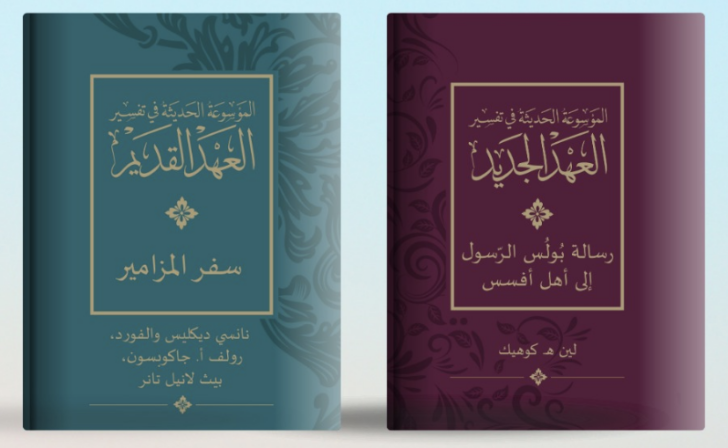
Five volumes from two English-language Bible commentary series used widely in seminaries are now available in Arabic. Organizers describe the release as the first result of a translation effort meant to address a shortage of detailed biblical scholarship in the language.
The Arab Baptist Theological Seminary in Lebanon and the Christian publisher Dar Manhal al Hayat released Arabic editions of commentaries on Genesis, in two parts, along with Psalms, Galatians and Ephesians on Sept. 22, according to a report by THIMAR. The books come from the New International Commentary on the Old Testament (NICOT) and the New International Commentary on the New Testament (NICNT), both published in English by Eerdmans.
Project leaders say the translations are meant to reach churches as well as seminaries. They present the series as a working tool for pastors, teachers and theology students across the Arabic-speaking world, where they say thorough and reliable commentaries have long been scarce.
Filling a gap in the Arabic library
Wajih Youssef, editor-in-chief of the Arabic project, told those gathered for the launch that few comprehensive commentaries exist in Arabic. In his view, the translations respond to a need in the Arabic theological library rather than simply adding more titles to it.
Youssef said the series engages closely with the biblical texts in their original languages. It examines historical, linguistic, cultural and theological questions, takes on difficult passages and gives readers references for further study, he said.
For Youssef, the study also became a matter of worship. While translating, he said, he often found himself pausing to say, "Glory be to God."
The THIMARS report said the project has drawn on translators, editors, reviewers and scholars in Lebanon, Jordan and Egypt, as well as partners who funded or otherwise supported the effort.
Scholarship for the local church
Sandra El Hajj Baz, publishing and communications director at Dar Manhal al Hayat, opened the launch with Psalm 119:18, a prayer asking God to open the reader's eyes to the wonders of his law. Organizers framed the commentaries as aids that help readers grasp Scripture's context and meaning, not as a substitute for the Bible itself.
Wissam Nasrallah, president of the seminary, described the project as a bridge in three directions. It links academic study with local church ministry, connects Arab churches with Christians in other parts of the world and joins one generation of church leaders to the next, he said.
Scholarship, Nasrallah said, should shape preaching, discipleship, youth work and theological training instead of staying in classrooms. He said Arab churches have much to learn from believers elsewhere but also bring questions and experiences of their own. He described a longer-term hope that it will encourage new Arabic works written from within the region.
"This is not the end of a project, but the beginning of new growth," Nasrallah said.
Depth over speed
Walid Zailaa, the seminary's academic dean, said that while the Bible is far easier to obtain than in the past, readers still need dependable help interpreting it.
Drawing on Psalm 1, which pictures a tree planted by streams of water that bears fruit in its season, Zailaa cautioned against measuring success by speed or visible results. A tree without fruit at a given moment is not necessarily failing, he said. What matters is where it is rooted.
Speakers also discussed whether resources this detailed could serve house churches and Christian communities with little access to formal theological education. Churches need depth in Scripture to last, even in ministry settings that place a premium on rapid multiplication, they emphasized.
Organizers called the five volumes one step in a longer process. Nasrallah said he hoped the books would be "opened and read, reaching classrooms and pulpits, so that Christ may be served more faithfully."