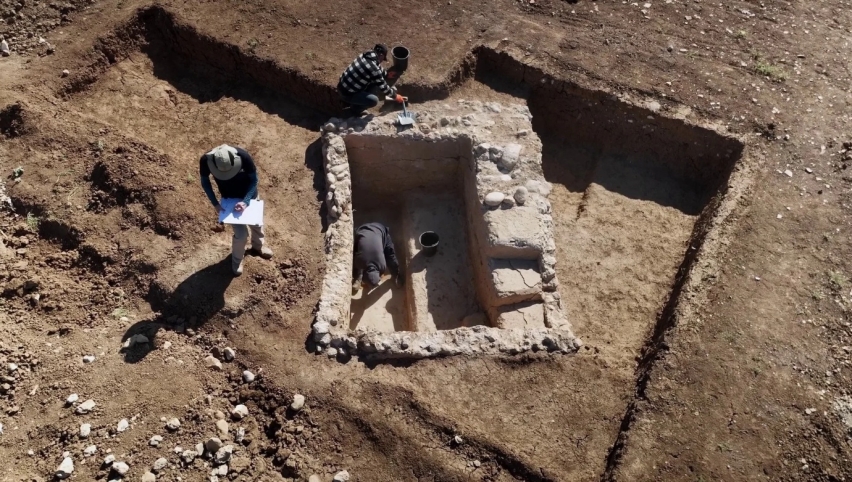
Archaeologists in southern Israel have uncovered evidence of a previously unknown Jewish settlement dating to the era of Jesus and the early church, highlighted by the successful extraction of an intact 2,000-year-old ritual purification bath (mikveh) weighing 25 tons.
The excavation in the new Carmei Gat neighborhood, funded by the Israel Land Authority with 28 million NIS ($7.6 million), revealed what the Israel Antiquities Authority described as the first Second Temple-period Jewish community documented in the area between the Judean Lowlands and the northern Negev.
Alongside the ancient mikveh, Israel Antiquities Authority (IAA) archaeologists discovered stone measuring vessels. Such vessels were commonly used during the Second Temple period because, according to Jewish purity laws, stone was not considered susceptible to ritual impurity.
“The Jewish settlement we discovered here is the first and the only known one in this area,” said IAA excavation directors Dr. Elena Kogan-Zehavi, Maayan Margulis and Shira Lifshitz.
Findings indicate that the Jewish community abandoned the site during the Bar Kokhba Revolt in the second century A.D. The location was later resettled during the Byzantine period.
To protect the 4-meter-wide ancient structure from nearby construction, conservationists spent two weeks securing its delicate plaster with adhesives and foam. Engineers then drilled beneath the bath and placed steel support beams underneath it, allowing a 300-ton crane to lift the 25-ton structure onto a transport vehicle.
The ritual bath was temporarily moved under police escort to the National Treasures Department storage facilities in Beit Guvrin.
“If it falls apart, we’ve lost the mikveh,” said Eyal Kaho, senior conservator at the IAA. “There’s simply no price that can compensate for mistakes.”
Once residential development is completed, officials plan to return the ancient purification bath to Carmei Gat and incorporate it into an open public space at the heart of the new neighborhood.