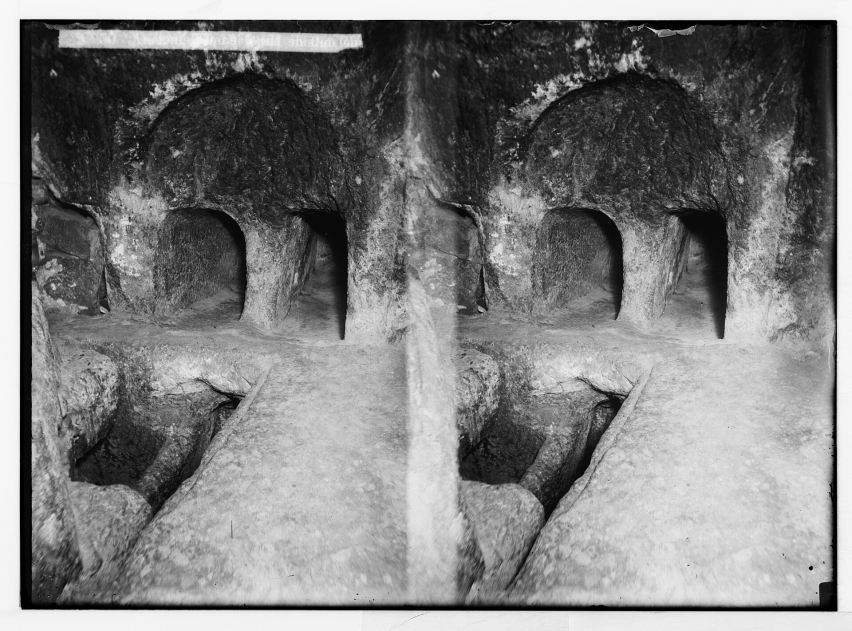
Excavations beneath the Church of the Holy Sepulchre in Jerusalem have revealed an ancient garden and burial landscape that archaeologists say is consistent with the description of Jesus’ burial site in the Gospel of John.
Francesca Romana Stasolla, an archaeologist at Sapienza University of Rome, spoke to the Daily Mail following the completion of investigations at the Jerusalem site.
The excavation took place beneath the site of the first church complex constructed by Roman Emperor Constantine in the fourth century and dedicated in A.D. 335. Constantine’s workers reportedly uncovered a rock-cut tomb identified as Christ’s burial place during the initial construction.
Although there is no direct archaeological proof of Jesus’ burial at the site, the deliberate Roman and Byzantine construction history around the tomb suggests that early Christian generations may have preserved knowledge of its location.
“The archaeological area beneath the Church of the Holy Sepulchre reveals the long history of a part of Jerusalem that, in the early fourth century A.D., underwent the monumentalization of Christological memory,” Stasolla told the Daily Mail. “In this case, I believe that the archaeological evidence should be used primarily to understand the places and contexts in which Christian memory took shape and became firmly established.”
The original Constantinian complex suffered extensive damage during the Persian Sassanid invasion in A.D. 614 and was later completely destroyed in A.D. 1009. The core of the structure standing today dates largely to 12th-century Crusader-era reconstruction.
The church is built over an abandoned stone quarry outside ancient Jerusalem, where cultivated plots and rock-cut tombs existed side by side. The discoveries stem from excavations beneath the church floor that began in March 2022 and concluded in 2025.
The findings provide archaeological evidence for the historical context of the Holy Sepulchre site, although they do not establish that Jesus was buried there. The site is one of several proposed locations associated with Jesus’ burial, including the Garden Tomb elsewhere in Jerusalem.
“We have found evidence of a funerary landscape, alongside small areas planted with vines and olive trees, as well as a pastoral landscape characterized by sporadic human activity,” Stasolla said.
Findings from the excavations were detailed in a 98-page report published in Liber Annuus, the journal of Jerusalem’s Studium Biblicum Franciscanum.
The excavations enabled researchers to reconstruct the site’s early topography, including cultivated plots, stone quarry faces descending nearly 20 feet below the current church floor and adjacent burial chambers.
As stone extraction gradually ceased, workers filled the deepest areas with soil and built low dry-stone walls to create small agricultural plots.
“Evidence of cultivation is provided by archaeobotanical and pollen remains, which have enabled us to reconstruct a landscape suitable for pastoralism, with natural vegetation used for grazing,” Stasolla said. “This type of Mediterranean landscape was widespread throughout the region and coexisted with the abandoned quarry area and the presence of rock-cut tombs.”
Archaeologists dated the cultivated landscape to a period spanning Jesus’ lifetime — after quarrying stopped but before Emperor Hadrian rebuilt the area in the second century. However, without direct radiocarbon dating of the plant remains, researchers cannot definitively establish that the garden was cultivated at the exact time of Christ’s crucifixion.
“The Church of the Holy Sepulchre gives monumental form to the sites where, since very early times, tradition has located the memory of Christ’s death and resurrection,” Stasolla said. “Archaeology undoubtedly attests to the enduring nature of this commemorative tradition.”