The archbishop of the Church in the Province of the West Indies, the Most Rev. Philip Wright, has backed initiatives to provide reparations for the historic transatlantic slave trade.
United Society Partners in the Gospel, an Anglican mission agency, reported Feb. 16 that Wright praised the Church of England’s Project Spire initiative, which seeks reparative justice rather than symbolic regret to redress the fact that the Church Commissioners’ endowment — now worth billions — is rooted in Queen Anne’s Bounty, a fund that historically invested in the South Sea Co., which transported enslaved people.
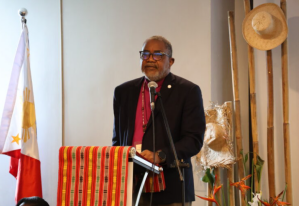
Despite parliamentary criticism, Wright told an international meeting of 40 Anglican leaders from 31 countries that the Anglican Church’s credibility in witnessing to the gospel is at risk if it refuses to move from symbolic apology to reparative justice. He spoke at “Breaking the Chains of Injustice,” an event organized by USPG examining the effects of colonialism on Indigenous people.
“The legacy of slavery places the Anglican Church at a significant moral crossroads,” Wright reportedly said.
“The recognition of the complicity of the Church in the transatlantic slave trade opens the door to the possibility of transformation. However, if we are not careful, words can become empty rhetoric which leads to false hope — the end state of which can be worse than the original.
“The aim of reparatory justice is not to seek retribution. It is about recognizing the harm caused by centuries of enslavement and exploitation that now demands deliberate and intentional redress. Initiatives like Project Spire and USPG’s Renewal and Reconciliation: The Codrington Project are the first steps toward achieving this aim.”
Wright also said the Anglican Church could support Caribbean communities by helping to “make a difference in the lives of our people.”
“Despite all the baggage the Anglican Church comes with, that is still our mission,” he added. “And we hope that these collaborative efforts can help facilitate this. There remains a lot of good that the Church has accomplished over the centuries of its work in the region.
“It is not just about money, it is about acknowledging that the issues we face today are part of the legacy of slavery. We are calling for support in building new schools and hospitals so our people can step out of the legacy of this horrendous period of history.”
Christian Daily International previously reported that USPG, which has past links to slavery in Barbados, partnered with the Codrington Trust in September 2023. The trust oversees the Codrington estate on the island and announced a multimillion-dollar fund focused on addressing the historic injustices of enslavement. The fund is part of a long-term project entitled “Renewal & Reconciliation: The Codrington Reparations Project.”
Slavery officially ended in the British Caribbean in 1834 under the Slavery Abolition Act. However, USPG acknowledged in its press release that decades of slavery continue to be “one of the leading causes of intergenerational economic disparity and inequality, environmental degradation, and social challenges facing the region today.”
USPG has previously acknowledged its “disgraceful links to the slave trade,” according to a prior press statement.
The Society for the Propagation of the Gospel, as USPG was formerly known, received a bequest from Sir Christopher Codrington for two plantations in Barbados in 1710. The organization subsequently benefited financially from the labor of enslaved people working on the Codrington estate from 1710 to 1838.
Calls for reparations from countries and institutions that benefited financially from the slave trade continue to grow.
The Caribbean Community (CARICOM) called for a “10-point plan for reparatory justice” in 2013, and the Church in the Province of the West Indies in 2015 also called for similar actions for redress. The Codrington Project is the vehicle created by USPG to atone for its involvement in the slave trade.
USPG’s general secretary, Duncan Dormor, said it is critically important that members of the Church of England take seriously the moral claims of Caribbean Anglicans for reparative justice.
“The Church was deeply involved in the brutal, inhumane and shameful activities of the slave trade and plantation chattel slavery,” Dormor said.
“As Christians we are called to the work of repair and reconciliation in a spirit of openness, humility and constructive critical reflection on the past, and we should grasp this opportunity to work together to build a more just future.
“For USPG, reparative justice lies at the heart of the practice of Christian mission today, and initiatives like Project Spire and the Codrington Project receive strong support across the Anglican Communion.”
The Archbishop of Canterbury, Most Rev. Sarah Mullally, sent a message of appreciation to the gathering and its ongoing work on redress for historic slavery.
“I am deeply grateful for the work you are doing together this week, and for the spirit of fellowship, shared mission and mutual encouragement that characterizes your time together,” Mullally said.
“USPG’s commitment to partnership, justice and the flourishing of local churches continues to bless the Anglican Communion in profound and enduring ways.”