
Artificial intelligence is becoming a place where young people talk about their problems, seek advice and, in some cases, discuss the things they cannot bring themselves to tell another person.
But a new global study suggests that the rise of AI companionship is not necessarily a sign that young people no longer want human relationships. In fact, the opposite may be true.
The RELATE Project 2026, released Sept. 10 by Christian youth ministry Young Life, found that young people are increasingly turning to AI while also expressing a strong preference for face-to-face relationships. The study, surveyed 7,105 people ages 13 to 24 across 11 countries, including Ethiopia, Kenya, Liberia, Nigeria and Zimbabwe.
The findings offer a particularly interesting picture for Africa, where millions of young people are coming online as the continent undergoes a rapid digital transformation.
Young Life found that the average number of close relationships reported by young people had fallen from 5.3 in 2023 to 4.4 in 2025. Yet 64% said they preferred communicating face-to-face with their closest friends, up from 54% in the previous study.
Young people are spending more of their lives in digital spaces, but that does not appear to have eliminated their desire for physical presence, friendship and someone they can trust.
Instead, technology may increasingly be filling gaps that already exist in their relationships.
One of the clearest examples came from Zimbabwe.
A male participant in the RELATE focus groups described himself as “being someone others turn to during difficult moments.”
“I’m the kind of person people go to when they're going through things, but very few people show up for me,” he said.
He said that after training his AI system to respond in ways he found useful, he sometimes turned to it when he was at his lowest to have deep conversations and work through his problems.
That experience helps explain why AI companionship is gaining traction among young people.
The RELATE study found that 35% of respondents reported having an AI companion. The proportion rose to 45% among those ages 13 to 15.
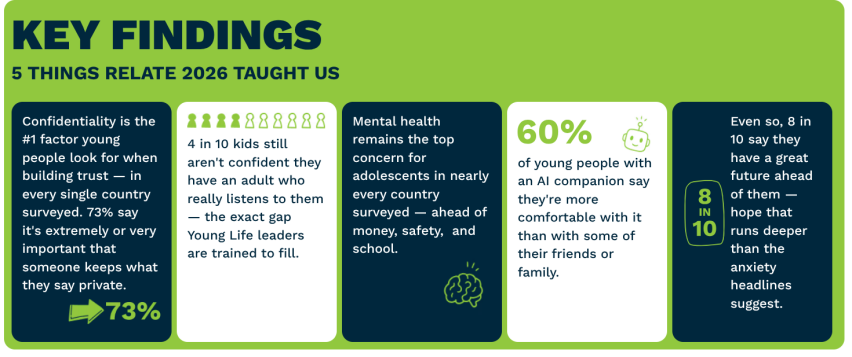
Among young people with an AI companion, 60% said they were more comfortable sharing personal information with the AI models than with some friends or family members. One in 10 adolescents also said they cope with stress by talking to an AI companion.
The African context makes these findings worth examining beyond the familiar debate about whether young people are spending too much time on their phones.
Africa is still experiencing a significant digital access gap. The GSMA reported in 2026 that 63% of people across Africa lived within mobile broadband coverage but were not using mobile internet. The organization said affordability, digital skills and other barriers continue to limit mobile internet adoption. At the same time, mobile technologies and services contributed $240 billion to Africa’s economy in 2025.
This means Africa is entering the AI era from a different starting point than many countries in the west.
For some young Africans, digital technology is already deeply embedded in daily life. For others, internet access remains limited or expensive. In between are millions who are rapidly moving between the physical and digital worlds, using technology for education, work, entertainment, friendships and increasingly for emotional support.
Why the youth are turning to AI buddies
RELATE found that 40% of young people were not fully confident there was an adult in their lives who was genuinely interested in listening to them. Confidentiality was the most important factor in building trust, with 73% saying it was extremely or very important that someone keep what they said confidential.
A Zimbabwean participant offered an explanation for the importance of that finding.
“Without confidentiality, people will shut down and go back to not talking about feelings,” the participant said.
The study found that young people value full attention, care and a nonjudgmental response when someone listens to them. Yet 63% said they were more comfortable expressing themselves online than in real life.
The World Health Organization’s Commission on Social Connection reported in 2025 that about one in five adolescents and young adults experience loneliness. The rate was higher in low-income countries, where 24.3% of people reported loneliness compared with 11.2% in high-income countries. The commission said loneliness is shaped by social and economic conditions as well as technology.
In Kenya, a 2025 study involving 1,445 secondary school students found loneliness was central to a network of psychosocial factors affecting adolescents, including depression, anxiety, social support and wellbeing. The researchers said loneliness among adolescents remains an important issue requiring greater attention in African settings.
Research published by the Journal of the Kenya National Commission for UNESCO found that online groups can help young people develop social capital. The study found that young people participated in academic, sports, family, friendship and former-school groups, among others, with online communities providing opportunities for both bonding and connections across different social groups.
Young Life President and CEO Newt Crenshaw said the study showed that young people are looking for “trusted, consistent adults who will step into their worlds and listen.”
That finding sits alongside one of the study’s most revealing statistics.
Although 89% of respondents said they use AI in some way, 64% still chose face-to-face communication as their preferred way of connecting with close friends.