Artificial intelligence is not something Christians can afford to watch from the sidelines, according to Steele Billings, president of Gloo AI.
"One of the things that I believe about this technology is that we are called to shape it, and I don't mean that lightly. I mean, that is a big calling," he said in an exclusive interview with Christian Daily International. "I believe this technology is going to be radical."
Most people, including members of his own family, do not engage with AI on a daily basis, he said, and "they don't see a tidal wave coming, a tidal wave of change that this technology is going to bring."
Billings has been with Gloo since 2018. As founder of Gloo AI, he led the development of the company's Flourishing AI Standards and Benchmark, which measures how AI contributes to well-being. The Boulder, Colorado-based company, listed on Nasdaq, describes itself as a technology platform serving the "faith and flourishing ecosystem," providing software and AI tools to churches and to some of the largest faith-based nonprofits in the world.
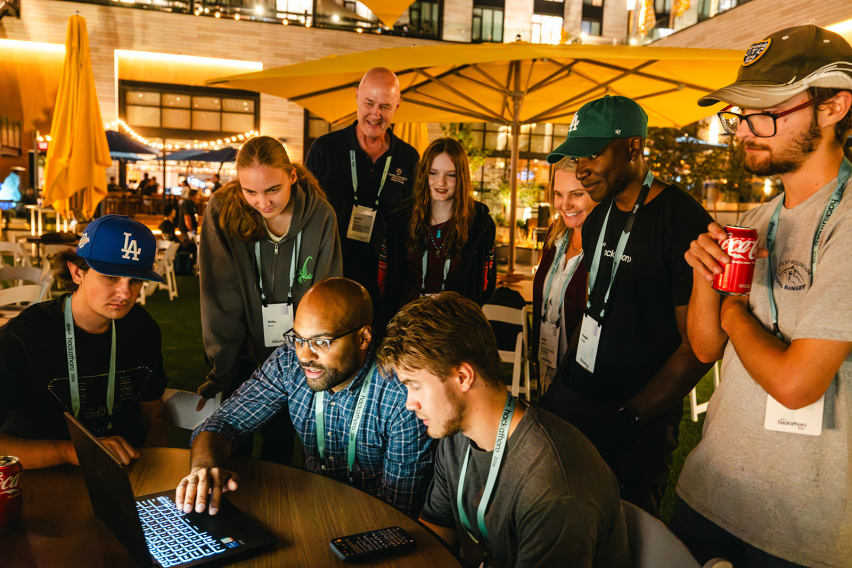
Its annual Gloo AI Hackathon, which held its fourth edition Oct. 6-8 in Boulder, has become the most visible expression of the company's conviction that AI should be deliberately directed toward the human good.
For Billings, the starting point is a line Gloo co-founder and CEO Scott Beck shared with him when he first joined the company: the idea of "technology helping people be all that they were born to be."
"How do we help people be all that they were born to be in all areas of life?" he said, noting that this vision for human flourishing is rooted in Scripture.
"Relationships and mental health and physical health, and vocation and purpose — the Bible speaks to all of those topics, and we believe those definitions are actually the best versions of human flourishing," Billings said.
Will AI lead to abundance or dystopia?
Public predictions about AI's future span a wide range. In a July interview with The Economist's editor-in-chief, Zanny Minton Beddoes, Tesla and SpaceX CEO Elon Musk predicted that AI and robotics would make work optional within about a decade. At the same time, some AI safety researchers have warned of potentially far darker scenarios. Meanwhile, among Christians, responses range from enthusiasm to caution to uncertainty.
Asked about his own view on the debate as an AI professional, Billings framed the debate as a choice between "a very optimistic and abundance point of view" and "a pessimistic and sort of dystopian point of view." He described Musk as "a futurist" and "one of the best inventors of our time," whose bold claims merit attention from those in the field. "In no way do we blindly agree with everything Elon says," he added, acknowledging "very real security concerns related to technology."
His own position is optimistic, but conditional. "I think that there are a couple of very important things for us to get right with AI," he said. "If we get those two right, I lean towards the very positive, optimistic view on AI."
The first is alignment between the United States and China. Without it, he said, "there is a very real threat of potential war." He pointed to the war in Ukraine, where AI and drones are in regular use, as "the dystopian side of the technology."
The second is aligning AI with human flourishing, the area where Gloo concentrates its work. Billings pointed to recent remarks by Microsoft CEO Satya Nadella, who said on the 20VC podcast in late October that he had once assumed alignment would "just fall out" of more capable AI models but "no longer" believes that.
"That is where we live at Gloo. We believe we have to take a very intentional approach to aligning AI toward human flourishing," Billings said. "If we can align AI toward human flourishing, then we will have the most advanced technologies the world has ever seen helping us all be the best versions of ourselves."
Rather than speculating about distant futures, he argues for asking practical questions now. "What does this mean for society today? What could it mean for kids that are in college right now who are going to be entering the workforce over the next few years? What does it mean for my own kids who are elementary aged?" he said. "What does it mean for my aging or retired parents or grandparents?"
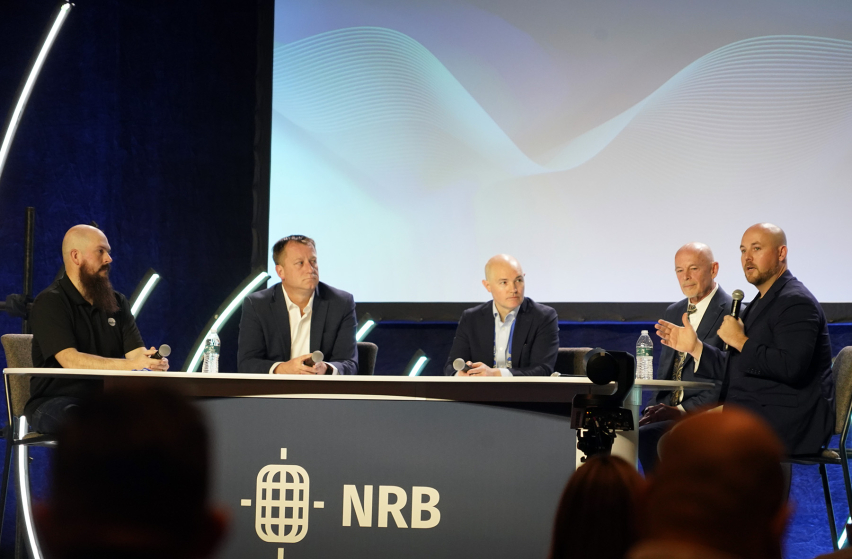
Billings also serves with the American Society for AI, an invitation-only nonprofit of leaders from industry, government and academia. The group is working on what he called a "U.S. Constitution for AI," an effort to define "the values that we would want to see in all AI."
From defense to offense
Gloo's work with AI predates the public release of ChatGPT. In 2022, Billings served as the company's head of data exchange, helping organizations collaborate using data while respecting privacy and "the expectations that users have of their own data." In that role, his team began experimenting with Large Language Models (LLMs).
At the time, he said, "the technology itself was not something that was interesting to people. In fact, it was very scary to people."
The release of ChatGPT brought significant change to the conversation within the faith ecosystem Gloo serves. The question shifted from how to use the technology to "how is it going to shape society, and what could we do about that?"
Gloo's answer was to educate, convene and build. "There's a lot of ways that we could get on the defensive side of the technology," Billings said. "But we said, we want to play offense with the technology. We want to put it to use for good."
Gloo AI launched with several initiatives, including educational resources, funding for organizations doing AI research and development, convening, and the integration of AI into Gloo's own products. The hackathon grew out of the convening effort and Beck's insistence on results over discussion.
"I don't just want to pull people together to talk about AI," Billings recalled Beck telling him. "I want to pull people together to actually build technologies that could go out and make an impact in the world."
Putting AI to work for the greater good
The first Gloo AI Hackathon took place in 2023 at the company's Boulder headquarters. Across four editions, Gloo has awarded more than $1 million in cash prizes, an investment Billings said has drawn "world-class builders" alongside local pastors who feel called to build something.
This year's event, themed "Building Together: Humans, Agents and the Future of Flourishing," drew more than 1,000 registrants from 12 countries, 34 U.S. states and eight universities, forming more than 115 teams. Participants completed a 30-day virtual build beginning Sept. 8, followed by a 48-hour in-person build in Boulder. More than 30 CEOs attended alongside researchers and technologists. According to Billings, participants included students from Stanford, MIT and Harvard, staff from frontier AI labs, and big tech employees building on their own time.
The winning projects, which shared $200,000 in prizes, reflect the breadth of what Gloo means by flourishing.
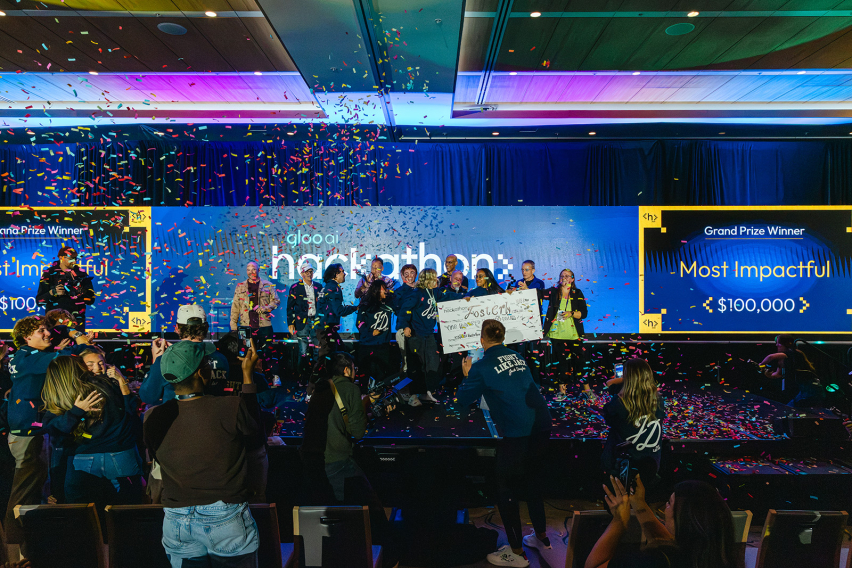
The $100,000 grand prize went to Fosterly, from Austin Christian University, an AI agent that connects young people aging out of Texas foster care to the services and people they need. The university also won the $20,000 Best of Agents Track, powered by Gloo, with Unify, which equips nonprofits with agents that build software, replacing up to 20 disconnected tools with a single system.
The Best of Ministry Resourcing Track, powered by Masterworks, went to OnBoard, from Frontier Commons, an AI interface that collects ministry moments as they happen so missionaries can keep donors informed. The Best of Bible Track, powered by YouVersion, went to Envoy Mission, an offline, private Bible disguised as an ordinary app for people who could be imprisoned for owning one, delivered through multilingual AI conversations with seekers around the world. Each track winner received $20,000.
Seven of the 28 finalist teams came from Oral Roberts University, Biola University, Austin Christian University, Indiana Wesleyan University, Grove City College and Baylor University. University teams took two of the four top prizes.
"Something that only God could do"
For Billings, the defining moment of this year's event was the story of Fosterly team leader Jack Malouff, who was unable to attend because of a serious accident that left him hospitalized. His teammates presented the project in his place under the slogan "Fight Like Jack."
Billings said Gloo staff prayed for Malouff's healing days before the event, after learning that his team had won a feeder hackathon at Austin Christian University. As one of the preliminary judges reviewing more than 100 submissions, Billings saw the project early.
"The very first time I saw it, I remember thinking, this is going to win," he said. "I remember just being in awe of what the story could be that God was getting ready to do through Jack, and through this event, and through this gathering of Christians who were just faithfully coming together to say, God, we don't know what you're going to do with all this, but we're just coming together to build something on your behalf."
Billings said he regularly prays over the technology itself: "God, do something big with this that only you could do." He said he felt Malouff's story was "extremely authentic" and "something that I believe only God could do."
Inspiring Christians in tech to "live out their faith"
The hackathon does not require participants to be Christian. "We don't ask you if you are a Christian if you are going to attend. We invite anyone and everyone to come and be a part of it," Billings said.
Because of Gloo's history and partnerships, however, the event naturally draws a largely Christian audience and includes worship sessions and a devotional.
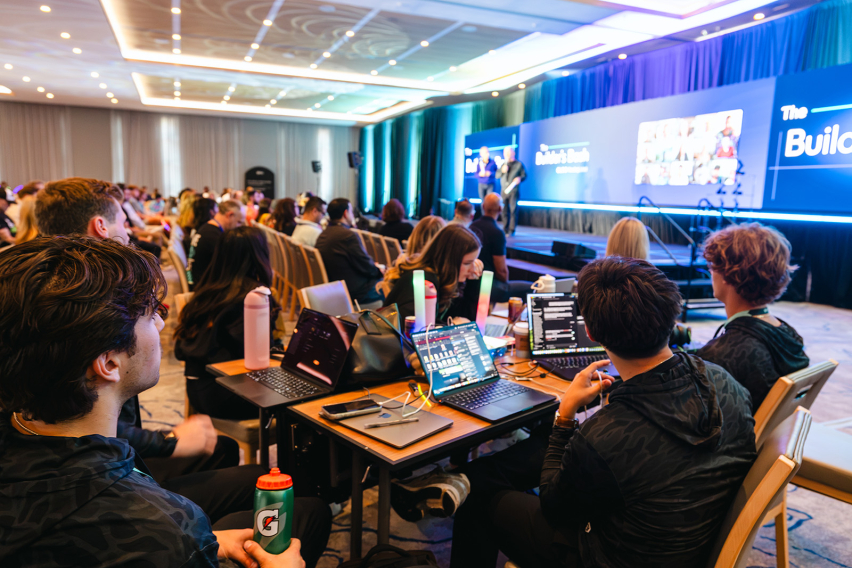
Billings recalled remarks by Bobby Gruenewald, founder and CEO of YouVersion, at last year's event. YouVersion, the creator of the Bible App, powered this year's Bible track and served as title sponsor and co-host. According to Billings, Gruenewald told participants that as a tech-minded Christian he had at times felt like an outsider, and that the hackathon reminded him there were hundreds or thousands of others who felt called by God to explore these technologies.
"You could be working in big tech, you could be working in the heart of advanced technologies, in Silicon Valley at one of the frontier labs, and you could feel like you're a little bit of an outsider when it comes to your faith, or even because of your faith in some ways," Billings said. "And you come to this hackathon and you actually feel like you're a part of a community and what you are doing matters."
The goal, he said, is to inspire talented people to "live out their faith in their work."
Technology is a tool, so "lean in"
For Christians uneasy about AI, Billings' counsel is to engage, with discernment. He encourages pastors, church leaders and nonprofit leaders, whom Gloo calls "champions," to "lean in to the technology."
"This technology is a tool. We like to say the technology is neutral," he said. "It can be shaped toward good, or it can be shaped away from good."
That engagement, he said, requires a critical eye. "You can't trust everything that AI says. AI has flaws," Billings said. "It's not always 100% accurate. It's not always 100% safe. It's not always 100% compliant."
Leaders should double-check and fact-check what AI produces, he said, but not hold back. "Lean in, look for opportunities for the technology to actually help you achieve your mission."