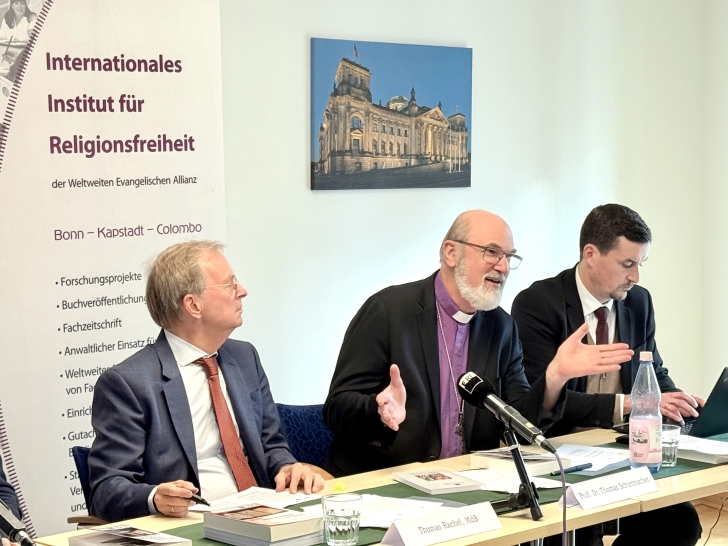
Levels of persecution of Christians worldwide this year worsened compared with 2025, according to editors of the yearbooks “Religious Freedom 2026” and “Persecution and Discrimination against Christians 2026.”
Releasing the yearbooks at a news conference in Berlin on Tuesday (Nov. 3), the editors gave an unequivocal “No” to the question of whether conditions for people of faith had improved. Global religious freedom in 2026 ranges from “worse” to “persistently bad” when measured against previous years, the reports show.
The editors highlighted severe downturns in Iran, Pakistan, Egypt, China and Cuba. They pointed directly to the rise of populist exploitation of religious identity, faith weaponized as an ideological instrument, and Russia’s religious justification of its war against Ukraine.
“Religious freedom faces a twofold threat worldwide: from those who trample it underfoot, and from those who seek to marginalize it in international politics,” said Thomas Paul Schirrmacher, president of the International Institute for Religious Freedom and the International Society for Human Rights.
Even experts are struggling to keep up with rapidly increasing persecution, he said.
“The horrifying reports of religious persecution show no sign of abating,” Schirrmacher said. “In Africa, for example, the killings of Christians, moderate Muslims and adherents of traditional religions by Islamist extremists are spreading geographically ever further.”
Schirrmacher noted a second dangerous trend emerging alongside this violence: not only direct curbs on religious freedom, but a fading political resolve to defend it.
Religious freedom is increasingly sidelined amid armed conflicts and civil wars in Ukraine, Ethiopia, Iran, the Middle East and elsewhere, overshadowed by geopolitical power struggles and energy dependencies, he said.
“For governments that oppress religious minorities, this is good news: they are increasingly unlikely to face serious consequences,” Schirrmacher said.
He argued that the only way to counter this trajectory is through a “broad, interfaith alliance of politicians, parliamentarians, journalists, academics, religious leaders and human rights organizations.”
“Such an alliance requires a common foundation: independently gathered, carefully verified and reliable facts,” Schirrmacher said. “With our yearbooks, we aim to make a concrete contribution to this cause. For those who marginalize religious freedom in international politics create new scope for the persecutors.”
Johann Matthies, political representative of the Evangelical Alliance in Germany, warned that restrictions on religious practice routinely foreshadow broader authoritarian crackdowns. He pointed specifically to faith under fire in Ukraine.
“Ukraine shows just how much faith can come under attack,” Matthies said. “According to the Ukrainian Ministry of Foreign Affairs, more than 640 places of worship have been damaged or destroyed in the course of Russia’s war of aggression.”
Matthies added that official Ukrainian estimates place the number of clergy from various denominations killed by Russian forces at no fewer than 67 by spring 2025.
“In the occupied territories, congregations are being dispossessed,” Matthies said. “Church services are being disrupted by raids. Clergy are being interrogated and sentenced to long prison terms. I have met pastors who have lost their churches and now live as displaced persons in their own country.”
Matthies identified the weaponization of religion itself as a particularly disturbing dimension of the war.
“The leadership of the Russian Orthodox Church interprets the war of aggression as a ‘metaphysical struggle’ and equates death on the front line with the sacrifice of Christ,” Matthies said. “At the same time, Russia is portraying itself in the West as a defender of Christianity.”
Matthies urged observers to call out this narrative for what it is. He pointed to a position paper released by the German Evangelical Alliance in September, which declared that the Christian faith does not seek political dominance and rejected any attempt to exploit faith for political objectives.
“This applies first and foremost to ourselves, but certainly also to Moscow,” Matthies said. “When the Russian Orthodox Church is misused to further state objectives at home and abroad, it ceases to be the church of the faithful and becomes an instrument of those in power.”
Matthies said German Christians must speak out against every violation of religious freedom and stand in steadfast solidarity alongside those suffering for their beliefs. He also urged proactive, cross-political dialogue between evangelical leaders and policymakers before violent conflicts erupt.
“The Church in Ukraine shows that faith cannot be eradicated,” Matthies said. “Parish halls have become places of refuge and aid centers, and displaced congregations have re-established themselves elsewhere. This Church serves the people, not those in power. We should model ourselves on this.”
Gudrun Kugler, an Austrian lawmaker, vice president of the OSCE Parliamentary Assembly, and human rights spokesperson for the Austrian People’s Party, emphasized that women bear distinct, frequently ignored burdens under systemic religious repression.
“Freedom of religion is a fundamental human right – and yet it is being disregarded worldwide to such an extent that decisive action is required,” Kugler said. “People of all faiths are discriminated against, threatened, persecuted or even killed because of their religious beliefs.”
Kugler said anti-Christian persecution harms millions across every continent, yet remains widely underestimated in the public consciousness.
“It is all the more important to consider the various dimensions of persecution in a nuanced way,” Kugler said. “This also includes the gender-specific dimension. Women from religious minorities often experience persecution in a dual or multiple capacity – both as women and on account of their faith.”
While men face direct physical violence more frequently, Kugler noted that women are disproportionately subjected to forced marriage, abductions, sexual violence and severe social exclusion.
“These forms of violence often remain invisible, yet have a profound impact on the lives of those affected and on the stability of entire communities,” Kugler said.
Martin Lessenthin, a human rights expert and co-editor of the yearbooks, underscored overlooked human rights crises in Egypt and Cuba in a written statement.
“The global situation regarding religious freedom is steadily deteriorating,” Lessenthin said. “Wars and political tensions have created a situation in which oppression, discrimination and persecution can be more easily concealed by the perpetrators and more easily ignored by decision-makers in democratic states. This disregard has reached its highest possible level.”
The yearbooks are available for free digital download online at iirf.global/jahrbuch, or in print through booksellers for 16 euros ($17). Charitable organizations may request complimentary sets of 10 copies for targeted distribution by contacting jahrbuch@vkw.li or by fax at 0228/9650389.