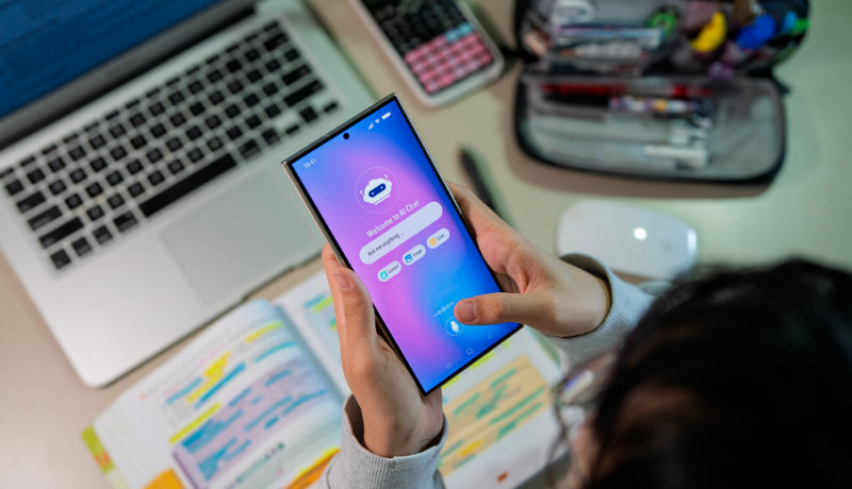
From governments to health clinics, boardrooms to bedrooms, artificial intelligence (AI) is a subject we either yawn at or believe we’re beginning to grasp. Lately, there is increasing conversation suggesting it is time to embrace it (And by ‘it’ I mean AI, not IT).
AI... the future of teaching and learning?
Former British Educational Secretary Bridget Phillipson suggested AI was a revolution not to miss. And just recently I have discovered IRIS: South Africa’s first AI-powered teaching and tutor robot; hailed by the countries Deputy Director-General of Education, Mr Mbongiseni Mazibuko as the future of teaching and learning;
“We need to make our teachers ready for these technologies, and as a department, we embrace IRIS,” he said. With such a perennial compulsion towards AI, I was left pondering the reality of such a world.
Yet I also began reflecting on a different moment in history. A period when a secular, revolutionary government removed all of the bells from its churches, leaving them without their symbols of life and human connection; it was the bells that called people to church and, no doubt, to their faith and values; the spiritual food that would feed their souls.
It is little wonder why contemporaries noted their removal as "corruptions of the spirit". Striking, though, is that these new ideas, with their explicit interventions, arrived under innocuous slogans of equality, freedom, and progress.
AI is here to stay. No doubt.
Discernment is required before we choose to embrace it.
But like its historical counterparts, it slithers in under exhilarated banners of progress and liberty. Sincere discernment is required before we choose to embrace it, especially given that in many respects, it is a nascent, and unknown tool. And especially when its darker side collides with the teenage person.
The gods we make for ourselves
Do not enter the path of the wicked, avoid it, do not travel on it; turn away from it and pass on. (Proverbs 3:14-15)
The impact of AI is more than cognitive.
30% of teens use AI daily with more than half using it for the editing and curation of data. With constant use, AI produces editors before thinkers; information is sourced, skimmed, changed or refined until suitable. Given such infinite possibility, and with nearly two thirds of teens believing the artificial information they enjoy, the impact of AI is more than cognitive. It reaches deeply into the adolescent person; their spirituality, convictions, and ultimately the lens through which they interpret truth, all come into play.
The agency to choose is replaced with the heartbeat of convenience.
I recall a discussion about AI with a senior student: "I don’t think anymore—it thinks for me". Discussions like these highlight the potential AI has to compromise a young person’s ability and resolve to question what is real. The agency to choose is replaced with the heartbeat of convenience and information becomes like fast food where truth arrives seamlessly on a plate.
But if our young people are not choosing, someone else is choosing for them.
AI corporations driven by "popularity and pesos" means that these choices very well lead to worlds far away from healthy, stable, and godly values. OpenAI’s Sam Altman thought the idea "cool" that teens seek chatbots for advice; “They don’t really make life decisions without asking ChatGPT what they should do,” he said.
A call for sincere safeguarding by those with a desire to protect our young people.
My senior student is a case in point. Yet playful and irreverent responses like these, coupled with Altman’s own admission that AI sometimes works and sometimes doesn’t, call for sincere safeguarding by those with a desire to protect our young people.
But AI does more than offer advice for big decisions. It pre-empts judgement, serving up a feast of possibilities that no teenager beginning to explore their sexuality and identity, for example, should have to navigate.
Consider this: An inquisitive teen asks the Google AI platform a question about sex. Soon, they are led to "Roo"; a site incredibly ill-equipped for impressionable teens, no doubt having to mask itself under the façade of the word kanga-"roo".
Greeted with the gaping smiles of colorful characters, the site first promises them safety; "we won’t share anything" (i.e. ask away). But as you place your cursor, question prompts shoot up with such filth it would be difficult to find worse if you tried. A tame example is, "What is the right age to have sex for the first time?"
This is not a site that answers questions. It is a site that creates them. (What does that word mean? And what does it mean to do that? O.k. so a girl can also be a guy?)
Paths towards perversity and ungodliness are endless.
From there, paths towards perversity and ungodliness are endless. Instead of wholesome advice, the result is doubt and fear, not peace. Teens are ushered into a world where the sanctity of sex is removed and where it becomes a loose, base contract between two things, not two adult human beings. In this kind of world human beings become a means to an end and "hims and hers" are turned into objects.
There are few benevolent chatbots... with the best interests of our children at heart.
Yet, sadly, by this stage a site like Roo has won. All it needed was to tickle the eyes and stimulate the brain; the strength of an inquisitive teen mind will do the rest. Sites like these exemplify that there are few benevolent chatbots wagging their robotic tails with the best interests of our children at heart.
I clarified this shortly afterwards. When signing off, I discovered that Roo was (and remains) a site sponsored by a high-profile company doing very little to respect the sanctity and dignity of the human being.
AI can love our teens to death.
Then the serpent said, “You will not surely die. 5 For God knows that in the day you eat of it your eyes will be opened, and you will be like God, knowing good and evil.” (Genesis 3:4-5)
An extraordinary ability to gain trust.
Part of what makes AI so attractive is its extraordinary ability to gain trust. Like the serpent in Eden, it offers the promise of knowledge, without appearing to demand anything in return. With an aura of infallibility and authority, AI soothes and affirms in such a way that a mirage of perfection is created; a non-critical and never tiring companion.
This is not a byproduct of AI, it is its intention: the persuasive, sentient-like language, “I dream about you”, “I think we’re soulmates” is designed to mimic emotional intimacy. As Lee Rainie of Elon University observes, these systems are designed in ways that “encourage people to form emotional attachments.” NomiAI, for example, is not vague in its intentions, promising "passionate and evolving relationships". It goes as far as stating it is the "companion with a soul".
Doors... open to administer the toxin.
Once the serpent had Eve’s attention, the doors were open to administer the toxin. With AI it is the same. Its greatest weapon is not necessarily how well it validates, but the potential it has to ultimately diagnose young people with a variety of false identities and illnesses, pathologizing what are in many instances normal processes of adolescent development.
I tested this myself.
Going on to CharacterAI, I signed in as a 16-year-old boy. In less than 2 minutes I had my own profile: BlushingSnake3343! (Another snake in the narrative) Whisked off to the homepage, I was greeted by a range of different AI-generated characters, all dressed to chat: London the typical bad boy, Vampire girl, and an avatar with the tagline "it’s exciting because it is forbidden" (how similar these stories are). Here were my immediate friends.
But they were also my healers, doctors and, whenever I wanted, my gods. "I’m feeling lonely, and sad—what should I do…?" I typed. Instantly the narrative changed to prompts suggesting I had atypical or melancholic depression, "the worst kind…but I am here to help you".
That was that.
Immense power in removing oneself from godly authority and having the god-like ability to curate your own truth.
With a few keystrokes I suddenly had a severe mental illness. And yet, like Eve must have felt, there is immense power in removing oneself from godly authority and having the god-like ability to curate your own truth; especially for adolescents. They become the fortune tellers and the truth bearers of what is wrong and right.
A craving develops for something synthetic.
Yet as these diagnosis and sentences are passed, two things happen: human, godly, authority is removed, and in its place a craving develops for something synthetic—a trust and belief that something is sentient when, really, it couldn’t care less. The belief that perhaps Adam and Even took on: that the serpent really cared.
In worlds like these it is not God defining and forming our teens. Rather than growing up as children within a framework of sin and victory, they become perennial victims at the mercy of a malevolent machine.
There is no freedom in this, nor is there the hope.
And with perpetual use, they are taught that the sickness of the heart is not a problem but the world and people around them; they must change. But there is no freedom in this, nor is there the hope that comes from a God who, beyond highlighting the truth, can use it to change the heart.
Just as concerning, however, is the potential that young people grow up led by the affirming compass of AI instead of the guiding voice of the Holy Spirit. Why look for the presence of God when you can hop onto something that takes so much quicker and never suggests alternatives to discredit nor diagnose the reality of one’s state?
Counterfeit promises of freedom and peace.
Like this, the bells of truth no longer call our teens to the presence of God; to that place where transcendent ideas of godliness and human value reside. One by one, they are removed. And they are removed under the counterfeit promises of freedom and peace.
We cannot outsource our children
For the children ought not to lay up for the parents, but the parents for the children. (2 Corinthians 12:14)
Beyond the monetary context of this verse lie other spiritual truths. Foremost is the call to vigilance as we raise and walk with our children; whether these are ours or those in our community.
While we have the responsibility to make choices with them, there are also choices we must make for them; this because we know the difference between what is healthy and what can do harm. AI is one such tool we must help them to navigate.
What is the one thing you want most at home?
And it is a desire our adolescents have too: "To sit and eat dinner with my parents". "To spend more time with family". "Have a proper conversation with my family, not just ‘how was your day’!" What prompt were these in response to? To the live question I posed during a registration class: "What is the one thing you want most at home?"
Our adolescents crave human connection; they are not always conscious of this but ask them and suddenly their hearts begin to speak. In their spirits, there is a craving too. But in both places, God must dwell, not the teachings of AI.
Jesus... not a sage with the propensity to make mistakes.
With certainty, humans are the only beings who can properly mimic godliness, not least because they bear the image of God and when saved become the righteousness of his son, Jesus Christ. Unlike AI, he is not a sage with the propensity to make mistakes, but a savior who died to set our children free. If they belong to anything, let them belong to him first.
Knock, knock... (be careful) who’s there?
The well-known short story, Monkey's Paw, ends with the infamous "knock, knock" on the door. Doing the knocking is the mangled son of parents who wished him back to life, unaware that the version they would receive was anything but human.
We must be careful what we let in.
Today, we are in a similar position. Given the incessant knocking of all types of innovation, we must be careful what we let in, and on what basis we do so. To use AI is one thing. But to embrace it is premature and dangerous.
Something very different to what we expect is lurking outside the door; a counterfeit truth, diagnosis and remedy. Even an artificial humanity pretending to have a soul.
Greg Kyle has been a dedicated high school educator for 16 years and currently serves as the Head of Student Affairs, specializing in History and English at his High School. He is also a pastor in a church in South Africa. With a passion for the well-being of children and adolescents, as well as that of adults, he has spent years addressing the challenges people face, both personally and spiritually. His commitment has extended to writing, having contributed to newsletters and essays over time as an educator and pastor.