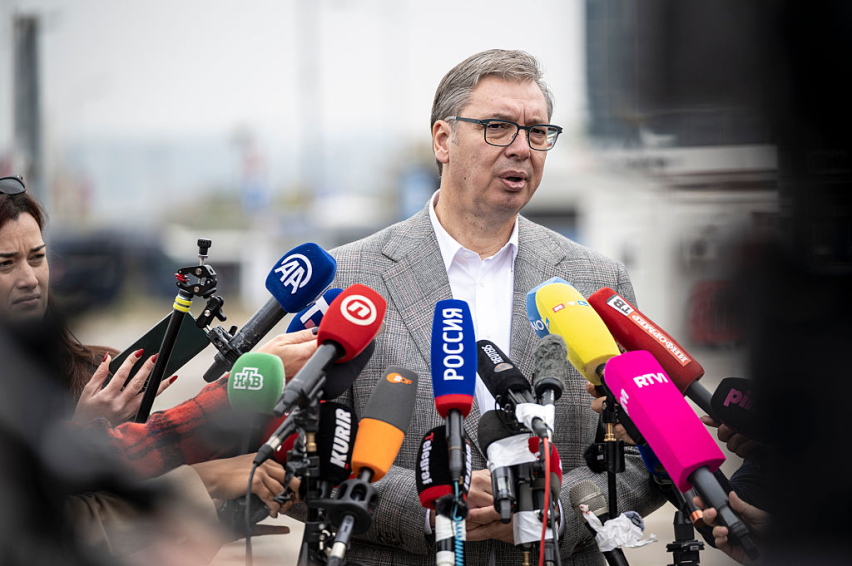
Aleksandar Vučić, who has dominated Serbian politics as prime minister or president since 2014, conceded defeat Sunday to a student-led anti-corruption movement in snap parliamentary elections.
"It is clear that we have lost these elections, the Student List has won," Vučić said in a televised speech.
Citing preliminary results, he said the Student List would take 135 to 140 seats in the 250-member National Assembly and his Serbian Progressive Party, known by its Serbian initials SNS, would win 105. The election commission had not released official results.
The vote follows nearly two years of street demonstrations set off by a deadly canopy collapse at the railway station in Novi Sad. Pastors, students and academics from Serbia's small evangelical community joined those protests, and several told Christian Daily International over the past 18 months that they saw the movement as a fight for justice.
Highest turnout in decades
Pollsters and the election commission put turnout at close to 70%, the highest since 1992, Reuters reported. The commission's figures showed 64.9% of voters had cast ballots by 6 p.m. local time, two hours before polls closed.
Long lines formed outside polling stations across the country. Serbian citizens also went to polls in several other countries across Europe and in some cities in the US.
"(The turnout) did not surprise me because there was a large and strong mass that has formed throughout the past two years," voter Katarina Petrović told Reuters.
Celebrations in Belgrade and Novi Sad
Minutes after the concession, crowds that grew to tens of thousands filled central Belgrade. People danced, drivers sounded their horns and students chanted "victory" and "he's done." Fireworks went off over the capital.
"Serbia is free," one student told the BBC. "It's a miracle."
In Novi Sad, where the protests began, the city center was packed. "Everything is going to get better now," resident David Vasić told BBC Serbian.
Speaking for the students at their headquarters, Belgrade University professor Radomir Sajčić said: "Dear Serbia, tonight the voice of the people is being heard. Tonight we celebrate victory, tomorrow we build the future."
Questions over the new majority
The Student List has no clear leadership, and most of its 250 candidates are political newcomers. They include university professors, doctors, actors, farmers and athletes.
Cardiologist Ilija Srdanović headed the list, but it was not clear who would become prime minister, Reuters reported. Srdanović told BBC Serbian: "This will be a free state." He said the movement aimed to "free the country from tyranny."
The students campaigned on rooting out corruption and improving education. Their platform also called for removing officials who broke rules while cracking down on protesters, ending the appointment of party loyalists to run state-owned companies and freeing the public broadcaster from political control.
Political analysts expect a purge of Vučić allies in the police, security services and government ministries, according to Reuters. The students have said little about foreign policy. Any new government will have to manage ties with China, a major investor; Russia, Serbia's traditional ally and main supplier of natural gas; and the European Union, its largest trading partner.
Vučić's campaign
Vučić resigned partway through his second term as president to run for prime minister, a post he held until 2017. He called the snap election in September.
He campaigned on promises to raise pensions and public-sector wages and to invest in state health care. Vučić supports Serbia's bid for EU membership but has refused to impose sanctions on Russia over its invasion of Ukraine.
Supporters credit him with modernizing the economy and building highways, railways, schools and hospitals. Vučić and the SNS have repeatedly denied accusations of corruption, repression and spying on opponents. He has accused foreign agents in Croatia and Montenegro of funding the students, a claim the students reject.
"Some businessmen, some people will leave us but our structure is firm, we are very united, very strong, we are used to being in the opposition," Vučić said after conceding.
From station collapse to snap elections
The protests began after the canopy at Novi Sad's railway station fell on Nov. 1, 2024, killing 16 people. Critics blamed corruption and negligence in the station's renovation. Demonstrations spread to Belgrade and other cities, closing universities for four months, and grew into the largest protests in a generation. Rights groups and activists say repression has worsened since they began.
In March 2025, the Rev. Dusan Beredi, pastor of the Protestant Christian Fellowship Novi Sad, told Christian Daily International that students wanted documents released that would show the extent of corruption and hold those responsible to account.
"At its core, this protest is a call for justice and a fight against corruption," he said at the time. Beredi said students were wary of opposition parties, "considering them equally prone to corruption."
"I see God's hand in this because we have prayed for a long time for this to happen," he said.
Kristina Tešić, a local coordinator for the International Fellowship of Evangelical Students in Serbia, said she joined the protests as both a student and a Christian. "We have had enough of corruption, we see everything, we know everything, and we want change," she said.
Warnings and prayer
By August 2025, some demonstrations had turned violent, with clashes between protesters and riot police and arson attacks on SNS offices. The Serbian Evangelical Alliance responded with a national initiative of prayer and fasting.
"Pray for the leaders to make wise decisions," Samuil Petrovski, the alliance's president, said then.
Beredi said in August that the violence had led him to stop taking part as a pastor, though he still joined and supported the protests as a private citizen.
Tatjana Samardžija, an assistant professor at the University of Belgrade, warned at the time that Serbia was "on the verge of civil war."
When Vučić announced in June that he would resign as president and call elections, both voiced doubts. "If President Vučić were to step down, many expect it would be in order to run again under a new political arrangement rather than to leave politics altogether," Beredi said in July.
Samardžija said Vučić wanted to extend his hold on power by moving between the presidency and the premiership. "Corruption is horrible," she said.
Beredi had also cautioned in 2025 that the long unrest risked splitting the country. "There is a danger of great division in society," he said. "The church must be a unifying factor."