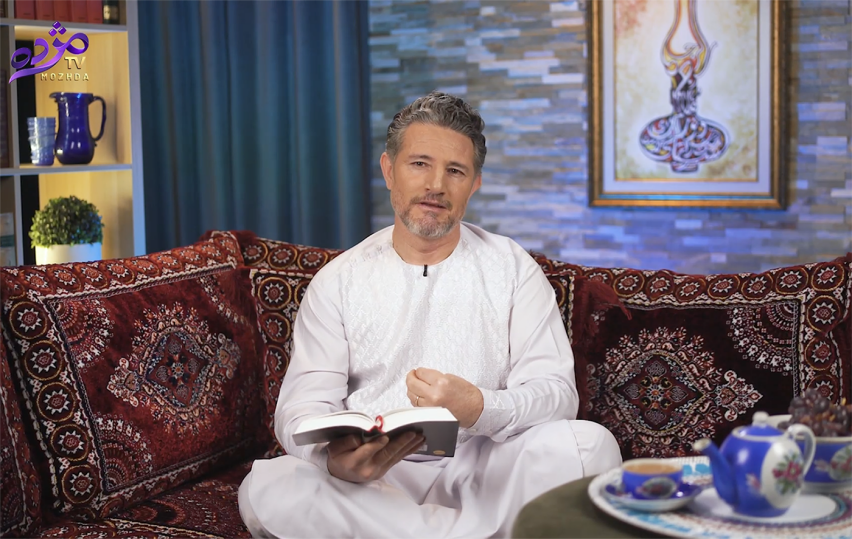
Mozhda TV, which its founders describe as the first Afghan Christian television channel, began broadcasting Saturday, Oct. 24, as church leaders, mission partners and Afghan believers gathered to mark its launch.
The satellite channel will carry Christian programming to Afghanistan in the country’s languages. Speakers at the event presented it as the product of decades of prayer and a coalition of mission organizations and Afghan Christian leaders.
Christian programs for Afghan audiences have aired for many years, but there has been no channel dedicated to them. Organizers said Mozhda TV is the first television channel to go live as an Afghan Christian channel.
“This day, for the first time in history, the first Afghan Christian satellite channel will start its broadcasting to Afghanistan and around the world,” said Shoaib Ebadi, executive director of the Afghanistan Bible Society, in a recorded video message.
‘Sheep without a shepherd’
Masoud Ghorbani, Mozhda TV’s executive director, delivered the main sermon minutes after the channel went on air. He preached from Mark 6:34, in which Jesus sees a crowd and has compassion on them “because they were like sheep without a shepherd.” Ghorbani asked the audience what they see when they look at Afghanistan, then asked what Jesus would see.
Afghans have endured years of suffering, he said. He pointed to separated families, persecution and discrimination against women, mothers who see no future for their children and young people struggling with despair.
The deepest tragedy for a nation, Ghorbani said, may be not its suffering but that it does not know its true shepherd. He told listeners that millions of Afghans now have an opportunity to hear the gospel.
“Jesus Christ is the good shepherd of Afghanistan,” he said, citing John 10:11.
Ghorbani also commented that the channel could reach many different audiences. “We don’t know who is watching our program for the first time right now, perhaps even the Taliban,” he said. “We need to pray for them.”
'Almost everyone has a television and a satellite dish'
In an earlier Finnish-language interview, Ghorbani and producer Mikael Tunér explained why the team chose satellite television.
After the Taliban took power in 2021 nearly all missionaries were removed from Afghanistan and Christian materials were banned and destroyed. Internet access has also been cut at times.
“Almost everyone has a television and a satellite dish at home,” Ghorbani told Sansa. “The Taliban control the country, but they cannot control the satellites.”
Tunér, a senior technical specialist and producer who previously spent nearly 20 years at the Persian-language Christian channel SAT-7 PARS, said it matters that Afghans see Christians from their own nation. He told the Finnish outlet that although the Taliban claim there are no Christians in the country, underground churches exist and several thousand Christians live there.
The channel airs programs in Dari and Pashto and plans to add other Afghan languages, including Hazaragi, Uzbek, Turkmen and Baluchi. “Our strategy is to make at least some program in every language, so that every viewer could find something to watch in their own heart language,” Tunér said in the interview.
Programs for women are a central focus. The channel is producing series that women can watch privately at home, including health programs and content that could help them continue their studies.
“We want to tell them that the Lord loves them and that ‘this is not the end; hold on to hope,’” Ghorbani said. Since March, the team has been recording new series.
From gramophones to satellite
At the launch, a former missionary who arrived in Kabul with his family in the 1970s traced how gospel outreach in Afghanistan has changed over five decades.
He recalled co-workers returning from mountain villages with records from Gospel Recordings, which had recorded New Testament stories in about 50 of Afghanistan’s languages. Villagers played them on gramophones made of thick cardboard, turning the records by hand with a pen.
In the 1980s, he said, he and a colleague built a cabinet on wheels holding a television and video player. They loaded it into a car, along with a generator, and showed a film on the life of Jesus based on the Gospel of Luke in Afghan homes.
With the new channel, he said, the message will reach “not only one village, not only one home, but the whole of Afghanistan.” He cited Psalm 147, which describes God’s word running swiftly across the earth.
An answer to a prayer from 1986
Harun Ibrahim, the founder of Al Hayat Ministries who was born to a Muslim family in Jerusalem and became a Christian in Finland in 1985, said the vision dates to a youth camp near Tampere in 1986. Participants prayed for a number of countries there, he said, and Afghanistan was among them.
“It was just like this time, the fall, and after 40 years, we have it,” Ibrahim said.
He said Mozhda TV brought together mission organizations from different denominations, which united to launch the channel. He praised the channel’s staff for learning media production within a year and said he expects the channel to not only reach Afghanistan but also its neighboring countries.
The event included worship in Farsi and Dari and a prayer of blessing over the Mozhda TV team.
Mozhda TV is now available online at mozhda.tv.