

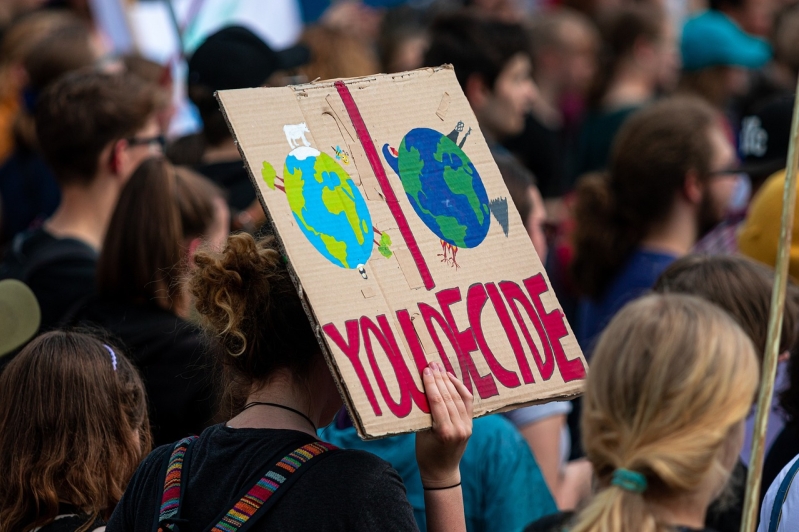
As concern about climate change continues to rise worldwide, the greatest obstacle to action is not denial but confusion over what to do according to leading climate scientist Katherine Hayhoe, climate ambassador for the World Evangelical Alliance, who says many people fail to see how the crisis directly affects their daily lives.
In an exclusive interview with Christian Daily International, Hayhoe said widespread anxiety about climate change has not translated into meaningful action because people have not “connected the dots” between rising housing or insurance cost with the quality of air, fossil fuels pollution and the climate crisis. “They don’t know what to do,” she added.
“The biggest challenge we have right now is that around the world, the majority of people are worried about this issue. But they don't understand how it affects them personally,” she said.
“You ask people, what can I do about it? And from America to Singapore, the number one answer is ‘recycle.’ And don't get me wrong, I recycle with the best of them, but that is not the solution to the climate crisis. It's the solution to a waste issue.”
This creates a “paralysing situation,” added the scientist, which concerns her because it creates a sense of societal indifference because people think there seems to be no accurate solution to the crisis.
“More and more people are dissociating and disconnecting and even becoming paralyzed from this issue,” she said.
“And then into that void, come the current structures of power and wealth in this world, which are primarily built on the extraction, processing, and sale of fossil fuels, and they realize that the world is changing as quickly now as it did at the beginning of the Industrial Revolution, so to speak.
“It's like the horse-and-buggy manufacturers of the world 100 years ago who controlled the power and wealth structures of the world. And they've decided that the car poses an existential threat to the horse and buggy market. And so they're doing everything they can to make sure that horses and buggies remain the mode of transportation in the future.
“That's exactly what the fossil fuel industry and those who support and benefit from them are doing today. So there's direct opposition to action.”
Hayhoe believed the majority of people are worried and want action but they “don't know what that looks like and they haven't made that connection.”
“So that's why I, as a physical climate scientist, spend so much of my time these days working in human behavioral science, because that is where the biggest barrier is to action.”
For Hayhoe, the urgency of the situation requires a response for Christians taking what the Bible says seriously.
“For me as a Christian, I believe that if we take the Bible seriously, that we will be at the front of the line demanding action because climate change disproportionately affects the poorest and most vulnerable people on the planet who've done the least to cause this problem, the very ones who we are told to care for and to love,” she said.
“And we believe that God has given us responsibility to care for every living thing on this planet, which includes animals, plants, everything we have in the ocean, as well as on land. And it also includes our sisters and brothers right here living beside us, as well as on the other side of the world.”
Hayhoe lauded the understanding of human wellbeing being dependent in turn upon the wellbeing of nature, as shown by large charitable organizations such as Tearfund and A Rocha, World Vision, Compassion International and Plant with Purpose.
“We cannot address those [human wellbeing issues] without tackling the climate and nature crises,” she pointed out.
The unique approach for Christians on tackling the issue is simply showing care to creation and Hayhoe said God has “literally given us the ability to act,” as commissioned in the biblical book of Genesis.
“He has poured out his love in our hearts to share with those around us. And he's given us a sound mind. What greater gifts could we have to make the right decisions for people and for the planet today?”
Hayhoe acknowledged that some Christians, preoccupied with the end of the world and End Times theology, present a challenge in regards the issue —”the number of theologically sounding objections to climate change abound.”
However, she believed that “if you scratch the surface,” these objections do not relate to theology and “can be easily dismissed by reading the Bible.” Instead, the climate scientist said such objections by some Christians related to an ideology.
“They have everything to do with ideology and people basically writing their statement of faith based on ideology rather than theology. And if the two come into conflict, they will go with ideology over theology.”
She referred to a YouTube series she presents called “Global Weirding” and one of the most popular episodes has been addressing what the Bible says about climate change. The episode addressed the most common objections, which is that if the world is ending anyway, why care to look after it?
However, Hayhoe said that people spoke similarly to the apostle Paul in the book of Thessalonians, some 2,000 years ago.
“They were actually quitting their jobs, and basically putting their feet up and saying, ‘Maranatha, come Lord, come.’ And he [Paul] wrote to them and he said, in a nutshell, paraphrasing, get a job, you know, care for the widows and the orphans. You don't know when the date or time is. And in the meantime, we are actually called to love others and care for others.
“So that exhortation applies today. And people often say, too, God's in control. So why does this matter? Well, in Genesis chapter one, it literally says God gave us responsibility over all living things on this planet.
“So when Christians have theologically sounding objections to climate change, they typically can be dismissed by the same theology that they claim to believe in.”
As a Canadian, Hayhoe disclosed that she had not heard of such objections until moving to the U.S. some 20 years ago. Whenever she travels abroad, she often hears similar narratives and upon asking people where they heard such objections, it can always be traced back to a source in the U.S.
More alarmingly, Hayhoe referred to the findings of a study by her colleague Jean-François Mouhot, National Director of A Rocha France, the French branch of the international Christian conservation organization A Rocha. He is a historian and apparently found that the denial of climate — whether it is real or a human cause, its seriousness and the prevailing need to act upon it — originated with narratives created by fossil fuel companies in the 1980s and 1990s.
Furthermore, she recommended a book on the subject titled, “Merchants of Dout” by Erik M. Conway and Naomi Oreskes, which explains how the denial of climate change entered Christian circles.
“So when people in the church say, well, you know, God's in control. Why does it matter? The world's going to end anyway. I don't argue with them based on science. I say, well, let's look at what the Bible actually says.”
“I think that something really important for people to recognize is that to care about these issues, you don't have to be a scientist or environmentalist,” added Hayhoe.
“You only have to be a human being living on this planet because if you live on this planet, which we share with eight billion other people, you depend on this planet for the air that you breathe and the water you drink and the food you eat and everything that we ship across the ocean comes from the resources of this planet.
“And so to care about the future of this planet, you literally just have to be a human being living on this planet. And if you're that, then you have everything you need to care. So that's sort of the bottom line.
“And then the layer I would add to that is, as Christians, if we take the Bible seriously, we don't only have every reason we need to care, we have every mandate and resource we need to care. And God has given that to us. So even more, how much more reason do we have not only to care, but to act?”


