
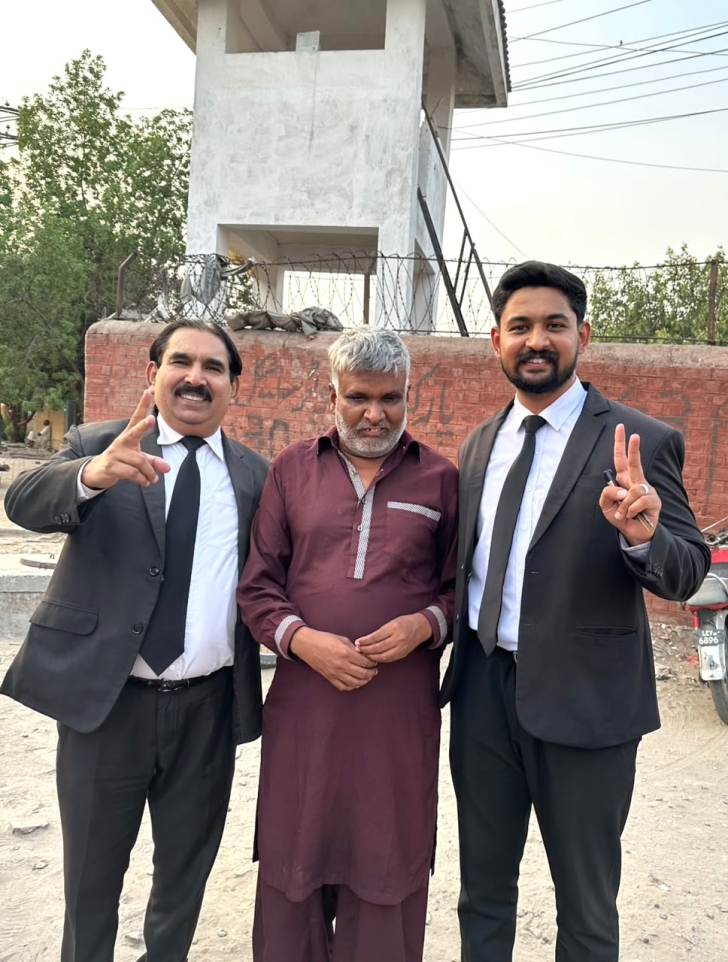
A court in Pakistan has acquitted a blind Catholic who spent 10 months in prison on a blasphemy charge carrying a mandatory death sentence, ruling that prosecutors failed to present sufficient evidence to prove the allegation, his lawyer said.
Lahore Additional Sessions Judge Saad Salman Khan on June 22 ordered the release of 49-year-old Nadeem Masih, who has been blind since birth, from a case registered under Section 295-C of Pakistan’s harsh blasphemy laws, which criminalizes alleged insults against the Prophet Muhammad and carries a mandatory death penalty upon conviction.
Attorney Javed Sahotra, who represented Masih alongside attorneys Shawaiz Javed and Hafiz Zahid Islam, said the defense exposed significant weaknesses in the prosecution’s case.
“During the trial and final arguments, the defense team identified numerous deficiencies, inconsistencies and procedural shortcomings within the prosecution's case,” Sahotra told Christian Daily International-Morning Star News.
According to Sahotra, the defense argued that the First Information Report (FIR) failed to specify the allegedly blasphemous words attributed to Masih. They also challenged the reliability of witness testimony, noting that statements from six prosecution witnesses were recorded after delays that undermined their credibility.
The defense further argued that no independent witnesses were presented to corroborate the allegations and pointed to inconsistencies surrounding the alleged incident. Prosecutors claimed the offense occurred at 11 p.m. in a public park, despite information indicating that the park closed at 9 p.m.
“The complainant's version lacked independent corroboration,” Sahotra said. “The police neither submitted call data records nor location data of the accused in court. It also did not produce any digital evidence to independently verify the allegations.”
He added that multiple contradictions emerged during the testimony of prosecution witnesses, further exposing flaws in the investigation.
According to Sahotra, the court accepted the defense argument that criminal liability cannot be established through assumptions, speculation or unsupported allegations, and that guilt must be proven beyond a reasonable doubt through reliable and legally admissible evidence.
Masih was released from Lahore’s District Camp Jail on Tuesday (June 23) and reunited with his elderly mother and sisters, the attorney said.
Masih was arrested on Aug. 21, 2025, at Model Town Park in Lahore. According to the FIR filed by Police Sub-Inspector Muhammad Ayub, police officers were patrolling the park at approximately 11 p.m. when they received information regarding the alleged blasphemy.
Masih’s family has consistently maintained that the accusation arose from a dispute with local contractors.
His mother, 80-year-old Martha Yousaf, a resident of Chak No. 9/4L village in Punjab’s Okara District, previously told Christian Daily International-Morning Star News that her son earned a modest living by operating a weighing scale for visitors at the park.
She alleged that some park workers regularly harassed him, extorted money from him and borrowed money without repayment. On the day of his arrest, contractor Waqas Mazhar and several others allegedly prevented Masih from setting up his stall, assaulted him and took him to the Model Town Police Station, where he was subsequently accused of blasphemy.
Yousaf also alleged that her son was beaten while in police custody and pressured to confess to a crime he did not commit.
Despite his disability, Masih completed his university education and served as the sole breadwinner for his family following the deaths of his father and another son, according to Yousaf. One of his divorced sisters now works as a domestic worker to help support the household.
Pakistan’s blasphemy laws have long been criticized by human rights organizations, which argue that the statutes are frequently misused to target religious minorities, settle personal disputes and pursue economic interests.
In a June 9, 2025 report titled “A Conspiracy to Grab the Land: Exploiting Pakistan’s Blasphemy Laws for Blackmail and Profit,” Human Rights Watch said blasphemy allegations are increasingly being weaponized to provoke mob violence, displace vulnerable communities and facilitate property seizures.
“Blasphemy accusations are increasingly weaponized to incite mob violence, displace vulnerable communities and seize their property with impunity,” the 29-page report stated.
The report noted that broadly worded legal provisions allow accusations to proceed with minimal evidentiary requirements, contributing to fear and insecurity among vulnerable groups.
While Section 295-C mandates the death penalty upon conviction, courts occasionally grant bail or acquit defendants when serious questions arise regarding the credibility of evidence. Such decisions, however, remain relatively uncommon due to intense public sensitivities surrounding blasphemy allegations.
According to the Human Rights Commission of Pakistan’s annual report, 812 people were imprisoned on blasphemy-related charges in Punjab in 2025, including 796 men, 15 women and one juvenile.
International advocacy groups continue to rank Pakistan among the countries where Christians face significant persecution. In its 2026 World Watch List, Open Doors ranked Pakistan eighth among the 50 countries where Christians face the greatest challenges, citing systemic discrimination, mob violence, forced conversions, bonded labor and gender-based abuses. The report also noted that perpetrators frequently act with impunity amid weak law enforcement and strong societal pressures.








