

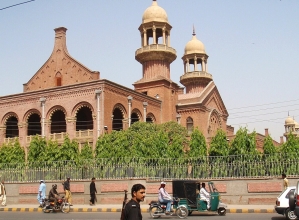
A high court in Pakistan this month rejected bail for a blind Christian charged with blasphemy despite significant discrepancies in the police report and prosecution testimonies, his attorney said.
Attorney Javed Sahotra said Justice Muhammad Jawad Zafar of the Lahore High Court (LHC) on Feb. 4 dismissed the bail petition of 49-year-old Nadeem Masih, in custody since Aug. 21 on a charge of blasphemy that is punishable by death. Sahotra said the court declined bail on grounds that the accused might abscond or attempt to influence witnesses if released.
“We were hopeful that the high court would grant bail because the discrepancies in the First Information Report [FIR] and the questionable statements of the prosecution witnesses warranted further inquiry,” Sahotra told Christian Daily International-Morning Star News. “However, the judge observed that he feared the accused could abscond or influence witnesses.”
Masih is completely blind and comes from a low-income family, his lawyer said.
During the hearing, Sahotra cited a 2024 ruling by the Multan Bench of the Lahore High Court, authored by then-Justice Sarfraz Dogar, who now serves as chief justice of the Islamabad High Court. In that case, a murder suspect was granted bail after becoming blind while in custody.
Sahotra also referred to a 2022 Supreme Court decision granting bail to Salamat Mansha Masih, a Christian, in a separate blasphemy case. The two-judge bench of the Supreme Court of Pakistan found that the primary witnesses against him, park employees, had falsely implicated him.
Nadeem Masih was arrested from Model Town Park in Lahore on Aug. 21 and later charged under Section 295-C of the blasphemy statutes, which mandates the death penalty for insulting Muhammad, the prophet of Islam, according to court documents.
Police Sub-Inspector Muhammad Ayub filed the FIR, stating that he and his team were patrolling the park at 11 p.m. when they received information about the alleged blasphemy.
Sahotra challenged that account, noting that the park closes at 9 p.m. and that call data records for both the complainant and the accused allegedly indicate neither was present at the park at the time cited in the FIR.
He also questioned the credibility of two prosecution witnesses, parking contractors who told police on Aug. 22 that Masih had made derogatory remarks about Islam’s prophet on Aug. 9, but that they had not reported the matter at the time.
“These delayed statements raise serious doubts about the prosecution’s case,” Sahotra said.
Masih’s family alleges that the blasphemy charge followed a dispute with local contractors. His 80-year-old mother, Martha Yousaf, a Catholic resident of Chak No. 9/4L village in Okara District, Punjab Province, said her son earned a modest income by operating a weighing scale for visitors at the park.
She alleged that some park workers harassed him, extorted money and, in some cases, borrowed money without repayment. On Aug. 21, contractor Waqas Mazhar and others prevented Masih from setting up his stall, assaulted him and took him to the Model Town Police Station, where he was accused of blasphemy, she said.
Police have not publicly responded to the family’s allegations of assault or coercion.
Yousaf said her son told her he was beaten in custody and pressured to confess to a false charge.
Masih, who completed his graduation despite his disability, was the sole breadwinner for the family after the death of his father and another son, Yousaf said. One of her daughters, who is divorced, now works in private homes to support the household.
Pakistan’s blasphemy laws have long drawn criticism from rights groups.
In a June 9 report titled, “A Conspiracy to Grab the Land: Exploiting Pakistan’s Blasphemy Laws for Blackmail and Profit,” Human Rights Watch said the laws are frequently misused to target religious minorities, settle personal disputes and seize property.
“Blasphemy accusations are increasingly weaponized to incite mob violence, displace vulnerable communities and seize their property with impunity,” the 29-page report states. It adds that the broadly worded provisions of the law allow accusations to proceed with minimal evidence, fostering fear among vulnerable groups.
While conviction under Section 295-C carries a mandatory death sentence, courts at times have granted bail in blasphemy cases, particularly where questions arise about the credibility of evidence, but such decisions remain rare amid strong public sensitivities surrounding allegations of blasphemy.
International watchdogs continue to rank Pakistan among countries with high levels of persecution of Christians. The country ranked eighth on Open Doors’ 2026 World Watch List of the 50 countries where it is most difficult to be a Christian. The report cited systemic discrimination, mob violence, forced conversions, bonded labor and gender-based abuses, noting that perpetrators often operate with impunity amid weak law enforcement and societal pressure.


