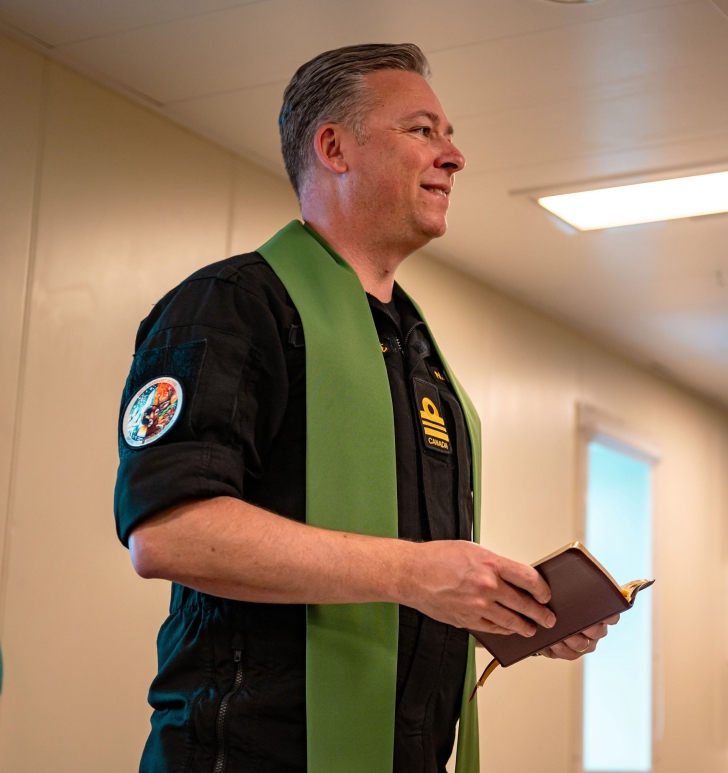
A new national policy in Canada forbids military personnel, including chaplains, from making references to God or any religious tradition at public events, prompting objections from the Evangelical Fellowship of Canada (EFC).
The Department of National Defense on July 26 issued personnel instructions titled “Spiritual Reflections in Military Settings” that bars faith-specific language and references to God during official public and semi-public ceremonies where personnel attendance is mandatory.
“CAF [Canadian Armed Forces] members providing public remarks or an address of any type at a public or semi-public event in their capacity as a CAF member shall uphold the principle of state religious and spiritual neutrality by not using words, actions, or symbols that are specific to a particular SFT [spiritual or faith tradition] on the part of the Government of Canada,” state the instructions.
While the directive permits chaplains to hold voluntary religious services, offer prayers at military funerals and provide pastoral care to personnel and families, it
prohibits them from praying, using faith-based symbols, or referring to God or the divine during public, semi-public and government-sponsored events, as well as mandatory military gatherings. This includes Remembrance Day ceremonies, which the Royal Canadian Legion typically hosts.
“This policy goes beyond banning prayer and prohibits even the acknowledgment to those gathered that some may believe in the divine and others not,” said Bruce Clemenger, EFC senior ambassador, president emeritus, and member of the Interfaith Committee for Canadian Military Chaplaincy. “This exclusion restricts the spiritual reflection of chaplains to a secularist and characteristically humanist expression.”
The directive replaces traditional prayers with neutral “spiritual reflections” at mandatory functions like graduation parades and change-of-command ceremonies.
Clemenger noted that chaplains previously offered preambles recognizing diverse beliefs before delivering non-denominational prayers or reflections.
“In 2023, the policy changed to prohibit any prayer,” Clemenger said. “Now, even a mention of God or any religious language is not allowed.”
The Canadian Armed Forces designed the 2023 policy to make spiritual reflections as inclusive as possible. Stating that military officials acted after non-believers reported feeling excluded by prayers or mentions of God, the EFC warned that the new policy eliminates acknowledgment of believers’ views.
“The policy presumes that the absence of any reference to the divine or use of religious language does not take sides among various worldviews or show favoritism to any one faith tradition,” Clemenger said. “But the exclusion rests on the myth of neutrality; it privileges one belief system over others.”
Defense officials based the policy partly on Supreme Court of Canada rulings regarding state neutrality, according to the EFC. The group noted that an earlier ruling acknowledged the impossibility of total neutrality, while a 2015 decision addressed the exclusionary impact of a city council reciting a set prayer at every meeting.
The organization asserted that the new rules enforce a specific secular worldview rather than maintaining a non-preferential, pluralistic stance.
“Prior to this policy, preambles were used to acknowledge the diversity of religious and spiritual views, and a rotation between prayers and spiritual reflections ensured one view was not privileged over others, something the Supreme Court has ruled against,” Clemenger said.
The EFC stated that the regulations diminish chaplain participation and undermine the plurality of beliefs within the armed forces. The group requested that the government rescind the policy and adopt a model offering “principled accommodation of the diverse beliefs of Canadians, including those who believe in God.”