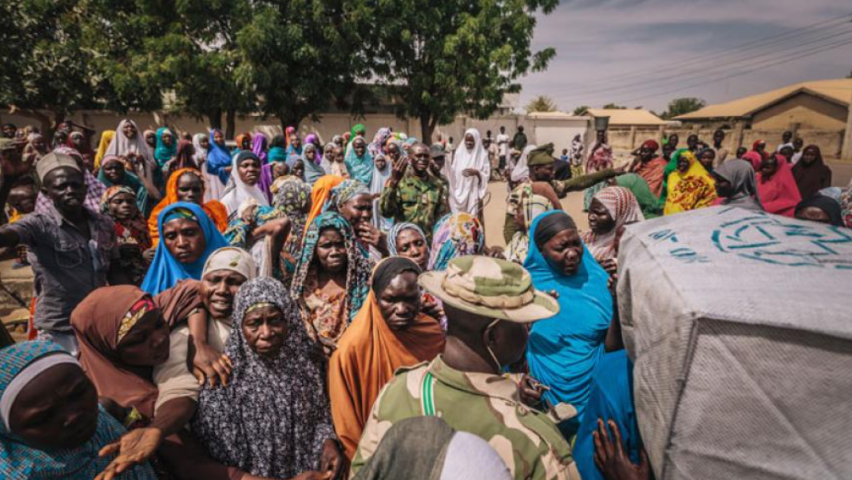
More than 1,000 Christians have been killed in northern Mozambique since 2017, while at least 1 million Christians are among those displaced by conflict in Nigeria, according to a new report warning of worsening persecution worldwide.
Aid to the Church in Need (ACN), a Catholic charity that supports persecuted Christians, said in its Persecuted and Forgotten? 2024-2026 report that conditions for Christians had deteriorated in 10 of the 18 countries examined. None recorded an overall improvement during the period reviewed, which ran from August 2024 to June.
The report identifies sub-Saharan Africa as a major center of extremist violence against Christians, documenting killings, abductions, attacks on churches and the displacement of entire communities. It also describes religious repression in countries including China and India, where Christians face government restrictions and hostility linked to religious nationalism.
According to ACN, approximately 220 million Christians worldwide are directly exposed to persecution, while 413 million live in countries where serious violations of religious freedom occur.
The charity also cited Pew Research Center data showing that anti-Christian harassment was recorded in 165 countries in 2023, up from 160 in 2021.
Nigeria bears a heavy toll
Nigeria features prominently in the report, which describes mass attacks and abductions in the northeast and Middle Belt, alongside discrimination and pressure on Christians to abandon their faith.
Attacks on predominantly Christian settlements in the Middle Belt have contributed to more than 3.5 million internally displaced people across Nigeria. Bishop Wilfred Anagbe of Makurdi described the violence as deliberate targeting of Christian communities.
“What is occurring…is an organized, systematic and brutal cleansing of Christians,” he said, according to ACN.
The report documents attacks on villages, kidnappings of worshippers and the abduction of schoolchildren. In November 2025, 253 children and 12 members of staff were seized from St. Mary’s Catholic School. In January 2026, 177 worshippers were kidnapped from three churches in northern Kaduna state.
It also highlights the continuing uncertainty surrounding the Chibok schoolgirls abducted in 2014. Of the 276 girls seized, 91 remained unaccounted for at the time covered by the report.
The human cost is reflected in the testimony of Solomon Ako, a 33-year-old Christian abducted when militants attacked his village in northern Nigeria. He told ACN that his captors beat and shackled him and other hostages after demanding that they convert.
“Every night when our kidnappers were asleep, we prayed. We prayed knowing that we were not alone,” Ako said.
His account illustrates the report’s concern that violence is not only killing Christians but also forcing survivors from their homes and disrupting the life of local churches.
Mozambique faces continuing attacks
In Mozambique, the report describes persistent violence in Cabo Delgado Province, where Islamic State-affiliated militants have attacked Christian communities while seeking to establish an Islamic caliphate and gain control of mineral resources.
ACN said more than 1,000 Christians had been killed in Cabo Delgado since the insurgency began in October 2017.
The attacks continued during the review period. In August 2025, almost 60,000 people were displaced within a fortnight following attacks in the northern province, according to the report.
Four Christians were killed in a series of attacks in neighboring Nampula province in November 2025, and one victim was beheaded.
Father Kwiriwi Fonseca of Pemba Diocese described the consequences for children and families displaced by the violence.
“This aimless war only kills, kills, kills, and takes away the little hope that the people, especially the children, had,” he told ACN in August 2025.
He called for abducted children to be found and returned to their families, saying they deserved the opportunity to have a better future.
The report also records an April attack in which militants set fire to St. Louis de Montfort Church in Minhoene, destroying the worship building, offices and missionaries’ residence.
Militants impose religious restrictions in the Sahel
Burkina Faso and Mali offer further examples of how extremist groups are restricting Christian life in areas under their control.
In Burkina Faso, militant groups control at least 40 percent of the country, mostly in rural areas, according to ACN. Christians have faced church attacks, executions and pressure to comply with Islamist rules.
Around 100 Christians were reported killed in the Zekuy-Doumbala pastoral region between May and August 2024. In an attack on Sanaba village in August 2024, insurgents separated men older than 12 who were Christians, followers of traditional religions or others considered hostile to their ideology. They took the men to a Protestant church and killed 26 of them.
The attacks on nearby Catholic parishes prompted around 5,000 women and children to flee to Nouna.
Bishop Théophile Naré of Kaya also told ACN about women who formed a human shield to protect their priest after he was attacked during Mass in August 2025.
“This heroic act was not picked up by the media, but it remains an important symbol of faith and solidarity,” he said.
In Mali, where Christians make up approximately 2.2 percent of the population, the report documents church burnings, abductions and financial extortion. In August 2024, church leaders in Mopti were reportedly given a week to accept Islamist rules or leave. The demands included conversion to Islam and compliance with prescribed dress codes.
In October 2024, militants imposed a tax of 25,000 CFA francs on adult Christians in Douna-Pen village, threatening to close churches if the payments were not made.
Sudan’s churches damaged by war
Sudan presents a different but overlapping crisis, with religious persecution occurring amid a devastating civil war between the Sudanese Armed Forces and the Rapid Support Forces.
ACN reported that more than 100 church buildings had been damaged or destroyed since the conflict began in 2023. The war has displaced millions and caused more than 150,000 deaths, according to estimates cited in the report, although some estimates are considerably higher.
In December 2025, at least 18 Christians were killed and 18 others seriously wounded in a drone strike by the Sudanese Armed Forces in South Kordofan. The victims were travelling to the Episcopal Church of Sudan in Julud on Christmas Day.
The report also documents the demolition of church buildings in Khartoum and the killing of the Rev. Youhanna Al-Amin in June. The priest had remained with parishioners in the Nuba Mountains despite escalating violence.
The evidence points to the vulnerability of Christian communities in a conflict that has devastated civilian life more broadly. Attacks on churches and religious restrictions have compounded the dangers facing people already struggling to survive.
A global crisis with different causes
Africa’s violence forms part of a wider pattern of persecution identified by ACN. In China, authorities intensified restrictions on unregistered churches and online religious activity. In India, the report recorded more than 700 incidents of anti-Christian violence in 2025, linking the increase to social hostility and the expansion of anti-conversion laws.
In Egypt, more than 30 cases of Christian women and girls being kidnapped were documented in 2024, while Christians continued to face obstacles in obtaining recognition for church buildings.
ACN cautioned that religious hostility rarely operates in isolation. Ethnicity, political instability, poverty and competition for land and resources can also contribute to violence. Nevertheless, the charity argued that the religious dimension of attacks is frequently underestimated.