A Christian legal rights group is opposing moves by European lawmakers that would allow women to travel to another country on the continent to obtain abortions under a “My Voice My Choice” (MVMC) initiative.
The MVMC initiative was submitted to the European Commission on Sept. 1 after receiving 1,124,513 verified statements of support. The European Parliament then held a public hearing and, on Dec. 17, voted in favor of the measure, with 358 in favor, 202 against, and 79 abstentions.
The European Parliament subsequently invited the European Commission to consider an opt-in financial mechanism, supported by EU funding, to help finance and facilitate cross-border access to abortion in accordance with the domestic laws of participating member states.
More than 170 civil society organizations from all 27 European Union (EU) member states have sent a joint letter to the European Commission calling for a positive and decisive response to the plan aimed at widening access to abortion services.
“The letter concludes with a clear message: a positive response to My Voice, My Choice would save lives, reduce suffering, and translate EU values into concrete action,” stated an MVMC campaign press release.
The European Commission will announce its decision on the “My Voice My Choice” (MVMC) initiative on Feb. 25, 2026.
According to the European Centre for Law and Justice (ECLJ), this could allow a French woman who is between 14 and 22 weeks pregnant — outside France’s legal time limit — to travel to the Netherlands for an abortion.
Abortions for children diagnosed with Down syndrome are illegal in Poland, but under the proposed rules, a Polish woman carrying an unborn child with Down syndrome could travel to France for an abortion, with funding from the European Union.
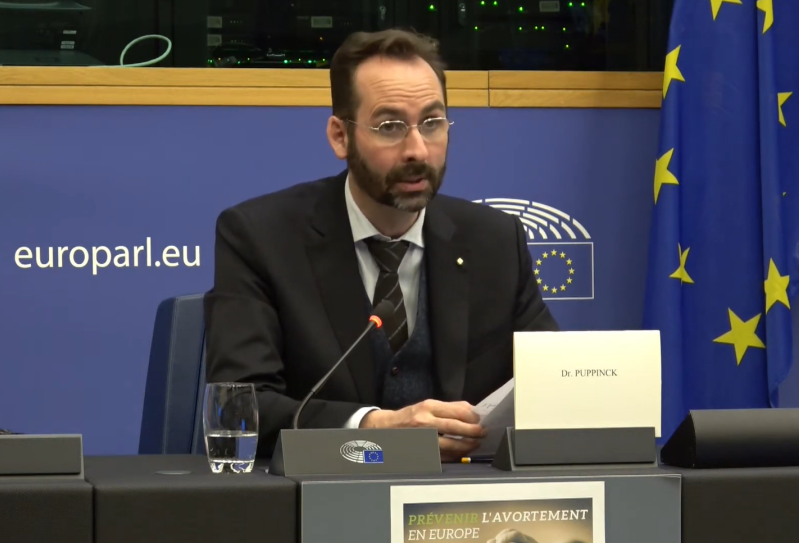
The ECLJ called the plan “scandalous,” and Grégor Puppinck, director of the European Centre for Law and Justice, sent a letter to Ursula von der Leyen, President of the European Commission; Stéphane Séjourné, former French minister and vice president of the Commission; and the twenty-five other European Commissioners, denouncing the strategy and what he described as an infringement of state sovereignty on this issue.
“The Commission’s assessment of the MVMC initiative concerns a proposal that would place Union financial instruments at the service of facilitating access to abortion, including through measures that risk circumventing national legislative frameworks adopted through democratic processes,” wrote Puppinck.
“Such an approach would involve using Union action to neutralize or bypass national law in an area of profound moral sensitivity that remains primarily within the responsibility of the member states.”
According to Puppinck, pursuing this course would risk a loss of credibility with citizens and member states opposed to abortion.
“It would amount to instrumentalizing Union competences to override national policy choices through financial means and to achieve outcomes that national legislatures have deliberately chosen to regulate differently,” he added.
“The use of Union financial mechanisms in this manner would raise serious concerns regarding the Commission’s neutrality and its commitment to sincere cooperation, and would further erode confidence in the equal and principled treatment of citizens’ initiatives in ideologically contested fields,” he said.
Puppinck, writing on behalf of the ECLJ, outlined five reasons why the initiative should be rejected.
First, the limits of EU competence and the principle of subsidiarity in matters relating to abortion.
Second, the absence of a recognized right to abortion under European and international human rights law.
Third, the institutional context and impartial assessment in which the MVMC initiative has been developed and promoted.
Fourth, the medical, psychological, and social implications of abortion for women.
Fifth, consistency and procedural fairness in the Commission’s treatment of ideologically opposed European Citizens’ Initiatives (ECIs), notably in comparison with the One of Us initiative.