
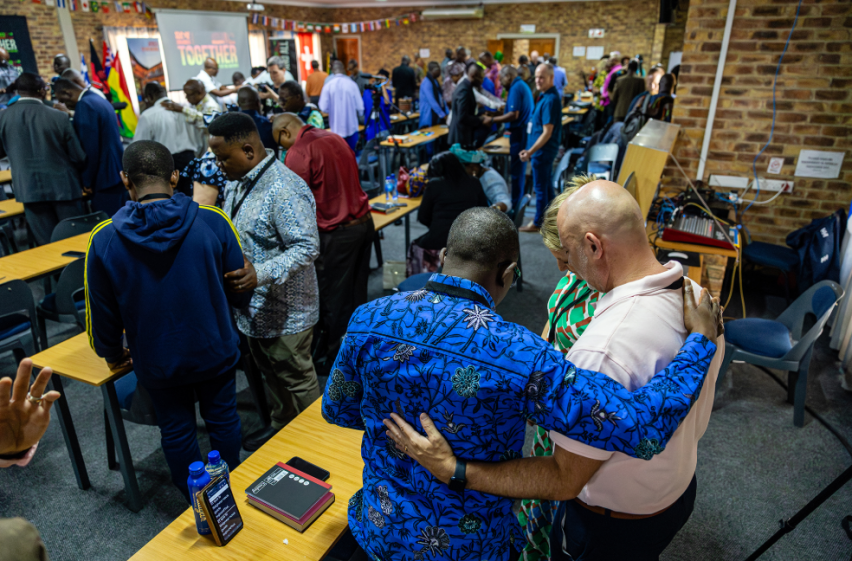
Christian leaders across Africa gathered in Johannesburg, South Africa for a meeting that aimed to affirm the narrative of global missions and position the African church as a sending force for the gospel.
The conference held on Feb. 16., brought 100 leaders from 33 African countries together under a common purpose: to equip and mobilize African believers to share the Christian faith both on the continent and around the world.
Organized by the International Mission Board, the “Together: Africa to the Nations,” conference focused on a vision that moves beyond seeing Africa as merely a field for mission work. Instead, it celebrated the continent’s growing role as a source of missionaries and mission influence globally.
For decades, Christian mission efforts were largely shaped and funded by Western organizations, sending workers into different parts of the world. But leaders who spoke at the conference emphasized that the African church has undergone significant growth in recent decades and is increasingly ready to take on a larger role in global outreach.
The gathering was notable for its emphasis on African leadership. Rather than being led primarily by Western voices, the conference put African pastors and mission leaders at the center of discussions. This choice reflected a shift toward local ownership of mission strategy.
“Christ belongs to all people. He belongs to the whole world. I know that we agree with this truth, and we embrace it, but we have come together this week to emphasize a second parallel truth,” Jeff Gunn, Senior Ambassador for U.S. and Global Relations at the International Mission Board said during the conference.
“His great commission also belongs to all nations. That means that it's not merely the privilege and the duty of select persons to carry the Gospel. That privilege and duty belongs to African believers, to Asian believers, to Latin American believers. In short, all of the Church has the responsibility to take all of the Gospel to all of the world,” he added.
Participants came from a wide range of cultural, linguistic, and national backgrounds, signaling a diverse yet united front in mission planning. Workshops and plenary sessions were led by participants who brought both theological insight and practical experience in church leadership and mission engagement.
Throughout the conference, speakers highlighted the rapid growth of Christianity in Africa. Scholars and church leaders emphasized that sub-Saharan Africa has one of the fastest growing Christian populations in the world.
This demographic trend has led many to question the conventional model of mission that sees Africa primarily as a recipient of aid and external missionaries. Instead, leaders at the conference affirmed a new reality: African believers are well positioned to contribute to mission work internationally.
A central theme of the event was cooperation. Delegates discussed ways that churches and mission organizations across the continent can work together to identify, train, support, and send missionaries.
The goal was not only to send workers abroad but also to build sustainable systems within Africa that can support long-term mission activity. Conversations touched on practical challenges such as raising financial support within local contexts, coordinating strategies among different groups, and developing training resources that are culturally relevant.
Beyond the practical aspects, the conference also took time to reflect on history. African Christian leaders spoke about the role Africa played in the early centuries of Christianity, especially in the first millennium.
These historical reminders served as a foundation for the broader vision that Africa has a legacy of faith and theological contribution that can inform and strengthen its mission engagement today.
Diaspora missionaries
Delegates also explored the role of African missionaries in regions of the world where Christianity is less established. Many African believers already live and work in diaspora communities across Europe, the Middle East, and Asia.
Participants noted that these communities often provide natural opportunities for gospel sharing because African Christians bring deep networks and authentic relationships into their host contexts. The idea was to leverage these existing movements of people as part of a broader strategy to share faith in ways that are organic and relational.
The event culminated in a collective affirmation that Africa’s church is ready to take ownership of its mission future. Leaders expressed a shared commitment to moving from vision to action. This included developing systems of mutual support, creating partnerships between churches and mission agencies, and investing in the next generation of African missionaries.
Organizers said the conference was not meant to be a one-time moment but rather the beginning of a longer journey. Follow-up conversations and initiatives were expected to take shape as participants returned to their home countries.
The conference also served as a reminder of the global shifts in Christianity over the past century. While Europe and North America were once seen as the heart of the Christian world, those regions have experienced declining church attendance and less influence in global mission decision-making.
Meanwhile, Africa, Latin America, and parts of Asia have seen steady growth in Christian populations and church engagement. For African leaders at the conference, this demographic shift reinforced the belief that their churches have both the responsibility and the capacity to participate fully in global mission work.
For the African church, the message was clear: the time to send believers out as missionaries is now, and the foundation for that movement is being laid within the continent itself.








