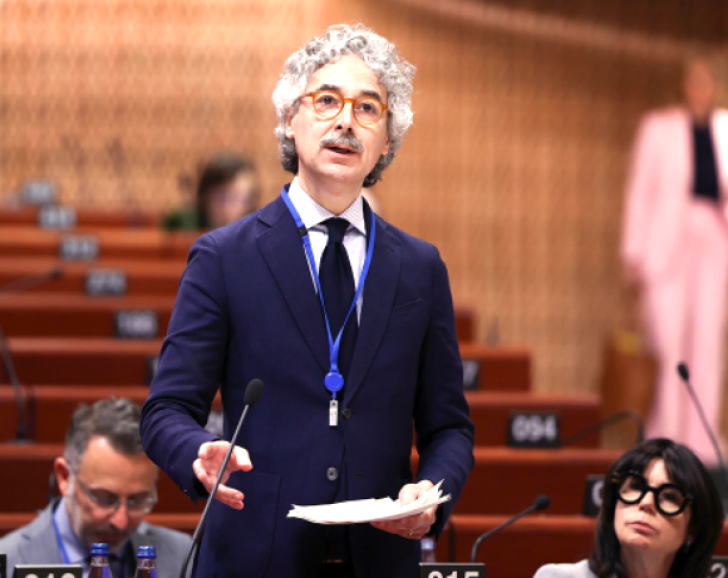
The European Centre for Law and Justice (ECLJ) this month criticized the Parliamentary Assembly of the Council of Europe (PACE) for underreporting attacks against Christians in Europe.
Thibault van den Bossche, an ECLJ advocacy officer, said an April 21 PACE resolution highlights antisemitism and Islamophobia but fails to “fully acknowledge the reality of attacks and discrimination against Christians in Europe.”
“Such an imbalance weakens the overall coherence of the resolution and raises questions about the equal treatment of different religious groups,” Van den Bossche said in a press statement.
The most recent mention of anti-Christian activity in the resolution dates to 2015, Van den Bossche said. The resolution was entitled, “Combating discrimination based on religion and protecting freedom of religion or belief in Europe.”
The Vienna-based Observatory on Intolerance and Discrimination against Christians in Europe (OIDAC Europe) has documented more recent incidents, including the arrest this month in Barcelona, Spain of a man from North Africa on April 11 for assaulting a Christian woman on the city’s famed La Rambla boulevard.
The 19-year-old man allegedly shouted “Christian whore” and assaulted the woman after she acknowledged her faith. She suffered minor injuries, and emergency responders treated her at the scene.
“The suspect was later located nearby and arrested by local police,” OIDAC Europe reported. “Authorities then brought him before judicial officials as the alleged perpetrator of offenses including violation of fundamental rights on religious grounds and bodily harm.”
Van den Bossche said the PACE resolution maintains a “clear imbalance in the treatment of different religions.”
“It fails to fully acknowledge the reality of attacks and discrimination against Christians, which the ECLJ has extensively documented,” he said.
The resolution affirms “essential principles” of religious freedom but still reflects an imbalance in how European institutions address attacks against Christians, according to Van den Bossche.
“This imbalance is not merely rhetorical: it reflects an implicit hierarchy of forms of religious intolerance and reveals a persistent difficulty in fully acknowledging anti-Christian attacks,” he said.
The resolution references antisemitism following the Oct. 7, 2023 attacks in Israel by Palestinian militants and the subsequent conflict in Gaza, as well as an increase in Islamophobic incidents. Van den Bossche said two 2022 resolutions focused exclusively on Judaism and Islam, demonstrating what he described as “once again the most exclusive focus of European institutions on these phenomena.”
“It is necessary to go back to 2015 for Christians to be mentioned, and even then only marginally, in the resolution,” he said.
Van den Bossche also pointed to a lack of explicit representation for Christians in the mandate of the Council of Europe’s special representative on antisemitism, anti-Muslim hatred and all forms of religious intolerance.
He cited OIDC Europe figures of 2,211 anti-Christian hate crimes in Europe in 2024, and said it calls for “equally explicit recognition.”
Acknowledging that PACE recognizes discrimination against Christians in limited terms, Van den Bossche noted that the report states “intolerance and discrimination based on religion or belief affect both majority and minority religious groups in Europe” and that “the expression of faith is sometimes unjustifiably restricted by national legislation and policies.”
“This wording deserves to be highlighted,” he said. “It introduces an implicit but real recognition of the attacks suffered by Christians, including in societies where they remain the majority. It also reinforces the ECLJ’s analysis concerning certain excesses of secularism, particularly in France, when it leads to a disproportionate restriction of Christian expression.”
The resolution calls on states to collect data on religious intolerance and discrimination. The ECLJ supports that objective but says accurate documentation remains essential.
Van den Bossche identified three limitations. First, some Christian victims underreport attacks because they fear they will “appear victimized, lack Christian charity, or inflame social tensions.” Second, he said public authorities often underreport anti-Christian crimes unless they identify a clear political motive.
Third, he said countries inconsistently transmit data to international institutions such as the Organization for Security and Co-operation in Europe’s Office for Democratic Institutions and Human Rights.
“These limitations contribute to rendering a significant portion of the violence and discrimination suffered by Christians in Europe invisible,” he said.
Van den Bossche also called for stronger protections for conscientious objection, citing the example of a nun who refuses to perform euthanasia in a Catholic hospital. He added that the resolution does not include specific provisions to protect places of worship despite a reported rise in vandalism and attacks against churches in Europe.
“To guarantee effective protection, attacks and discrimination against Christians must be recognized and addressed without bias,” he said, citing protections under the European Convention on Human Rights. “This implies a balanced consideration of the harm suffered by Christians, as well as concrete responses.”
The ECLJ has launched a petition urging PACE’s president to take a firmer response to attacks and discrimination targeting Christians.