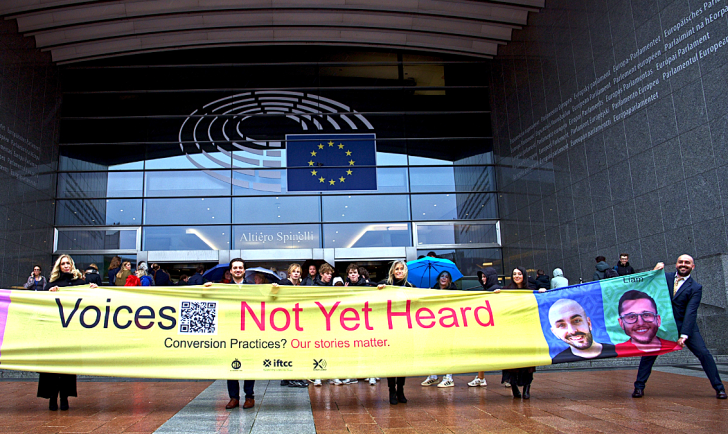
A formerly gay Christian from Malta warned European lawmakers last week against copying his home country’s ban on practices aimed at changing sexual orientation or identity.
Matthew Grech said in Brussels at an event addressing such bans that he endured three years of criminal proceedings for speaking about leaving homosexuality as part of his faith journey in Malta, after the island became the first European nation to enact such a ban in 2016.
“Malta’s law was meant to be a model for Europe, but my case shows where that model leads: to the police, prosecutors and courts deciding which life stories people can tell,” Grech said at the event at the EU Parliament, entitled “Protecting Freedom of Speech in the Context of ‘Conversion Practices’ Legislation in Europe.”
Next year, the European Commission plans to recommend that all 27 EU member states ban so-called “conversion practices.”
Member of the European Parliament Paolo Inselvini, of the European Conservatives and Reformists Group, and Core Issues Trust, a rights group for former homosexuals, co-hosted the Brussels event.
“I came to Brussels to ask MEPs to ensure that what happened to me in Malta does not become the law for every family in Europe,” said Grech, who recently married a woman. “People must remain free to share their stories, practice their faith and seek the support they choose, without fearing criminal investigation or prosecution.”
Grech, who had gained local fame competing on Malta’s “X Factor” TV show, had faced prosecution for allegedly advertising conversion practices during a 2022 interview on PMnews Malta, a free-speech media platform. During the broadcast, Grech shared his testimony of becoming a born-again Christian and voluntarily leaving a homosexual lifestyle. The program introduced him as a representative of the International Federation for Therapeutic and Counselling Choice.
On March 4, a judge at the Court of Magistrates in Valletta, Malta, found Grech not guilty of advertising therapies to reverse homosexuality, ending three years of legal uncertainty for the singer. Before his acquittal, Grech faced a five-month jail sentence and a 5,000-euro ($5,452) fine.
Magistrate Monica Vella delivered the verdict, clearing Grech of violating the Affirmation of Sexual Orientation, Gender and Gender Expression Act.
“That this should happen in Malta with the support of the wider European political network should be a warning to the world,” Grech said, at the time. “Throughout this ordeal, authorities compromised my constitutional rights, including my right to a fair and efficient trial. Accountability matters. No civilized authority in the world should have the power to censor and make its citizens suffer as I have simply for expressing the Christian faith and the morality that flows from it.”
The court also acquitted journalists Mario Camilleri and Rita Bonnici, the PMnews Malta presenters who hosted the 2022 interview that sparked the prosecution.
At the Brussels event, speakers from the United Kingdom, Hungary and Italy warned that vaguely drafted bans risk criminalizing personal testimonies, pastoral ministry and the freedom of adults to seek counseling consistent with their own goals and beliefs, according to a Christian Concern press release.
Speakers warned that lawmakers often define the term “conversion practices” so broadly that legislation can extend far beyond abusive conduct and threaten ordinary conversations between counselors and clients, parents and children, or pastors and congregation members.
Existing laws address coercive or abusive conduct, so there is no need to create sweeping new offenses that could restrict freedom of religion, freedom of expression and adults’ freedom to seek voluntary support, Christian Concern argued.
“Christians shared how their relationship with Jesus Christ – and, in some cases, pastoral care or clinical intervention – led to transformative changes in their feelings and behaviors,” Christian Concern stated.
Mike Davidson, chairman of the International Federation for Therapeutic and Counselling Choice and chief executive of Core Issues Trust, said politicians failed to listen to the positive messages of people, including himself, whom pastoral care had supported regarding their sexuality.
“Politicians seldom take the time to listen to those of us who have a positive experience of pastoral support or counseling,” Davidson said. “Our Voices Not Yet Heard campaign seeks to redress that. We are calling on Westminster and Stormont to listen to our stories and experience, and to protect the freedom of others like us to access support.”
Roger Kiska, legal counsel for the Christian Legal Centre, which supported Grech in his court cases, told the European Parliament that conversion practice bans conflict with human rights laws.
“In Europe, we have something called the European Convention on Human Rights, and fundamental human rights are at stake when it comes to self-fulfillment and identifying how you want to identify,” Kiska said.
The European Parliament has shown some interest in persecuted Christians. On Monday (Nov. 23) it took part in Aid to the Church in Need’s Red Week campaign by illuminating the EU Parliament building in Strasbourg in red, joining more than 1,000 churches and buildings worldwide to highlight the plight of 200 million persecuted Christians. In 2025, a similar display took place in Brussels.