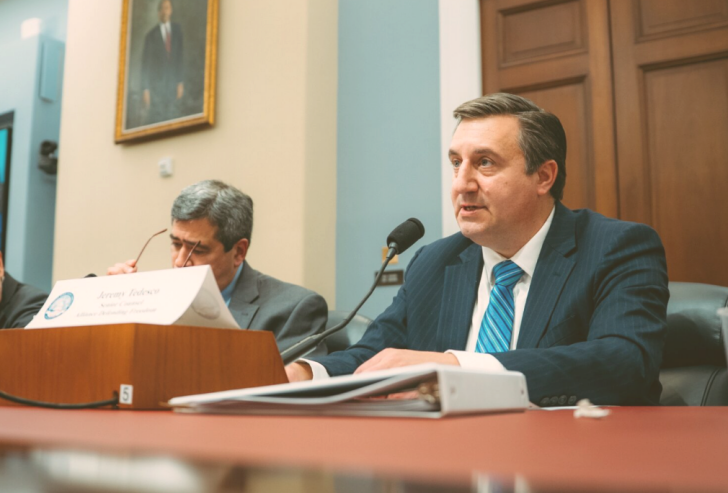
A legal expert this week warned U.S. federal policymakers that a European law suppressing free speech of Christians will likely be mirrored by online platforms worldwide.
Jeremy Tedesco, senior counsel and senior vice president of global free speech at Alliance Defending Freedom, commented on the Digital Services Act (DSA), which the European Parliament approved on July 5, 2022.
He testified at a hearing on Wednesday (Nov. 18) hearing titled “Worldwide Persecution of Christians: Responding to New Challenges” before the Tom Lantos Human Rights Commission, a bipartisan body of the U.S. House of Representatives that promotes, defends and advocates for internationally recognized human rights.
“Unfortunately, recent years have seen a proliferation of censorship enforcement proceedings by European states – most often pursuant to laws that use vague terms like ‘hate,’ ‘disinformation,’ ‘offense,’ and ‘insult,’ thereby granting government officials unbridled discretion to censor views they dislike,” Tedesco said. “But pluralism does not mean keeping religious convictions out of public life or silencing one view among many.”
Commission Co-Chairs Chris Smith and James P. McGovern led the hearing, which examined the plight of Christians globally and how the U.S. can better support followers of Christ, according to an ADF International press statement.
“The DSA gives European officials the machinery to export European speech restrictions worldwide, often targeting Christians and their most fundamental practices and beliefs,” Tedesco told the commission.
European Parliament President Roberta Metsola and Czech European Affairs Minister Mikuláš Bek, representing the Council of the European Union, signed the Digital Services Act into law on Oct. 19, 2022.
Tedesco warned that the effect of European censorship on Christians globally is not an abstract threat.
“Because of these large and complex censorship systems, online platforms are strongly incentivized to apply European speech rules globally,” Tedesco added.
“This means churches, ministries, and speakers feel the effects of European censorship far beyond Europe’s borders, including here in the United States.”
The EU gave itself “sweeping powers” under the DSA to “regulate so-called ‘illegal content’“ across the largest and most widely used online platforms, according to ADF International, adding that the bloc achieves this by “strong-arming” major platforms such as Google, Meta and X into enforcing EU speech standards.
The law’s lack of clear definitions for key terms like “misinformation” and “hate speech,” combined with crippling fines for social media companies that fail to comply, forces tech giants to adopt a “censor first, ask questions later” mentality, the legal group warned.
Tedesco said “hate speech” within the EU could become as innocent as citing a Bible verse, making a social media post or distributing a church pamphlet.
“The exportation of this censorial framework has enormous implications for Christian speech worldwide,” he warned.
Tedesco cited several examples of this censorship framework, including the case of Finnish Member of Parliament Päivi Räsänen, a former interior minister who has served in Parliament since 1995.
On March 26, the Supreme Court of Finland convicted Räsänen of “hate speech” for expressing biblical views on marriage and human sexuality in a 2004 booklet titled “Male and Female He Created Them.” The court fined Räsänen 1,800 euros ($1,950) and ordered her to pay her legal costs, overturning two previous acquittals by lower courts. On July 24, Räsänen officially filed her appeal with the European Court of Human Rights.
“In today’s Europe, Christian beliefs are seen as an existential threat to those who seek to assert control through authoritarian overreach. Räsänen’s prosecution sends an unmistakable message: dare to share Christian views that go against the orthodoxies of the day, and you may find yourself a convicted criminal,” Tedesco testified.
He also cited the case of Isabel Vaughan-Spruce, whom police arrested for praying near the British Pregnancy Advisory Service Robert Clinic in Kings Norton, Birmingham, England. Vaughan-Spruce twice successfully challenged previous arrests for praying near the clinic. She now faces five new charges, filed in October, with her trial set for January 2027.
Tedesco also pointed to the case of Adam Smith-Connor, whom he described as the first man in modern British history convicted of a “thought crime.” On Oct. 16, 2024, a court found Smith-Connor, a British Army veteran who served in Afghanistan, guilty of praying silently near an abortion clinic in England.
Smith-Connor breached a Public Spaces Protection Order, according to the ruling at Poole Magistrates’ Court in Poole, near Bournemouth, Dorset, England. The court gave Smith-Connor a two-year conditional discharge, meaning a judge would sentence him only if another court convicted him of a new offense within that period.
Tedesco testified alongside David K. Trimble, president of the Religious Freedom Institute; John Eibner, international president of Christian Solidarity International; Timothy Shah, research scholar in politics at the University of Dallas and secretary of the board of the G20 Religion Forum; and Matthew Soerens, vice president of advocacy and policy at World Relief.
“Christian speech is at the forefront of the censorship assault in Europe. And that same speech is now threatened here in the U.S. via the DSA’s exportation of EU censorship standards globally,” Tedesco said.
Tedesco closed his testimony by urging Congress to act and protect free religious expression in America from Europe’s censorship regime.
“There is much Congress can do to protect Christians from persecution, both at home and abroad,” Tedesco said.